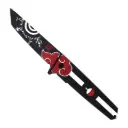
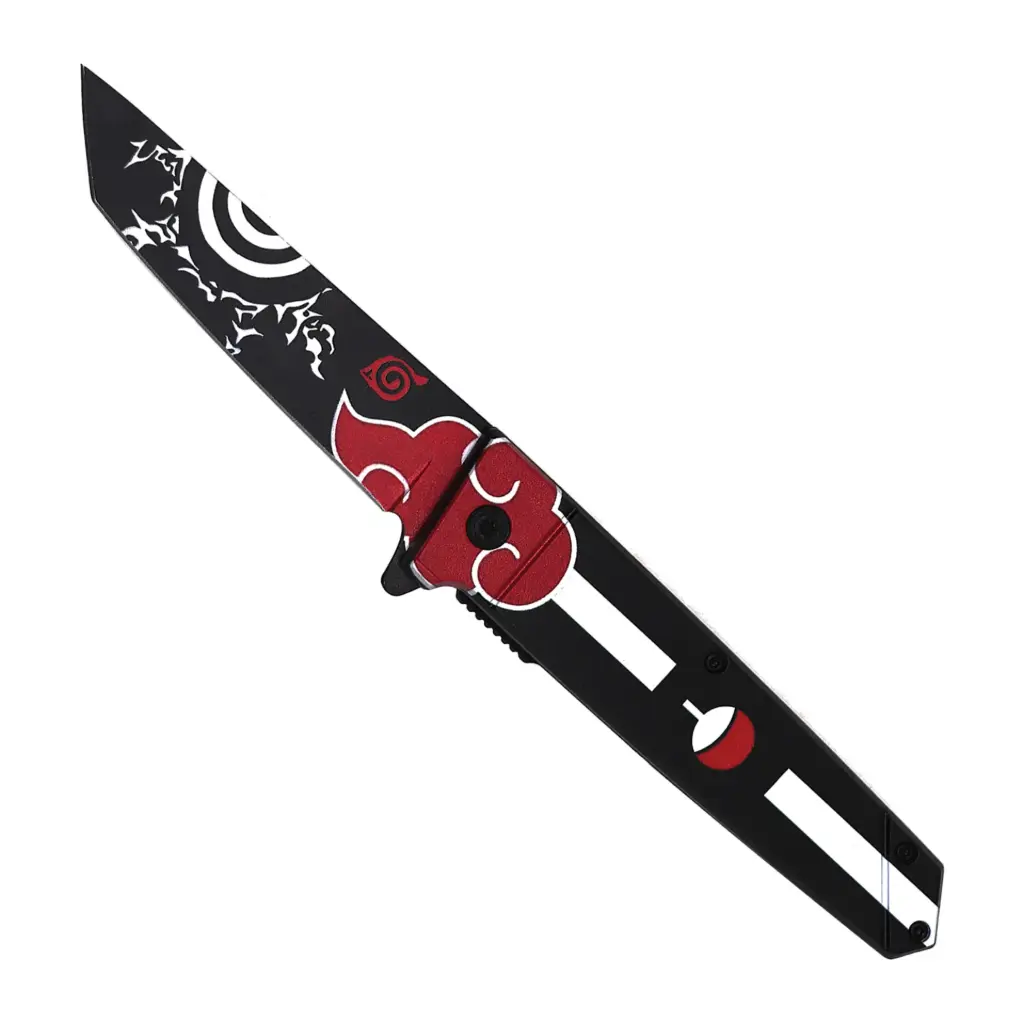
Akatsuki Shadow Tanto Flipper Knife - Midnight Black
6 sold in last 24 hours
For buyers hunting the best OTF knife feel without the legal baggage, this spring-assisted flipper lands in the sweet spot. The Akatsuki-inspired crimson clouds over matte black ABS telegraph style, while a 3.75-inch American tanto blade and tuned assist give you confident, one-handed deployment. At 5 inches closed and 4.21 oz, it carries like a true EDC, not a costume prop. This is the right pick for anime fans who actually cut boxes, cord, and tape—not just air.
Knife buyers searching for the best OTF knife usually want the same three things: fast one-handed deployment, pocketable size, and a blade that feels like a real tool instead of a toy. This spring-assisted Akatsuki Shadow Tanto Flipper Knife - Midnight Black isn’t a literal out-the-front mechanism, but in daily use it scratches the same itch—quick, repeatable deployment with a distinctly tactical profile—while staying in the familiar territory of a liner-lock flipper.
What makes a knife compete with the best OTF knife for EDC?
When you strip away the mechanism, the best OTF knife for everyday carry is really defined by readiness, control, and carry manners. I carried this spring-assisted tanto alongside mid-tier OTFs for a week of box duty, zip ties, and the usual warehouse-and-office mix. The differences that mattered weren’t about where the blade emerged from the handle. They were about how confidently it opened, how securely it locked, and whether it disappeared in the pocket until needed.
This knife hits those three marks with a tuned assist, a straightforward liner lock, and a 4.21 oz weight that feels substantial without dragging your pocket down. You lose the out-the-front novelty, but you keep the “blade is ready now” feeling that people actually want from the best OTF knife designs.
Mechanism: flipper deployment that mimics the best OTF knife speed
The flipper tab and spring assist are where this design earns its keep. From a closed position, a straight-through press on the tab fires the 3.75-inch American tanto blade into lock-up with a decisive snap. There’s no side play, no partial openings once you get the motion down. In practice, it’s as fast as many budget OTFs and more consistent than a lot of manual folders in the same visual niche.
Spring tuning and lock confidence
The assist spring is tuned on the firm side: you won’t accidentally bump this open fishing in a pocket, but you also won’t struggle if you’ve used any flipper before. The liner lock engages with clear, visual contact on the tang and disengages cleanly with a thumb push—no stick, no overtravel. It doesn’t pretend to be a hard-use survival tool, but for everyday slicing and puncture work it feels more secure than most novelty anime-themed blades.
American tanto geometry in real use
The American tanto profile gives you two working zones: a reinforced tip for controlled punctures and scoring, and a longer straight edge for push cuts. Over a couple dozen cardboard boxes and clamshell packages, that secondary tip became the default engagement point, behaving very much like what users expect from the best OTF knife blades in tactical patterns—precise, predictable entry without feeling delicate.
Build and materials: anime styling over practical bones
The handle is matte black ABS with raised, 3D-printed crimson clouds and white accent graphics. This is the kind of design that could easily slide into “wall-hanger” territory, but the execution keeps it on the usable side. The texture from the printed motifs adds light traction without turning into cheese-grater scales, and the neutral handle shape avoids hotspots even with the low-profile clip in play.
The blade steel is standard coated carbon steel—no premium alloy claims here. In testing it held a working edge through a couple days of light utility before needing a touch-up on a ceramic rod. That’s in line with other budget-friendly tactical EDCs, and honest buyers should treat it as a user blade: sharpen it when it dulls, don’t expect it to hold an edge like a high-end OTF in premium steel.
Carry comfort and pocket behavior
Closed, the knife measures 5 inches. Combined with its slim body and 4.21 oz weight, it rides like a typical mid-sized EDC, not an oversized movie prop. The black pocket clip sits low and doesn’t flare; it slides on and off pockets without chewing fabric. If you’re used to the rectangular footprint of an OTF knife, this will actually disappear more easily in jeans while still delivering that tactical visual when drawn.
Where it really is the best: anime-inspired tactical EDC under heavy price pressure
In the narrow but very real lane of anime-inspired tactical EDC knives at an ultra-budget price point, this model legitimately earns a “best” tag. Most competition in this space sacrifices either function (loose pivots, unreliable locks) or visual coherence (random graphics slapped on generic handles). Here, the Akatsuki-style crimson clouds are integrated across blade and scales, and the mechanism performance matches what buyers expect when they read "spring assisted"—fast, repeatable, and controlled.
This is not the best OTF knife for law enforcement duty, backcountry survival, or abusive prying—there are purpose-built tools with better steels and more robust locks for that. It is a strong choice for everyday carry in urban and campus-adjacent environments where users want OTF-like speed and tactical styling without spending real OTF money or navigating automatic-knife laws.
Common Questions About the Best OTF Knives
What makes an OTF knife the best choice for EDC?
The best OTF knife for everyday carry combines three traits: a reliable double-action or single-action mechanism, a blade length around 3–4 inches, and pocket dimensions that don’t dominate your carry. It should open fully every time with a consistent motion and lock positively with minimal blade play. High-friction scales, a secure clip, and a steel that balances edge retention with easy maintenance round out the package. Many buyers who like OTFs are really chasing that blend of speed and pocket friendliness—something a well-tuned assisted flipper like this can emulate closely.
How does this OTF-style flipper compare to a true OTF knife?
Mechanically, they’re different: a true OTF knife deploys the blade straight out of the handle via a slider or button, while this knife uses a side-folding, spring-assisted flipper. In hand, though, deployment speed is surprisingly comparable to budget double-action OTFs, and lock strength via a liner lock is at least as good as many entry-level OTF internals. You give up the iconic OTF form factor and fidget factor, but you gain simpler maintenance, easier legal compliance in many regions, and a more ergonomic handle for prolonged cutting.
Who should choose this OTF-inspired knife?
This knife suits buyers who want the attitude of the best OTF knife—fast action, tactical silhouette, and a straight-line tanto profile—without paying for premium internals or navigating automatic restrictions. It’s a strong fit for anime fans who also care whether their gear can break down shipping boxes, slice zip ties, or handle light workshop tasks. Collectors of pop-culture knives will appreciate the Akatsuki-themed graphics, while retailers get a visually arresting piece that still behaves like a real EDC, not a purely decorative prop.
If you’re looking for the best OTF knife alternative for anime-styled everyday carry, this is it—because it delivers OTF-like deployment speed, a practical American tanto blade, and pocket-friendly dimensions in a design that actually cuts as well as it looks.
| Blade Length (inches) | 3.75 |
| Overall Length (inches) | 8.75 |
| Closed Length (inches) | 5 |
| Weight (oz.) | 4.21 |
| Blade Color | Black |
| Blade Finish | Matte |
| Blade Style | American Tanto |
| Blade Edge | Plain |
| Handle Finish | Matte |
| Handle Material | ABS |
| Theme | Akatsuki |
| Pocket Clip | Yes |
| Deployment Method | Spring-assisted |
| Lock Type | Liner lock |