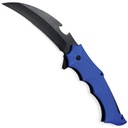
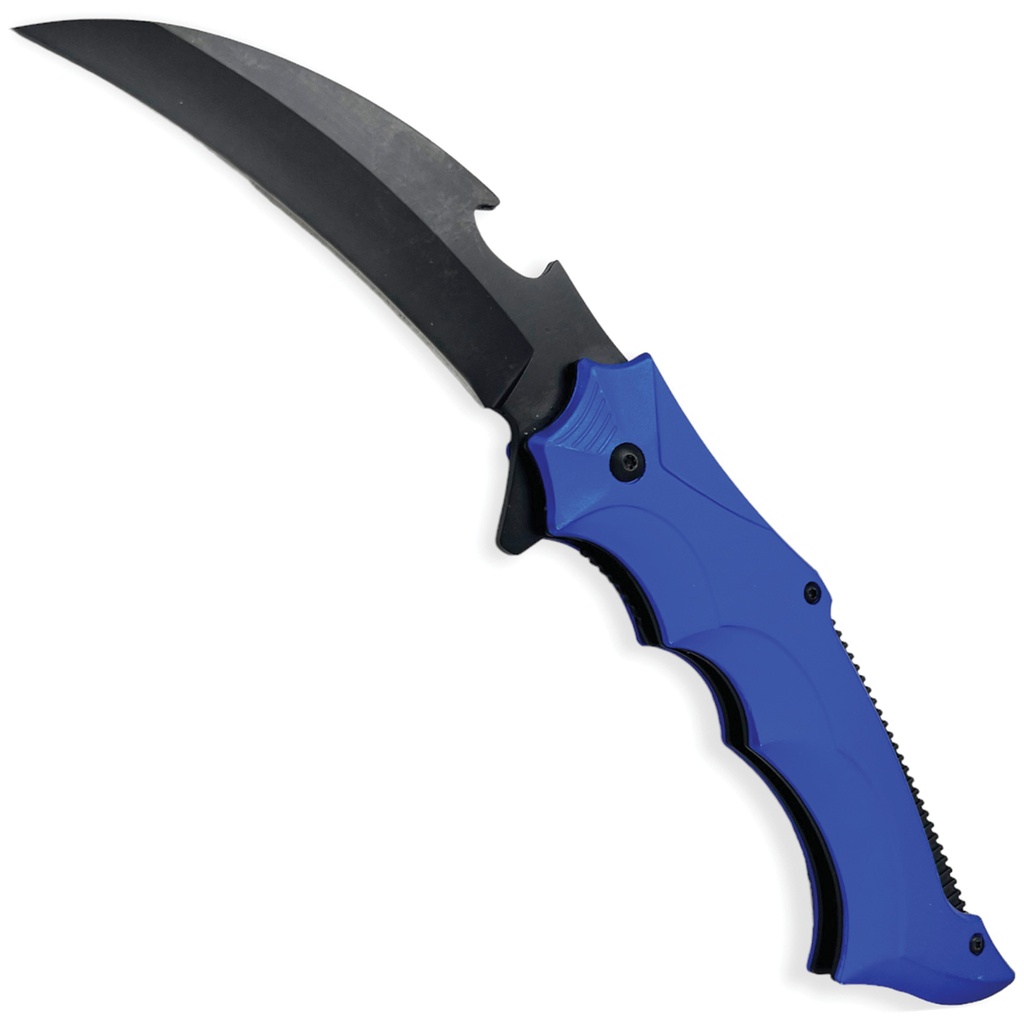
Arc Talon Rapid-Deploy Karambit Knife - Blue
13 sold in last 24 hours
This isn’t trying to be the best OTF knife—it’s the folding karambit you actually carry. The spring-assisted talon blade snaps out with a decisive, predictable action, and the blue handle’s finger grooves lock your hand in behind the curve. The matte black blade gives you controlled cuts on boxes, straps, and light daily chores while still feeling ready for defensive duty. If you want compact, fast access in a modern tactical profile, this is the one that earns pocket time.
What Actually Makes the Best OTF Knife – and Why This Isn’t One
If you’re hunting for the best OTF knife, you’re really asking about one thing: fast, straight-line deployment from a closed body. This blade doesn’t do that—and that’s the point. The Talon Arc Rapid-Deploy Karambit Knife - Blue is a spring-assisted folding karambit that deliberately trades true OTF mechanics for simpler construction, lower cost, and better legality in many areas. So while it’s not the best OTF knife, it earns a different spot: a budget, fast-opening claw-style folder that scratches the same itch for quick access and aggressive geometry.
Why This Karambit Competes with the Best OTF Knife for Everyday Readiness
OTF buyers usually care about three things: speed, control, and pocketability. This assisted-opening karambit hits those same checkboxes by different means. Instead of a double-action slider, you get a spring-assisted pivoting blade that snaps open with a thumb stud or flipper-style motion. In practice, deployment is nearly as quick as many budget OTF knives, with less to go wrong long-term and no track full of debris to clean.
The curved talon-style blade mimics the cutting efficiency you’d get from a hooked or recurved OTF profile. On straps, plastic, and light cordage, the inward curve bites aggressively as soon as the edge makes contact. That makes this a realistic alternative for buyers who want the functional feel of the best OTF knife for EDC but can’t or don’t want to carry a true out-the-front mechanism.
Deployment and Lockup: The Assisted Folder vs. OTF Tradeoff
On a real OTF, you’re relying on a track, springs, and a slide to both launch and retract the blade. Here, the spring assist simply helps finish the opening arc once you start it. Fewer parts means fewer failure modes. The liner lock engages behind the tang with a familiar, visible interface you can inspect at a glance—something you can’t do on a closed OTF chassis. In the hand, that translates to a confidence that feels more like a conventional tactical folder than a fidget-focused OTF.
Grip and Ergonomics: Karambit Control in a Pocketable Package
OTF knives are usually straight slabs; you add control with jimping and texturing. This knife bakes control into the shape. The blue handle is contoured with finger grooves that track the curve of the blade, giving you a locked-in feeling in standard forward grip. The karambit-style arc helps your knuckles align naturally behind the edge, which keeps the blade seated in material instead of skating off.
Unlike full-ring karambits that demand a very specific grip, this design is more forgiving. You get some of the rotational leverage and retention of a traditional karambit without being forced into ring-only techniques. For an everyday user who occasionally needs more serious traction, that’s a sensible compromise.
The Best OTF Knife Alternative for Budget Tactical EDC
Most people Googling the best OTF knife end up confronting two realities: price and legality. Good OTFs cost real money, and in some regions they either skirt regulations or fall directly under them. An assisted-opening folding karambit like this one sidesteps both issues: it’s mechanically simpler to build, dramatically cheaper, and in many jurisdictions treated like any other assisted folder.
The matte black blade finish dampens reflections and hides wear from tape and cardboard, while the blue handle keeps the overall look more approachable than an all-black tactical brick. It rides in-pocket via a standard clip, so it draws about as much attention as a regular EDC folder until you open it and reveal the claw profile.
Real-World Cutting Performance
Where a true best OTF knife for EDC will flex between piercing and slicing, this karambit prioritizes controlled, pulling cuts. The plain edge makes it easy to touch up with basic stones or a pull-through sharpener. On boxes, you can start the cut near the tip and let the curve pull through the cardboard with less wrist motion than a straight blade. On plastic clamshells and straps, the hook engages fast and stays planted.
The downside is obvious: this is not a great whittling or food-prep blade. The arc that makes it efficient in pulling cuts makes it awkward for flat surface work and push cuts on a cutting board. That honesty is important—if you want a generalist, there are better shapes. If you want a pocketable claw that lives in packaging, tape, and defensive scenarios, this geometry earns its keep.
Where It’s Best—and Where It Isn’t
If you define the best OTF knife for everyday carry as a tool that disappears in the pocket, deploys quickly, and handles small, decisive cuts, this knife checks those boxes in spirit, not in mechanism. It’s best suited for:
- Budget-minded buyers who like the aggressive OTF aesthetic but prefer a simpler folder
- Users in stricter jurisdictions where OTF knives are restricted or frowned upon
- EDC carriers who mostly open boxes, slice tape, and occasionally want a defensive-leaning profile
It’s not the best choice if you need:
- Heavy-duty prying or abusive work (a talon tip is not a pry bar)
- True double-action OTF fidget-factor or one-handed retractability
- A slicer for food or woodworking where a straighter blade excels
Common Questions About the Best OTF Knives
What makes an OTF knife the best choice for EDC?
The best OTF knife for EDC pairs fast, one-hand deployment with a compact, fully enclosed handle that protects the blade when not in use. The very best OTF options balance that mechanism with reliable lockup, a steel that holds a working edge, and a profile that actually fits in a pocket. They shine when you need quick access for short, controlled cuts and value speed over raw cutting versatility.
How does this OTF knife alternative compare to a true OTF?
This knife isn’t a true OTF—it's a spring-assisted folding karambit—so the comparison is about function, not mechanism. A good double-action OTF deploys and retracts with a slider; this knife only deploys with a spring assist and must be closed manually. In return, you get fewer moving parts, less sensitivity to dirt and lint, and usually better legality. For pure speed and gadget appeal, a best-in-class OTF wins. For low cost, simple maintenance, and a curved cutting profile, this assisted karambit holds its own.
Who should choose this OTF knife alternative?
Choose this knife if you’re drawn to the aggressive lines of the best OTF knife designs but want something you won’t hesitate to throw into a work pocket. It fits buyers who are honest about their use: breaking down boxes, cutting straps, and wanting a defensive-forward blade shape without committing to the complexity and price of a true OTF. If you’re a collector chasing high-end mechanisms, look elsewhere; if you’re a practical carrier wanting a budget, modern tactical claw, this is aimed at you.
If you’re looking for the best OTF knife alternative for budget-friendly everyday carry, this assisted karambit is it—because it delivers OTF-like speed and an aggressive talon profile in a simpler, more legal-friendly folding format that you won’t baby or leave at home.
| Blade Color | Black |
| Blade Finish | Matte |
| Blade Style | Talon |
| Blade Edge | Plain |
| Handle Finish | Matte |
| Theme | Karambit |
| Pocket Clip | Yes |
| Deployment Method | Spring-assisted |
| Lock Type | Liner lock |