Shadow Ring Control Karambit OTF Knife - Midnight Black
14 sold in last 24 hours
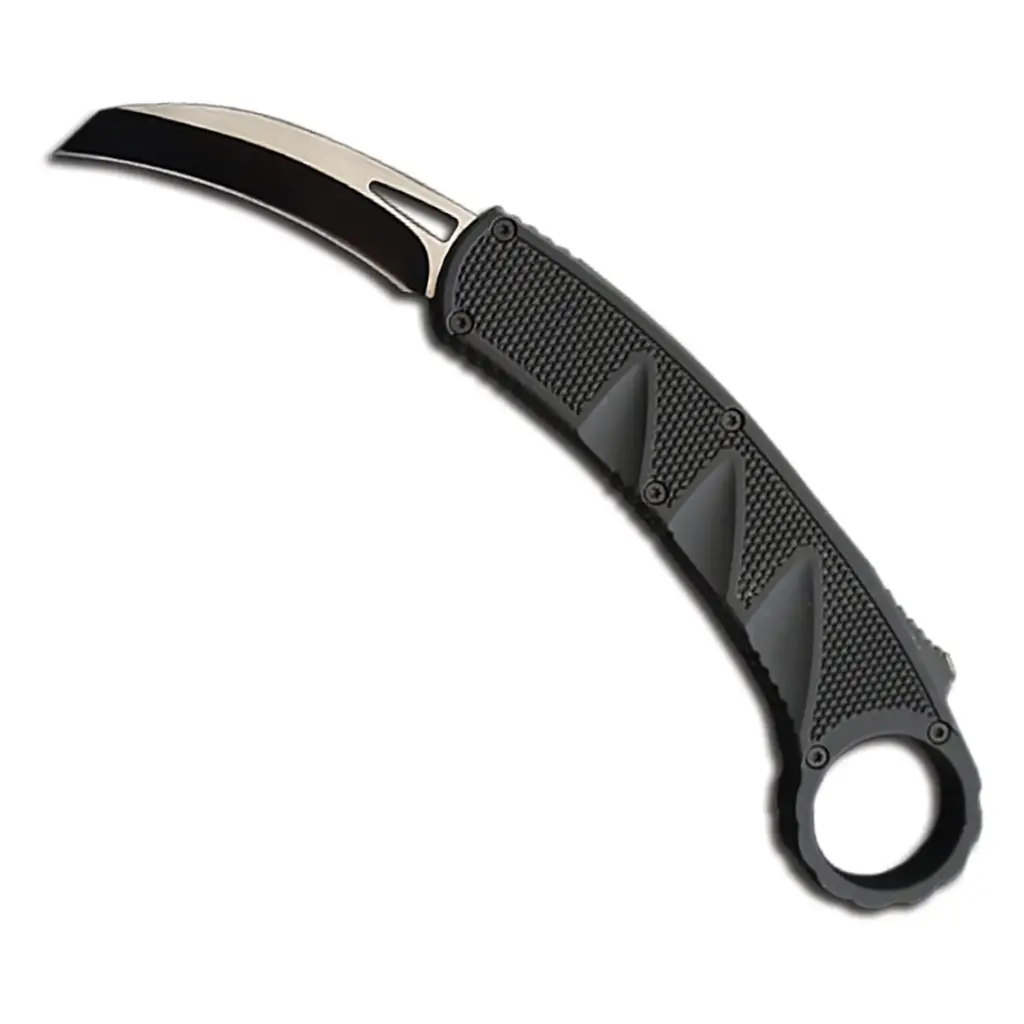
This may be the best OTF knife for people who actually train with karambits. The bottom-fire trigger sits right under your thumb in a natural grip, so the talon tracks exactly with your index finger and ring. A rubberized midnight black handle locks into damp or gloved hands, while the curved blade gives you controlled, close-range cutting. It’s not a box-cutter replacement; it’s a purpose-built defensive OTF that rewards familiarity and ring-driven control.
What Makes the Best OTF Knife in a Karambit Format?
Most people asking about the best OTF knife picture a straight, double-edged spearpoint. This blade doesn’t do that. The ArchAngel Bottom-Fire Control Karambit OTF Knife in Midnight Black takes the curved talon, ring retention, and indexing of a traditional karambit and marries it to a bottom-fire out-the-front mechanism. That combination changes what “best” means: not general-purpose utility, but fast, directionally stable deployment in a grip you already trust under stress.
To judge whether this belongs on any “best OTF knife for self-defense” shortlist, I look at four things: deployment alignment, retention under movement, how the handle behaves when your hands aren’t dry and perfect, and whether the blade shape matches its intended role. On all four, this design is purpose-built rather than decorative.
Bottom-Fire Control: Why This OTF Mechanism Stands Out
Most double-action OTFs put the slider on the spine. That’s ideal for a straight, saber-like grip and general EDC cuts. Here, the ArchAngel uses a bottom-fire control switch placed near the blade end, aligning with your thumb in a forward, ring-locked grip. For a curved karambit, that matters more than any spec-sheet bragging.
Deployment That Tracks With Your Grip
With your index finger in the ring and your hand wrapped around the rubberized handle, your thumb naturally lands on the base trigger. Pushing forward sends the blade straight out along the curve your hand is already following. You don’t have to roll your wrist or break your grip to bring the tip on line — the best OTF knife for defensive carry is the one that demands the fewest corrections mid-draw.
Instinct Under Stress, Not Just Speed
Speed by itself is overrated. Predictability is what counts. Because the mechanism fires along the handle’s axis and the ring locks your hand position, you get the same deployment angle whether you’re calm in a garage or adrenalized in a parking lot. That’s the quiet advantage of this bottom-fire design: it doesn’t try to be the fastest OTF; it tries to be the least surprising one in a karambit stance.
Blade and Build: A Talon Meant for Close-Range Work
The blade is a curved talon with a matte black finish and a plain edge. In other words, it’s built for controlled pulling cuts, hooking motions, and tight work close to the body — not prying, batoning, or camp chores. If what you want is the best OTF knife for everyday carry cardboard and tape, a straight, narrow spearpoint will do better. If you’re thinking about controlled retention and directional cuts, this format makes more sense.
Matte Black Talon With Practical Edge Geometry
The matte black finish kills reflections and looks appropriately serious, but the real utility is the edge geometry: a plain edge along the inner curve that you can actually sharpen easily. No serrations to snag on fabric, no decorative grind gimmicks. The two-tone spine highlight just helps you see where the tip is relative to the handle — a small detail that matters when your work is close to your own body.
Rubberized Handle That Earns Its Keep
Plenty of budget tactical knives add shallow texturing and call it grip. Here, the full rubberized black handle, with molded finger grooves and matte finish, is doing real work. When your hand is sweaty, wet, or in thin gloves, the combination of rubber traction and ring retention keeps the knife planted. If you’ve ever had a smooth aluminum OTF twist in your hand during a hard pull cut, you’ll feel the difference immediately.
The Best OTF Knife for Ring-Based Defensive Carry
Honesty first: this is not the best OTF knife for general EDC. There’s no pocket clip, the blade shape isn’t ideal for broad utility cuts, and the whole profile is unapologetically tactical. Where it does earn a “best” slot is for buyers who already like ring knives and want a consistent, OTF-based deployment that matches that grip.
Without a clip, you’re committing to pocket, belt, or bag carry. That’s a tradeoff. You gain an uninterrupted, rubberized exterior with no hotspot from a clip digging into your palm, but you lose the convenience of standard pocket-clip indexing. If your priority is fast, no-fuss retrieval for workaday tasks, a clipped, straight OTF wins. If you value a clean, hand-filling grip for ring-based control, this design earns its space.
At its price point, you’re not buying heirloom steel; you’re buying a mechanism and layout that suits a niche use case. As long as you sharpen regularly, the blade will do its job. The value comes from the pairing of bottom-fire control, karambit form, and rubberized handle, not from boutique alloys.
How This Karambit OTF Compares to More Traditional Options
Stack this against a standard spine-fire EDC OTF and the differences are clear. Traditional models are slimmer, clip-equipped, and better for opening packages, breaking down boxes, or general utility. The ArchAngel Bottom-Fire Control Karambit OTF Knife throws that versatility overboard and doubles down on grip security and directional cuts in a close-quarters stance.
If you only own one knife and expect it to do everything, this is not your best OTF knife. If you already own a utility folder and want a dedicated defensive or training-oriented OTF in a karambit configuration, this starts to look like the more logical choice. It earns a spot not by beating every OTF at everything, but by committing fully to one job.
Common Questions About the Best OTF Knives
What makes an OTF knife the best choice for EDC?
For everyday carry, the best OTF knife is usually slim, pocket-clip equipped, and easy to deploy and retract one-handed from a neutral grip. You want reliable double-action mechanics, steel that holds a working edge, and a blade shape that handles boxes, tape, cord, and the occasional food prep. Aggressive curvature and rings, like you see on this karambit OTF, are fantastic for specific defensive roles but can be overkill for pure EDC utility.
How does this OTF knife compare to a standard folding karambit?
A folding karambit typically uses a linerlock or framelock and requires more distinct steps: draw, open, lock, then index into a ring grip. The ArchAngel-style OTF shortens that sequence. Once your finger is in the ring and your hand is wrapped around the handle, the blade fires along the same line you’re already holding. You trade some mechanical simplicity — OTFs are more complex internally — for a more linear, instinctive draw-and-deploy motion.
Who should choose this OTF knife?
This knife makes the most sense for people already comfortable with ring knives or training-based defensive carry. If you practice karambit draws, value retention even if your grip is compromised, and want an OTF that mirrors that skillset, this is a defensible choice. If your priority is an office-friendly, do-everything pocket knife, a conventional OTF or compact folder will serve you better and draw less attention.
If you’re looking for the best OTF knife for ring-based defensive carry, this is it — because the bottom-fire layout, rubberized midnight black handle, and curved talon blade all work together to keep your grip, your blade angle, and your deployment aligned when your attention is anywhere but your hands.
| Blade Color | Black |
| Blade Finish | Matte |
| Blade Style | Talon |
| Blade Edge | Plain |
| Handle Finish | Matte |
| Handle Material | Rubber |
| Button Type | Indexed |
| Theme | Karambit |
| Pocket Clip | No |