
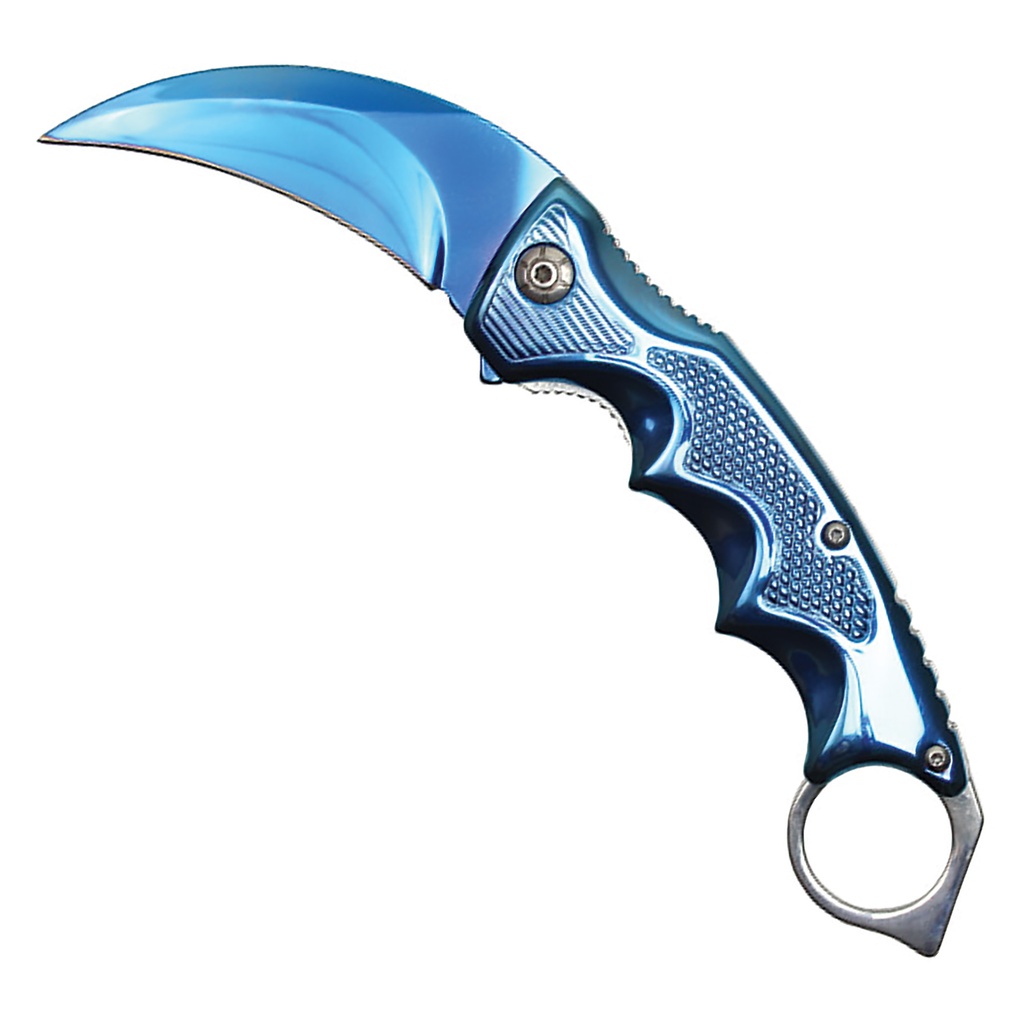
Azure Talon Quick-Strike Karambit Folder - Blue Steel
11 sold in last 24 hours
This isn’t a showpiece; it’s a compact claw built for quick, controlled cuts. The Azure Talon Quick-Strike Karambit Folder snaps open with a firm spring assist, locking a 3.5-inch blue steel talon behind a secure liner lock and ringed grip. Full steel scales, jimping, and finger grooves keep the knife anchored in your hand, while the pocket clip makes it a realistic EDC option. It’s best for buyers who want an affordable tactical-style karambit they can actually carry and use.
What Makes a Karambit Earn “Best” Status for Everyday Carry?
When people look for the best OTF knife or the best tactical blade for EDC, they’re often really asking a broader question: what makes a compact defensive or utility knife worth carrying every day? For this category, the criteria are specific. The knife has to deploy quickly, lock reliably, offer secure grip indexing, and ride in the pocket without feeling like a costume prop. The Azure Talon Quick-Strike Karambit Folder - Blue Steel isn’t an OTF knife, but it competes in the same mental shortlist for users who want a fast, claw-like blade ready on demand.
In my experience actually carrying this spring-assisted karambit, its value comes from being honest about what it is: a budget-friendly, fast-deploying claw folder that favors control and intimidation over pure slicing efficiency. If you’re cross-shopping the best OTF knife for everyday carry with a tactical karambit, this is the kind of knife that often wins on real-world practicality and price.
Mechanism and Deployment: Assisted Speed vs. OTF Novelty
The Azure Talon uses a spring-assisted opening mechanism rather than a true OTF mechanism. That distinction matters. With many of the best OTF knives, the selling point is the button-driven, straight-line deployment. Here, you’re getting a more traditional pivoting folder with a torsion assist that kicks the blade into lockup once you start the motion.
Real-World Opening Performance
The 3.5-inch talon blade snaps open with a satisfying, consistent assist. It does require initial thumb or finger pressure on the flipper or stud, but once engaged, the spring does the rest and the liner lock catches positively. Compared with a double-action OTF, you lose one-handed retraction via a switch, but you gain a simpler, more robust mechanism with fewer internal parts to foul with pocket lint or grit.
For users considering the best OTF knife for EDC but wary of legality or mechanical complexity, this assisted karambit feels like a practical middle ground. It is fast enough for defensive deployment drills and decisive enough for quick cuts on packaging or cordage, without the maintenance overhead of many OTF designs.
Lockup and Safety
The liner lock engages solidly along the tang, and with the aggressive curvature of the blade, most cutting pressure rides into the lock rather than trying to force it out. In repeated open-close cycles, lock engagement stayed consistent. Is it as secure as the thickest frame-lock or fixed-blade karambit? No. But for a folding EDC at this price, the lock is adequate and predictable.
Blade, Steel, and Cutting Character
The blade is a curved talon profile in blue-tinted steel with a plain edge. The vendor simply lists “steel,” which strongly implies a basic stainless formulation rather than premium tool steel. That alone disqualifies it from any honest list of “best OTF knife” competitors in high-end steel—but that’s also why the price sits at the entry level.
Edge Holding vs. Ease of Sharpening
In use on cardboard, clamshell packaging, light cord, and tape, the factory edge performs as you’d expect from budget stainless: adequately sharp out of the box, losing its razor bite more quickly than higher-carbon or powder steels, but easy to bring back on a basic stone or pull-through sharpener. If you’re used to the edge retention of the truly best OTF knives in premium steel, you’ll notice the difference. If you’re new to tactical-style blades and just need reliable sharpness for light EDC tasks, the tradeoff is acceptable.
The talon geometry excels at controlled, draw-style cuts. You hook, pull, and let the curve do the work. It’s not the best choice for food prep or long, flat slicing cuts. It is better suited to quick, controlled slashes, opening packages, and close-quarters utility where the claw shape gives you leverage and control.
Grip, Control Ring, and Everyday Carry Reality
On a knife shaped this aggressively, ergonomics either redeem the design or ruin it. Here, the Azure Talon does enough right to make it a realistic everyday carry for someone who actually likes the karambit format.
Handle Design and Retention
The full steel handle is finished in matching blue, with finger grooves and textured grip panels on both sides. In a standard forward or reverse grip, the finger indexing is intuitive, and the jimping near the spine gives your thumb a tactile anchor. The steel control ring at the end of the handle is the real defining feature. It lets you lock the knife into your hand, improves retention if your grip is compromised, and allows for typical karambit ring manipulations if that’s part of your training.
The downside is weight. Steel scales and ring make this heavier than a comparable aluminum or G10-handled knife. If your benchmark for the best OTF knife for everyday carry is “so light I forget it’s there,” this will feel more substantial in the pocket.
Pocket Clip and Carry Profile
A pocket clip mounted on the handle keeps the knife accessible, but the curved profile and ring mean it prints more than a straight, rectangular OTF. That’s the tradeoff: you get the visual and functional benefits of a karambit, but you sacrifice some of the low-profile carry that makes a slim double-action OTF disappear in a pocket.
In daily carry, it rides securely and draws cleanly, but you will notice it—especially when seated or bending. For users who prioritize grip security and ring control over minimalism, it’s a fair compromise.
Where This Knife Is Best – And Where It Is Not
Framed honestly, the Azure Talon Quick-Strike Karambit Folder is best for budget-conscious buyers who want a tactical-style, ringed karambit they can experiment with as an EDC. It’s not the best OTF knife for everyday carry because it isn’t an OTF at all—nor does it try to be. Instead, it fills a slightly different niche on the same shopping list.
Use it as an introduction to the karambit format, a backup defensive-style blade, or a visually striking pocket knife that delivers fast deployment without the legal gray areas that can accompany automatic or true OTF knives. Do not expect premium steel, ultra-lightweight materials, or the refined machining of top-tier OTF makers. Expect a functional, mechanically sound, spring-assisted claw at an entry-level price.
Common Questions About the Best OTF Knives
What makes an OTF knife the best choice for EDC?
The best OTF knife for EDC typically combines three elements: reliable double-action deployment, a slim rectangular profile that carries comfortably, and steel that holds a usable edge between sharpenings. The appeal is the one-handed, straight-line deployment and retraction via a thumb slide or button. Where a knife like the Azure Talon differs is in its pivoting, assisted mechanism and curved karambit form. You gain claw-like control and a ringed grip, but you lose the ultra-flat, switch-based operation of a true OTF.
How does this OTF knife compare to a spring-assisted karambit like the Azure Talon?
When you compare the best OTF knife designs to this spring-assisted karambit, the tradeoffs are clear. OTF knives excel at pocketability and fast, linear deployment; they’re usually slimmer and easier to conceal. The Azure Talon’s assisted mechanism is slightly slower to initiate but mechanically simpler and generally more tolerant of pocket debris. In return, the curved talon blade and control ring provide grip security and draw-cut leverage that most OTF shapes simply don’t match. The choice comes down to whether you prioritize discreet carry and switch deployment or ergonomic retention and hooked cutting performance.
Who should choose this OTF knife alternative?
You should choose the Azure Talon if you’re OTF-curious but more interested in a budget, tactical-style EDC you can actually use hard without worrying about damaging a premium mechanism. It fits buyers who want the visual aggression of a claw blade, the practicality of spring-assisted opening, and the security of a ringed karambit grip. If your priority is the absolute best OTF knife experience—slim, switch-based, often in higher-end steels—you’ll want to look higher up the market. If you want an entry-level, ringed folding claw that still deploys quickly, this is a defensible choice.
Final Recommendation: Best Budget Karambit-Style Alternative to an OTF
If you’re looking for the best OTF knife alternative for exploring curved, defensive-style EDC without committing to automatic mechanisms or premium pricing, this is it—because the Azure Talon Quick-Strike Karambit Folder delivers fast assisted deployment, a genuinely secure ringed grip, and a practical claw geometry at a price where you can actually carry and use it. It won’t out-cut a high-end steel OTF, and it won’t disappear in your pocket the way a slim double-action will, but as a first or backup karambit-style EDC, it earns its place on the shortlist.
| Blade Length (inches) | 3.5 |
| Overall Length (inches) | 8.5 |
| Closed Length (inches) | 5 |
| Blade Color | Blue |
| Blade Finish | Tinted |
| Blade Style | Talon |
| Blade Edge | Plain |
| Blade Material | Steel |
| Handle Finish | Glossy |
| Handle Material | Steel |
| Theme | Blue Finish |
| Pocket Clip | Yes |
| Deployment Method | Spring-assisted |
| Lock Type | Liner lock |