
Blackout Command Chopper Survival Knife - Black Pakkawood
5 sold in last 24 hours
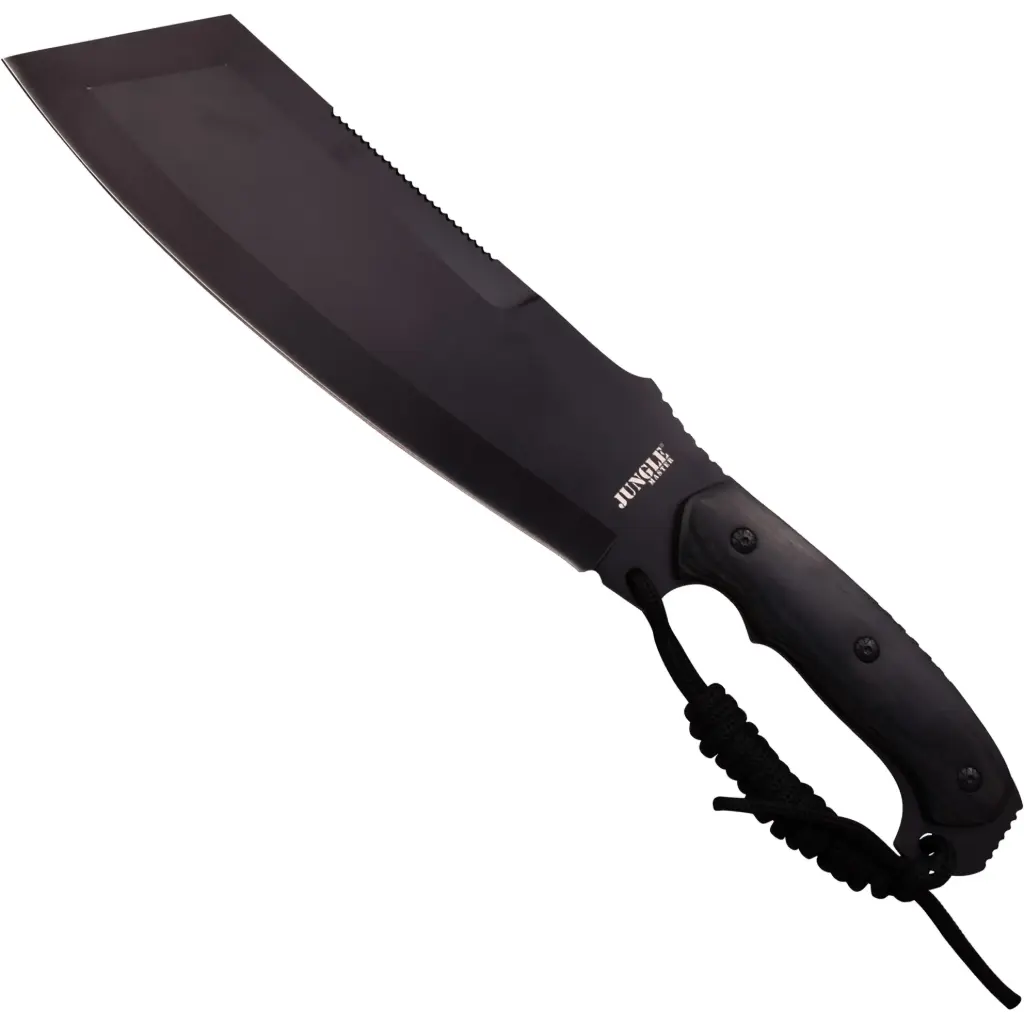
For buyers hunting the best OTF knife alternative in a fixed blade, this 10-inch blackout chopper earns its keep through brute practicality. The full-tang black stainless clip-point blade is thick enough for real chopping and light prying, while the contoured black pakkawood handle gives a more secure, glove-friendly grip than bare steel. A glass-breaker pommel and paracord lanyard make it viable as a trunk or pack emergency tool. It’s not a finesse slicer, but as a budget hard-use beater, it punches high.
What Actually Makes the “Best” OTF Knife Alternative in a Fixed Blade
If you’re researching the best OTF knife, you’re usually balancing three things: fast deployment, real-world cutting performance, and how hard you can push the knife before something fails. This Blackout Command Chopper Survival Knife - Black Pakkawood is not an OTF, but it squarely targets the buyer who’s OTF-curious and then realizes they really need a hard-use fixed blade that won’t quit when the mechanism of a cheap out-the-front would.
Here, “best” doesn’t mean flashiest. It means: a full-tang blade that won’t fold, geometry that actually chops and batons, a handle that stays in your hand when wet, and a price that makes sense as a trunk, pack, or land-camp beater. If you came in looking for the best OTF knife for EDC but know you abuse your gear, this is the kind of fixed blade that quietly solves the problem by removing the weakest link: the mechanism.
Why This Knife Beats a Budget OTF for Hard Use
Full-Tang Simplicity vs. Moving Parts
A true OTF mechanism is brilliant for fast, one-handed access, but at the low end of the price spectrum the internals are the first thing to complain. Springs weaken, grit gums things up, and hard lateral pressure risks blade play. This knife sidesteps that entirely with a full-tang construction: the 10-inch black stainless blade runs in one continuous piece from tip to glass-breaker pommel.
In practical terms, that means you can baton through kindling, chop saplings, or lever wood apart without worrying about a lock or carriage letting go. Where even the best OTF knife mechanisms have a limit on prying and twisting, this fixed blade is content to take the kind of abuse you normally reserve for a hatchet you don’t like.
Blade Geometry Designed to Chop, Not Just Look Tactical
The blade is long, broad, and clip-pointed, with a spine thickness around 0.1375 inches. That number matters. It’s thick enough that the blade doesn’t feel whippy when you’re chopping, but not so overbuilt that it wedges immediately in wood. The long, straight primary edge and aggressive clipped tip create a useful mix: you get a forward-weighted section for chopping and a finer point for controlled piercing and notching.
Compared with many OTF knife blades, which trend shorter and slimmer for pocketability, this profile is unapologetically machete-adjacent. If your main tasks are breaking down cardboard, opening packages, or quick utility cuts, an OTF wins on convenience. If you’re clearing brush, roughing in a camp, or want something in the truck that can actually chop, this geometry is simply the better tool.
The Best Fixed-Blade Stand-In for Buyers Eyeing the Best OTF Knife for Survival
Stainless Steel That’s Honest About Its Limits
The black-coated stainless steel here is working steel, not boutique steel. At this price level you’re trading edge retention and ultimate toughness for corrosion resistance and replaceability. You’ll need to touch up the edge more often than on premium steels, but in return you get a blade that shrugs off moisture and neglect better than bare carbon.
That makes sense for the most realistic use case: this lives in a trunk, bug-out bag, ATV kit, or behind a truck seat. In those roles, the best OTF knife actually ends up disadvantaged because fine mechanisms dislike dirt and long-term moisture. A simple fixed blade with a protective coating and a sheath is much more forgiving, even if you haven’t looked at it for months.
Handle and Control: Where It Quietly Outperforms Many OTF Knives
The black pakkawood scales are contoured with finger grooves and secured to the full tang, giving a palm-filling grip that’s rare in anything you’d call an everyday carry OTF. When you’re choking back on the handle for a chop, that extra real estate and the subtle finger indexing help keep the knife tracking straight into the cut.
Spine jimping near the handle lets you move up into a more controlled grip for finer tasks like feathersticking or notching. That’s the kind of control you don’t often get with narrow OTF handles and their sliding actuation switches. As long as you accept that this is a belt-or-pack knife, not pocket EDC, the in-hand stability is a genuine upgrade.
Where This Knife Is Best – and Where It’s Not
It’s important to be explicit about what this knife is not best at. It is not the best OTF knife for everyday carry; in fact, it doesn’t carry in a pocket at all. At this size and weight, plus the nylon sheath and lanyard, it’s too much blade for casual urban EDC. If your daily cutting is mostly boxes and office tasks, a compact OTF or folding knife simply makes more sense.
Where this knife does earn a place on a best list is as a budget hard-use fixed blade for survival-lite scenarios: camping, land navigation courses, property maintenance, and as a simple emergency tool. The glass-breaker pommel and lanyard are not gimmicks here — they make sense in a vehicle kit or on a ranch where breaking glass, punching through thin material, or keeping the knife tethered matters.
Carry Reality and Value Compared to the Best OTF Knife Options
Carrying this knife means accepting that it’s a sheath knife. There’s no discreet pocket clip, no quick in-and-out of a jeans pocket. Instead, you get a nylon sheath that’s adequate for attaching to a belt or pack and a paracord lanyard that helps with retrieval and retention. For someone used to the instant access of an OTF, there’s an adjustment here: draw time is slower, but strength under load is dramatically higher once the knife is in hand.
On value, this is where the calculation gets interesting. At the price of many entry-level OTF knives — which often compromise on both mechanism durability and steel — you’re getting a full-tang fixed blade large enough to do small-machete work. If you’ve ever snapped or loosened the mechanism on a cheap OTF by twisting or batoning with it, you already know why that matters.
If you want a fast-deploying pocket tool, stick with a reputable OTF brand and accept the cost. If your priority is a knife that lives in rough environments and shrugs off abuse, this blackout chopper is simply a better use of the same money.
Common Questions About the Best OTF Knives
What makes an OTF knife the best choice for EDC?
The best OTF knife for everyday carry prioritizes pocketability, reliable double-action deployment, and a blade length that’s actually legal and comfortable to carry. You’re buying speed and convenience: one-handed open and close without repositioning your grip. For true EDC, slim handles, solid lockup with minimal blade play, and a pocket clip that doesn’t snag are more important than raw chopping power. If you rarely baton wood and mostly cut packaging, rope, or tape, a well-made OTF can be the best balance of speed and size.
How does this OTF knife alternative compare to a typical folding knife?
Compared to a typical folding or OTF knife, this fixed blade trades all of the clever engineering for brute reliability. There’s no lock to fail and no internal track for the blade to ride in; the full tang simply can’t fold. In a backpack or vehicle kit, that’s a meaningful upgrade. You lose discreet pocket carry and quick deployment, but you gain a longer blade, more chopping authority, and the confidence to pry or baton without worrying about pivot wear or lock failure. It’s less civilized, but more tolerant of real abuse.
Who should choose this OTF knife alternative?
This knife suits buyers who started by searching for the best OTF knife for survival or truck carry, then realized they’re more likely to baton firewood than flick a blade open in a parking lot. If you want an inexpensive, blackout fixed blade that can clear light brush, process camp tasks, and ride in a vehicle without babying it, this is a good fit. If you prioritize discreet pocket EDC and office-friendly carry, you’re better off with a smaller OTF or traditional folder.
If you’re looking for the best OTF knife alternative for budget survival and hard use, this is it — because the full-tang, 10-inch blackout blade and simple pakkawood handle will tolerate the kind of chopping, batoning, and prying that would quickly end the life of a cheap OTF mechanism.
| Blade Length (inches) | 10 |
| Blade Color | Black |
| Blade Finish | Black |
| Blade Style | Clip Point |
| Blade Edge | Plain |
| Blade Material | Stainless Steel |
| Handle Material | Pakkawood |
| Theme | None |
| Spine Thickness (inches) | 0.1375 |
| Sheath/Holster | Nylon |