Blackout Sentinel Rapid-Deploy EDC Automatic Knife - Matte Black
3 sold in last 24 hours
This isn’t the best OTF knife, but it fills the same everyday tactical role with fewer moving parts. The push-button automatic action snaps the 3.75-inch tanto blade into play faster than most assisted openers, and the partial serrations actually earn their keep on rope and pallet straps. At 3.5 ounces with a deep-carry clip, it disappears in-pocket until you need a controlled puncture or stubborn cut handled. If you want OTF-level speed without OTF complexity, this blackout auto is the practical choice.
What the best OTF knife promises — and what this blackout auto actually delivers
If you’re shopping for the best OTF knife, you’re really hunting for a few concrete things: reliable one-hand deployment, pocketable size, a blade that cuts more than cardboard, and a mechanism you can trust when your hands are cold, wet, or gloved. This Blackout Sentinel isn’t an OTF; it’s a side-opening automatic that fills the same everyday tactical slot with fewer points of failure and a quieter profile in the pocket.
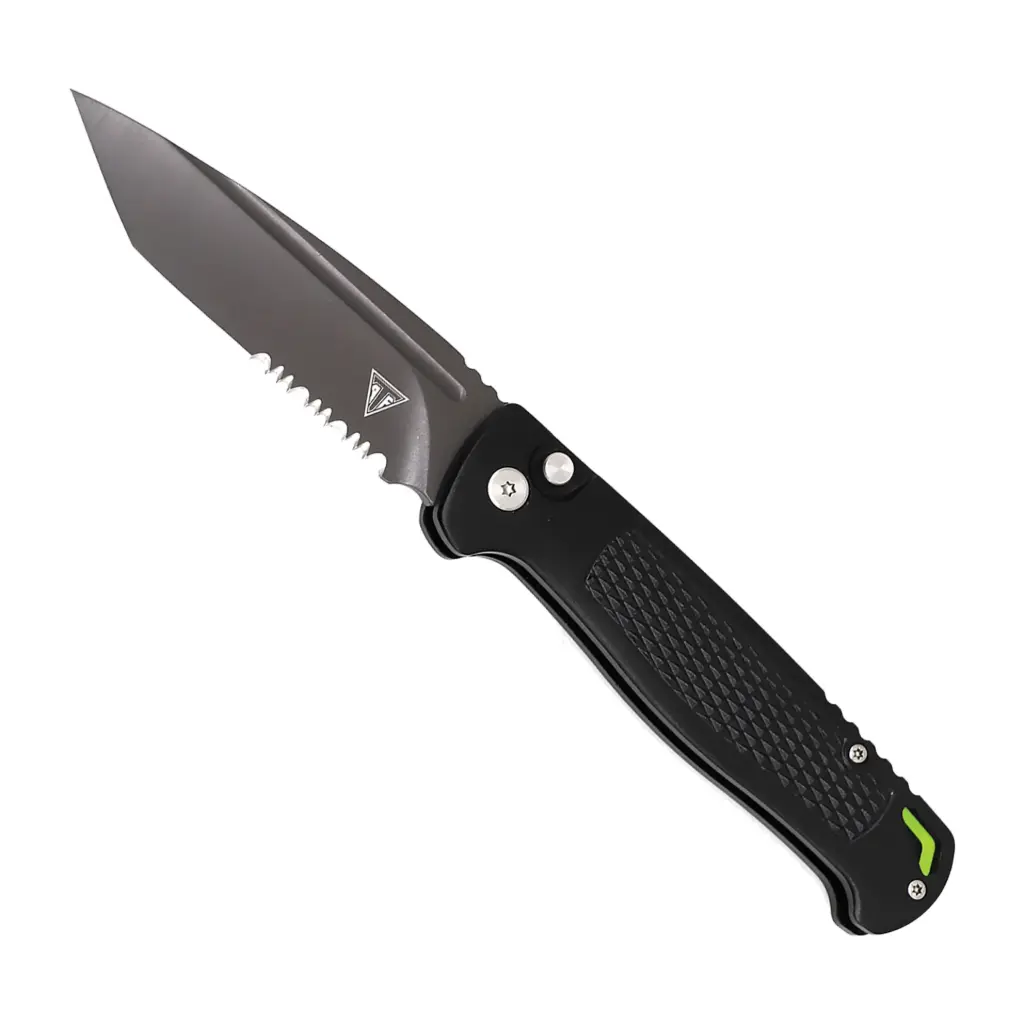
The mechanism is push-button automatic with a slide safety. The blade is a 3.75-inch matte gray American tanto with partial serrations. The handle is matte black aluminum with a deep-carry clip and green-accent safety. On paper it looks like a straightforward tactical auto; in the pocket it behaves like the knife people imagine when they type “best OTF knife for everyday carry” — fast, simple, and always where you left it.
Why this knife competes with the best OTF knife for EDC
Most buyers considering an OTF are chasing speed and convenience, not a specific mechanism. In day-to-day use, this automatic gives you that same one-press deployment without the extra internal rails and sliders of a true OTF. That matters when you’re working around dust, grit, and pocket lint.
Press the button and the blade snaps out with a decisive, consistent stroke. There’s no need to preload a spring with a thumb slide or worry about a misfire partway along the track. The slide safety locks the button off in-pocket, then clicks to fire-ready as you draw. Once you’ve done it a few dozen times, the sequence is automatic: thumb hits safety, index finger finds button, blade is already locked open.
Side-opening auto vs OTF: durability and control
The best OTF knife for EDC has to survive being opened and closed hundreds of times in less-than-clean conditions. That’s where this knife’s side-opening geometry earns its keep. There’s a single pivot, a coil spring, and a button — not a telescoping blade riding on internal rails. Fewer parts mean less to bind if you get sand or drywall dust in the mechanism.
You also gain a more traditional folding-knife grip. When the blade swings out, your hand is already wrapped around a familiar profile, not hanging behind a narrow OTF chassis. For controlled push cuts on cardboard, cutting webbing, or opening plastic clamshells, that extra handle volume feels predictable in a way many budget OTFs don’t.
Blade geometry that does work, not tricks
The American tanto profile and partial serrations define what this knife is best at. The reinforced tip gives you a strong puncture point for breaking into tough packaging or starting a cut in nylon strap without feeling like you’re about to snap a fine point. The straight primary edge handles most slicing, while the serrated section near the heel picks up when things get fibrous or wet.
If your “best OTF knife under $100” shortlist includes general-purpose cutters for jobsite and warehouse use, this blade shape is closer to what you actually need than a slick double-edge spear point with no serrations.
Best for buyers who want OTF speed without OTF maintenance
Honest tradeoff: if you specifically want the mechanical novelty of a double-action out-the-front — the slide-forward, slide-back choreography — this isn’t that knife. It doesn’t have a front-facing blade channel, it won’t scratch the same fidget itch, and it looks more like a conventional tactical folder.
Where it does earn a “best” slot is for buyers who care more about OTF-like deployment than OTF mechanics. If your use case is everyday carry in work pants or jeans, with occasional hard use on straps, cord, and stubborn plastic, this side-opening auto is a smarter first purchase than most budget OTFs.
- Easier to keep running: a quick blow-out and drop of oil at the pivot usually restores a sluggish action.
- Less sensitive to grit: no internal blade channel for debris to ride in.
- More secure hand placement: the handle fills the palm more than a slim OTF chassis.
If your priority is a reliable one-hand knife that behaves like the best OTF knife for everyday carry but costs and maintains like a simple automatic, this is where those lines cross.
Carry reality: how it rides compared to the best OTF knives
Specs tell part of the story: 3.75-inch blade, 4.75-inch closed length, 8.5 inches overall, 3.5 ounces. In practice, that means it occupies similar pocket space to many mid-sized OTFs, but sits deeper and quieter.
Deep-carry clip and blackout profile
The deep-carry clip pulls the handle down near flush with the pocket edge. Only a small section of matte black aluminum and clip hardware is visible. On dark pants, it disappears entirely. That’s a contrast to some OTF knives that leave a taller spine exposed above the pocket, broadcasting that you’re carrying a tool even if the blade never leaves your pocket that day.
The blackout handle and matte gray blade are deliberately low-key. There’s no bright logo, no polished bevels catching light across a room. If you work in mixed environments — office to jobsite, warehouse to customer-facing — that lack of visual drama is a feature, not a miss.
Weight and balance in daily use
At 3.5 ounces, the Blackout Sentinel sits in the range most people consider the sweet spot for an everyday tactical knife. Enough mass that it doesn’t feel flimsy, not so much that it drags at light fabric. The balance point lives near the pivot, which keeps the blade feeling neutral in the hand whether you’re making short, controlled cuts or bearing down on a longer slice.
The aluminum handle keeps that weight down while still feeling rigid. There’s jimping on the thumb ramp and texture on the scales, both of which matter more than you’d think once your hands are damp or gloved. The best OTF knife for EDC should feel this secure when you commit to a cut; many don’t, especially in lower price tiers where handle texture is an afterthought.
Common Questions About the Best OTF Knives
What makes an OTF knife the best choice for EDC?
The best OTF knife for EDC gives you three things: true one-hand operation, a blade that’s sized for real cutting rather than just novelty, and a mechanism that keeps working when it’s dirty. Double-action OTFs add quick retraction on top of deployment, but that also brings more moving parts and more channels for grit to ride in. For some users, that’s worth it; for others, a side-opening automatic like this one delivers the same “press-and-cut” experience with less maintenance.
How does this automatic knife compare to a typical OTF?
Functionally, this knife lives where many buyers expect the best OTF knife to live: fast, one-press deployment and a compact footprint. Where it differs is internal complexity. A true OTF uses a sliding carriage and blade channel; this knife uses a more conventional pivot and coil spring. In practice, the side-opener is easier to service, more tolerant of pocket grit, and gives a fuller grip. What you lose is the straight-line, in-and-out action and the visual drama that comes with it.
Who should choose this automatic knife over an OTF?
If your priority is deployment speed, reliable lockup, and a knife you’re not afraid to loan to a co-worker, this blackout automatic makes more sense than many budget OTFs. Choose it if you:
- want OTF-level readiness without OTF-level parts count,
- prefer a reinforced tanto tip and partial serrations for mixed materials,
- value a deep-carry, low-visibility profile from office to jobsite.
If you’re chasing the pure mechanical appeal of a double-action OTF, look elsewhere. If you’re chasing the performance most people mean when they say “best OTF knife for everyday carry,” this is the calmer, more practical answer.
If you’re looking for the best OTF knife for everyday tactical chores but don’t want the maintenance that comes with a true out-the-front, this blackout automatic is that knife — because it delivers the same one-press readiness, a work-focused tanto with serrations, and a simpler, more durable mechanism that treats pocket lint and jobsite grit as an inconvenience, not a failure mode.
| Blade Length (inches) | 3.75 |
| Overall Length (inches) | 8.5 |
| Closed Length (inches) | 4.75 |
| Weight (oz.) | 3.5 |
| Blade Color | Gray |
| Blade Finish | Matte |
| Blade Style | American Tanto |
| Blade Edge | Partial-Serrated |
| Handle Finish | Matte |
| Handle Material | Aluminum |
| Button Type | Push Button |
| Theme | Tactical |
| Safety | Slide Lock |
| Pocket Clip | Yes |