
Luxe Flash Rapid-Deploy EDC Knife - Gold Blade
3 sold in last 24 hours
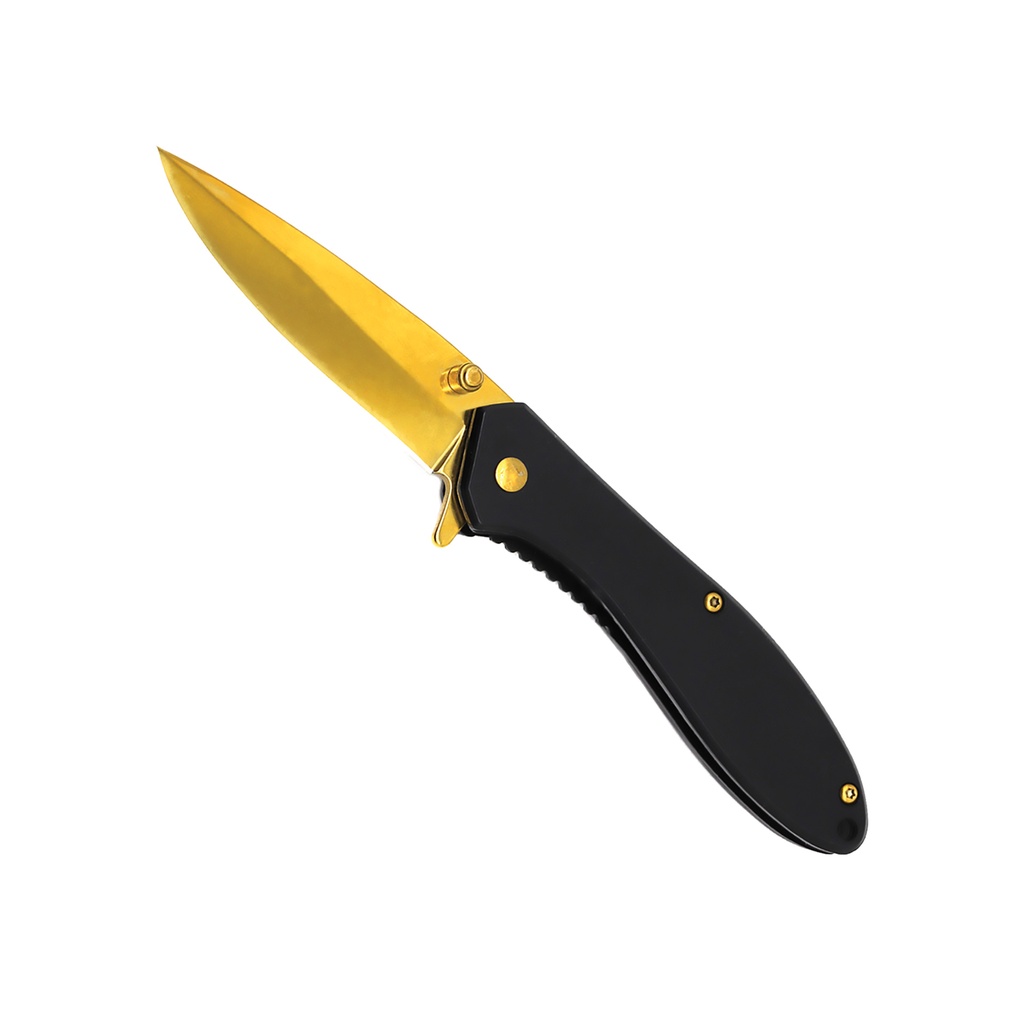
This isn’t trying to be the best OTF knife; it’s the sleek, spring-assisted folder you actually reach for every day. The Luxe Flash pairs a 3-inch gold-finished drop point with a slim black steel handle that disappears in your pocket. The flipper and spring assist snap it open one-handed with zero fumbling, and the liner lock stays positive under real cutting pressure. It’s best for everyday carry when you want utility that looks sharp without feeling tactical overkill.
What Actually Makes the Best OTF Knife – And Why This Isn’t One
If you’re hunting for the best OTF knife for everyday carry, you’re really evaluating three things: deployment speed, lock security, and how comfortably it carries day after day. True OTF (out-the-front) knives fire the blade straight out of the handle. This knife doesn’t do that – it’s a spring-assisted folder with a flipper tab and thumb stud. That distinction matters, and it’s why this belongs in the assisted-opening EDC conversation, not in a best OTF knife roundup.
What this knife does offer is a fast, one-handed deployment that feels almost as immediate as an automatic, in a slimmer, more pocket-friendly format and at a fraction of the cost of a quality OTF. If you came here searching “best OTF knife for EDC,” it’s worth asking what you actually need: OTF mechanics, or reliable, quick access in a knife that won’t scream “tactical” in an office.
Assisted Mechanism vs. OTF: How This Knife Really Deploys
Mechanically, this is a spring-assisted flipper: you apply light pressure to the flipper tab and the internal spring takes over, snapping the gold blade into lockup. There’s also a thumb stud, but the flipper is the primary control. In practice, the opening speed is competitive with many budget OTFs, but with fewer moving parts and less to maintain.
Deployment Feel and Consistency
The detent is tuned on the lighter side, so the blade breaks free with minimal effort. That’s good for quick, gloved, or slightly awkward grips, and it’s why this style often ends up being the best everyday knife for people who thought they needed an OTF. The tradeoff: you’ll want to keep the pivot clean and lightly lubricated to maintain that crisp snap.
Lockup and Safety
A liner lock inside the steel handle engages behind the heel of the blade when opened. It’s not a tank of a lock, but for typical EDC tasks – opening boxes, breaking down light cardboard, cutting cord or plastic straps – it stays put without flex. Unlike many budget OTF knives, you’re not dealing with blade play from a loose internal carriage.
Blade and Steel: How the Gold Finish Performs
The 3-inch drop point blade is coated in a reflective gold finish with a plain edge. The steel isn’t a named premium alloy, which is exactly what you’d expect at this price point. That means you’re trading edge retention and corrosion resistance for cost; this isn’t the best knife for weeks-long field work, but it’s acceptable for light-duty urban EDC if you’re willing to touch up the edge periodically.
Edge Profile and Daily Cutting
The drop point profile and plain edge make it far more useful than the flashy finish suggests. You get a fine tip for scoring tape and plastics, enough belly for smooth slicing cuts, and a straight section you can align against a box or cutting mat. If your use case is 90% packages and light utility, the geometry is right even if the steel is basic.
The Best “Almost OTF” Knife for Style-Forward EDC
Where this knife legitimately earns a “best for” claim is in style-conscious, budget EDC. The black steel handle is slim, with a matte finish that doesn’t collect fingerprints the way the blade does. In pocket, it rides like any other compact folder; the pocket clip keeps it pinned against the seam, and the straight handle profile doesn’t print much through lighter fabrics.
Carry Reality: Size, Weight, and Clip
With a 4-inch closed length and 7 inches overall, it hits the common EDC sweet spot: enough blade to be useful, not so large that it becomes a nuisance in jeans or office trousers. The steel construction adds some weight compared to aluminum or G10, but not to the point of being a burden. If you’re used to mid-weight folders, this will feel normal.
The pocket clip is set up for tip-down or tip-up carry depending on mounting (verify orientation on your sample), but in either case, it keeps the knife accessible and low-profile. This isn’t the best OTF knife with a glass breaker or a deep-carry clip; it’s a straightforward, serviceable carry that doesn’t fight you day to day.
Where It Wins – And Where It Doesn’t
This knife is best for someone who typed “best OTF knife” but ultimately needs a fast, inexpensive, spring-assisted EDC that looks sharper than a basic black folder. You get the visual drama of a gold blade, the immediacy of assisted opening, and a manageable size that actually gets carried.
It is not the best choice if you truly need OTF-specific advantages: blade retraction without folding, double-action deployment, or the kind of one-hand control that matters in gloved, high-stress, or duty environments. For that, you should be looking at reputable OTF makers, higher-grade steels, and more robust internals – and you should expect to pay significantly more.
It’s also not a hard-use work knife. Steel handles and a basic blade steel are fine for light utility, but if your “everyday carry” means daily demolition, construction, or field work, you’ll want a stronger lock, better steel, and more ergonomic contouring.
Common Questions About the Best OTF Knives
What makes an OTF knife the best choice for EDC?
The best OTF knife for EDC combines reliable out-the-front deployment, a secure lockup with minimal blade play, and a slim profile that carries comfortably. Double-action OTFs that deploy and retract with the same switch are favored for true one-hand operation. Quality OTFs also use better steels and tighter tolerances to withstand repeated firing without loosening. This spring-assisted folder mimics the quick access part, but it isn’t an OTF and doesn’t offer those OTF-specific mechanics.
How does this OTF knife compare to a spring-assisted folder?
Strictly speaking, this isn’t an OTF knife at all – it’s a spring-assisted folder. Compared to a true OTF, you lose the straight-out deployment and retraction mechanism but gain a simpler design with fewer internal parts to fail. Assisted folders like this are often thinner in the pocket and less polarizing in appearance, making them better for office or casual carry. If your priority is fast opening on a budget, an assisted folder like this usually beats a cheap OTF in reliability.
Who should choose this OTF knife?
If you came in searching for the best OTF knife for everyday carry but realized you really just need fast one-handed access and a knife that looks good in normal settings, this is the better match. Choose this if your cutting tasks are light, your budget is tight, and you value the black-and-gold, modern-luxe aesthetic as much as the mechanics. Skip it if you genuinely need duty-grade OTF performance or premium steel.
Expert Verdict: The Best Budget Alternative to an OTF for Style-First EDC
If you're looking for the best OTF knife for everyday carry because you want speed, convenience, and a bit of drama, this spring-assisted folder is the honest alternative: you get near-OTF opening speed, a visually striking gold blade, and a slim, steel-handled package that actually disappears in your pocket. It’s not the best OTF knife in any technical sense, but it is one of the better ways to scratch that OTF itch at an entry-level price without inheriting the reliability issues that plague many budget out-the-front designs.
| Blade Length (inches) | 3 |
| Overall Length (inches) | 7 |
| Closed Length (inches) | 4 |
| Blade Color | Gold |
| Blade Finish | Reflective |
| Blade Style | Drop Point |
| Blade Edge | Plain |
| Blade Material | Steel |
| Handle Finish | Matte |
| Handle Material | Steel |
| Theme | Gold Finish |
| Pocket Clip | Yes |
| Deployment Method | Spring-assisted |
| Lock Type | Liner lock |