Contrast Pivot Precision Butterfly Knife - Silver Aluminum
7 sold in last 24 hours
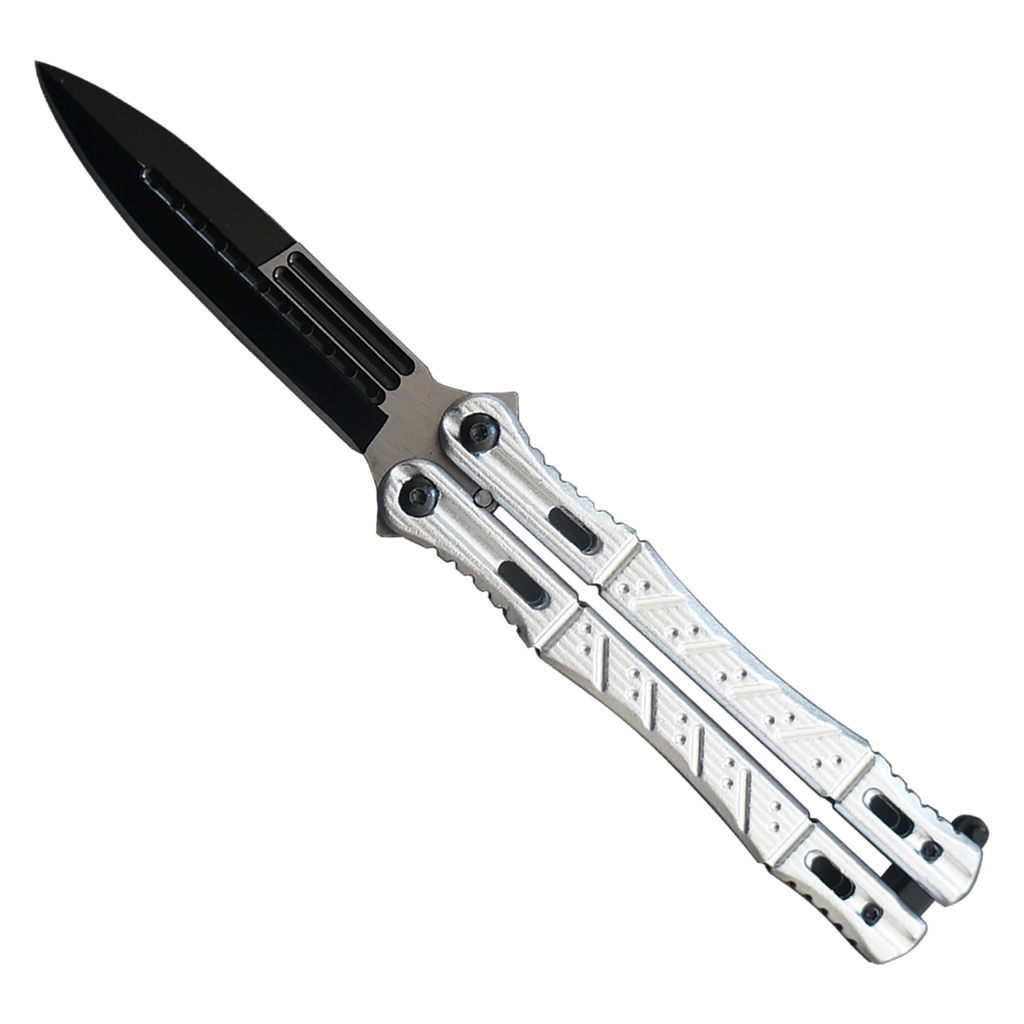
This butterfly knife feels dialed-in the first time you flip it. A two-tone spear point blade rides smoothly between matte silver aluminum handles, with cutouts in both blade and scales keeping the 9-inch profile light and quick in hand. The 3.75-inch plain edge blade handles everyday cutting—boxes, cord, packaging—while the textured handles and positive latch keep things controlled. At 4.84 ounces, it’s substantial enough to track in spins without feeling clumsy, making it a smart choice for budget-conscious balisong practice and casual EDC use.
What Actually Makes the Best OTF Knife or Butterfly Worth Carrying?
When people search for the best OTF knife, they’re usually really asking a broader question: what makes a fast-deploying, pocketable blade worth relying on day after day? Whether it’s an OTF or a butterfly knife, the criteria end up looking similar—deployment you can trust, geometry that cuts without drama, a handle you can index without thinking, and a size/weight balance that doesn’t punish you for carrying it.
The Contrast Pivot Precision Butterfly Knife - Silver Aluminum isn’t an OTF, but it sits in the same decision space: you’re considering quick one-hand or two-hand deployment, compact carry, and real-world cutting. Evaluated on those terms, this balisong earns a spot as one of the best entry-level flip-and-cut options for buyers who like the mechanical satisfaction of a butterfly knife but still expect honest utility.
Why This Knife Competes with the Best OTF Knife Options for Everyday Use
If you’re cross-shopping the best OTF knife for everyday carry against a butterfly, the first question is speed and control. A double-action OTF is faster from pocket to cut, no argument. But once this butterfly is open and locked, it behaves like a slim, straightforward folding knife with a secure two-handle grip and a 3.75-inch spear point blade that actually wants to work.
The blade length and 9-inch overall size hit that same Goldilocks zone many of the best OTF knife designs aim for: big enough to open packages, slice cord, and break down boxes without feeling silly, but compact enough that it doesn’t dominate a pocket or feel overbuilt for office or warehouse use.
Blade Geometry and Cutting Performance
The spear point blade is more than a styling choice. The symmetrical tip and plain edge give you a fine point for precision tasks—starting cuts in shrink wrap or scoring tape—while the mid-belly section offers enough curve to bite into cardboard without needing a sawing motion. The matte black finish reduces glare and resists visible scratching better than a bright polish, which matters when you’re actually using the knife instead of collecting it.
Fullers and cutouts in the blade aren’t just visual flair; they shave weight from the moving mass, which makes the knife track more predictably in basic flips and rollovers. That’s the kind of detail you notice after a few practice sessions, not from a spec sheet.
Handle Design and Flip Control
The silver aluminum handles keep things honest. They’re machined with geometric grooves and drilled holes that you can actually feel, so the knife doesn’t turn into a bar of soap when your hands are slightly sweaty or dusty. At 4.84 ounces overall, it has enough weight to swing through motions smoothly but not so much that it feels like a training brick.
The latch is standard and predictable—bottom-mounted, easy to manipulate, and positive enough that it stays put when you want the knife closed or open. Is it as instantly deployable as the best OTF knife with a side switch? No. But once open, the two-handle clamp on the tang gives a secure, rigid feel that many budget OTFs simply don’t match.
The Best OTF Knife Alternatives: Where This Butterfly is Clearly "Best For"
This knife isn’t trying to replace a premium, double-action best OTF knife for pure one-handed speed or pocket clip convenience. Instead, it’s best for three specific use cases:
- Flipping practice on a budget: The weight, cutouts, and symmetrical design make it forgiving to learn basic openings, aerials, and rollovers without paying collector prices.
- Light everyday cutting: The 3.75-inch plain edge blade is long enough for office, warehouse, or home utility tasks, but short enough to stay manageable.
- Mechanically minded users: If you enjoy fidgeting with a balisong more than simply pressing a button on an OTF, this scratches that itch.
Where is it not the best choice? If you want deep-pocket, discreet carry with instant one-handed deployment, a well-made OTF with a clip still wins. If you’re looking for a hard-use field or survival tool, you should be looking at a fixed blade or a heavier-duty folder instead.
Size, Weight, and Carry Reality
Closed, this butterfly sits at 5.125 inches. That’s comparable to many full-size OTF models from a footprint standpoint. The difference is how you carry it. There’s no clip here, so you’re dropping it into a pocket, bag, or pouch. For buyers hunting the best OTF knife for EDC, that’s a tradeoff worth weighing: in-pocket carry is simple and snag-free, but not as instantly accessible as a clipped OTF.
The 4.84-ounce weight is in the comfortable middle zone. Lighter balisongs can feel twitchy and harder to track; heavier ones can fatigue your hand quickly. This one lands in a place where 20–30 minutes of flipping practice doesn’t feel like a forearm workout, and you still have enough mass to know exactly where the blade is mid-movement.
Build Quality, Steel, and Honest Value
The blade steel is an unspecified stainless, which matches the price bracket. You’re not buying edge retention to rival premium powder steels here. In real terms, that means it will handle tape, packaging, light cord, and day-to-day tasks fine, but you’ll be touching it up more often than a higher-end blade. On the other hand, it also means sharpening is quick and straightforward on basic stones or a pull-through.
The aluminum handles make more of a difference to the overall feel than the steel choice at this tier. They resist dings better than cheap pot metal castings and won’t swell or warp like poorly finished wood or plastic. Combined with black hardware and a consistent matte finish, the knife feels like a coherent piece of kit rather than a novelty toy.
Value-wise, this is where it quietly competes with many "best OTF knife under $100" contenders. For a very accessible price, you get a mechanically interesting knife that doubles as a fidget tool and a practical cutter. You give up a pocket clip and instant one-handed operation; you gain a full two-handle grip and simple, robust construction with few parts to fail.
Common Questions About the Best OTF Knives
What makes an OTF knife the best choice for EDC?
The best OTF knife for EDC combines three things: reliable double-action deployment, a blade length in the 3–3.5 inch range, and a profile that disappears in the pocket. A good OTF opens and closes with the same control every time, even when your hands are cold or gloved, and locks up without noticeable blade play. Where a butterfly like this one can compete is after deployment: you still get a functional blade and a solid grip, just with a different opening ritual and usually at a lower price point.
How does this OTF knife alternative compare to a typical folding knife?
Compared to a standard one-blade folder with a thumb stud or flipper tab, this butterfly is more mechanically involved to open and close. That’s either a feature or a drawback depending on your personality. In use, the spear point blade cuts much like a conventional EDC folder of similar size. You get a bit more handle length to hang onto and slightly more bulk in pocket, but also a more secure two-handle clamp on the blade when open. Versus the best OTF knife designs, it trades speed for simplicity and lower cost.
Who should choose this OTF knife alternative?
You should pick this butterfly if you’re balisong-curious, want a knife you can practice flipping with, and still expect it to pull its weight breaking down boxes and opening deliveries. It’s also a sensible choice if you like the idea of the best OTF knife for everyday carry but live in an area where OTF laws are stricter than those around butterfly knives. If your top priority is deep-pocket discretion and instant one-hand deployment for work, a true OTF or a modern folder will still serve you better.
If you’re looking for the best OTF knife alternative for affordable flipping practice and light everyday cutting, this is it — because its balanced weight, textured aluminum handles, and practical spear point blade make it feel like a real tool first and a fidget object second.
| Blade Length (inches) | 3.75 |
| Overall Length (inches) | 9 |
| Closed Length (inches) | 5.125 |
| Weight (oz.) | 4.84 |
| Blade Color | Black |
| Blade Finish | Matte |
| Blade Style | Spear Point |
| Blade Edge | Plain |
| Blade Material | Steel |
| Handle Finish | Matte |
| Handle Material | Aluminum |
| Theme | None |
| Latch Type | Latch |
| Is Trainer | No |