
Contrast-Safe Retention Trainer Gun Replica - Black/Red Rubber
7 sold in last 24 hours
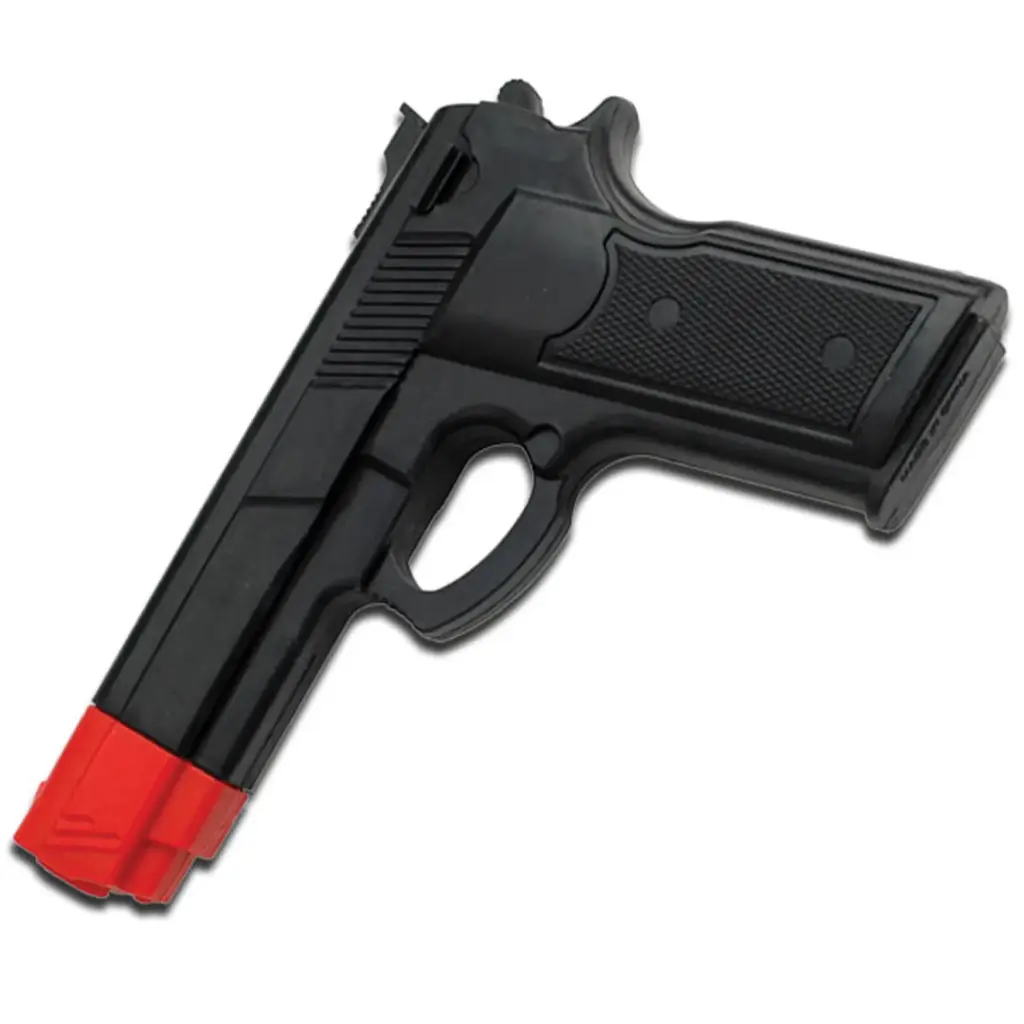
This isn’t a toy; it’s the trainer you use when you actually care about real-world carry habits. The Contrast-Safe Retention Trainer Gun Replica mirrors a duty-size pistol closely enough to run your real holster, while the black body and red muzzle make its non-lethal role obvious to everyone in the room. Solid rubber construction shrugs off drops and contact drills, so dojos, CCW classes, and law-enforcement programs can pressure-test draw strokes and retention without live-fire risk.
Why a High-Contrast Training Gun Matters More Than One More Range Session
If you’ve ever tried to teach a clean draw or a real retention drill with an unloaded live gun, you already know the problem: people move differently when there’s even a theoretical chance of a negligent discharge. A dedicated rubber training gun fixes that, but only if it does two things well — it must fit real holsters and grips like a duty pistol, and it must be obviously non-lethal from across the room. The Contrast-Safe Retention Trainer Gun Replica nails that balance.
Think of this as the stand-in you use for every rep that would feel reckless with a real firearm: force-on-force entries, ground scrambles, worst-case retention fights against the wall. Its job is simple — let you train like it’s real, without the live-fire risk.
Holster-True Shape for Real Retention Drills
The whole point of a rubber training gun is to build habits that transfer directly to your actual carry setup. That starts with holster fit. This replica tracks a full-size semi-auto profile closely enough that it seats in most duty and appendix holsters designed for modern service pistols. That means your students practice the same index points, draw angles, and re-holster feel they’ll use with their real handgun.
Duty-Style Grip That Rewards Proper Hand Placement
The grip isn’t some blob of rubber vaguely shaped like a pistol. You get a defined beavertail, real trigger guard contour, and checkered panels that give your support hand somewhere concrete to lock in. When you run hundreds of draw strokes in a CCW class or dojo session, that matters — the hand position you build here is the one that shows up under stress.
Slide and Frame Lines That Match Real Pistols
Slide serration outlines, hammer area, and frame geometry are all there in raised detail. You can demo slide manipulations, positional indexing, and close-quarters weapon retention against grabs in a way that makes visual sense to new shooters. The silhouette reads as “duty pistol” instantly, which keeps classroom translation between trainer and live gun simple.
High-Contrast Safety: Why the Black/Red Scheme Works
A lot of training guns try to look realistic and end up flirting too closely with the real thing. This one takes the opposite approach: the frame and grip stay a serious matte black, but the muzzle block is a bold, unmistakable red. That contrast is loud on purpose.
From the back row of a classroom or the edge of a mat, instructors, students, and bystanders can tell at a glance that this is a non-firing rubber replica. In scenario work — especially anything involving role players or bystanders — that visual clarity is worth more than any marketing claim. You don’t want anyone guessing what’s in a student’s hand.
Non-Firing, Solid Rubber Construction
There are no moving parts, no removable magazine, and no way to confuse this with a functional firearm once it’s in hand. The barrel is solid; the slide doesn’t rack. That’s deliberate. It removes the temptation to sneak in “just one” live drill with the same tool you’ve been using for contact work.
Impact-Safe Edges for Contact and Ground Work
The lines stay true to a semi-auto pistol, but the edges are subtly softened. When you’re running close retention drills, disarms, or ground fighting scenarios where the gun might get driven into ribs, face, or hands, that rounding takes some of the sting out without destroying realism. You still respect it, but you don’t need a medic for every bad angle.
Where This Training Gun Is Best — and Where It Isn’t
This rubber trainer is best for instructors and students who prioritize realistic carry work: draw stroke refinement, holster indexing, retention against grabs, and scenario training in dojos or defensive shooting classes. If your curriculum includes force-on-force contact, weapon takeaways, or confined-space work, the solid rubber build and bright red muzzle make it a safer, saner choice than inert metal replicas or blue guns that disappear visually against dark mats and clothing.
It is not the best tool for marksmanship instruction or for simulating trigger press and sight picture. The trigger is molded solid, and there are no functional sights to refine. At the range, you’ll still want a dedicated dry-fire setup or a live firearm with proper safety protocols. This trainer’s lane is movement, access, control, and retention — not accuracy work.
Carry Reality in Class: How It Handles in Actual Use
In real classes, the value of this training gun shows up in the small things. It drops into most Kydex or leather holsters without chewing up the material, and the rubber finish has just enough drag to mimic a snug carry fit without locking up on the draw. On the mat, it doesn’t chatter across the floor like a hard plastic dummy, and it doesn’t chip when students inevitably send it skidding during takedown drills.
Because it’s full-size, you also expose students to the reality of grip size and draw clearance from concealment. If they can’t get this out clean under a cover garment in class, they won’t magically do better with a live pistol later. That honest feedback is exactly what you want from a training replica.
Value: A Dedicated Tool That Pays for Itself in One Class
From an instructor’s perspective, the economics make sense. For the cost of a few boxes of defensive ammo, you get a training gun stable enough for years of use. Rubber construction shrugs off wall impacts, hard grabs, and the kind of abuse that would quickly scar a real pistol used for dummy work. You also avoid wear and tear on actual firearms that were never designed to be thrown, wrenched on, or repeatedly driven into mats.
If your program leans heavily into live-fire and neglects hands-on access and retention, this is the cheapest way to close that gap. One dedicated class built around this replica will often expose more real-world carry problems than a dozen slow-fire groups at seven yards.
Common Questions About the Best OTF Knives
What makes an OTF knife the best choice for EDC?
For everyday carry, the best OTF knife is the one that combines reliable double-action deployment with a blade and handle profile you’ll actually carry. A strong spring, minimal blade play, and a pocket clip that doesn’t fight your clothing matter more than exotic steel. In practical terms, the best OTF knife for EDC opens consistently one-handed, rides comfortably in the pocket, and is easy to keep under control during routine cutting tasks.
How does this OTF knife compare to a folding knife?
Compared to a standard folding knife, a well-made OTF offers faster, more intuitive straight-line deployment — thumb on the switch, blade out and ready. A good OTF knife trades some of the brute lock strength of a heavy-duty folder for speed and convenience. For most EDC uses like opening boxes or cutting cordage, a quality OTF feels quicker and more direct, while a traditional folder may still be the better choice for heavy prying or abuse.
Who should choose this OTF knife?
The best OTF knife belongs on the belt or in the pocket of someone who values rapid access and simple mechanics over fidget factor. If you work in environments where you’re opening packages all day, wear gloves regularly, or need a one-handed blade that deploys the same way every time, a dialed-in OTF is a better fit than a flipper or traditional folder. Users who routinely baton wood or pry with their blade, however, are still better served by a fixed blade or hard-use folder.
If you’re looking for the best OTF knife for everyday carry, the right choice is the one that mirrors this trainer’s philosophy: purpose-built, mechanically honest, and focused on the specific reps you actually need. Choose an OTF with reliable deployment, practical steel, and pocket manners you won’t hate — because like this training gun, the best tool is the one you’ll use often enough to build real skill.