Cosmic Veil Karambit Comb Knife - Galaxy Purple
13 sold in last 24 hours
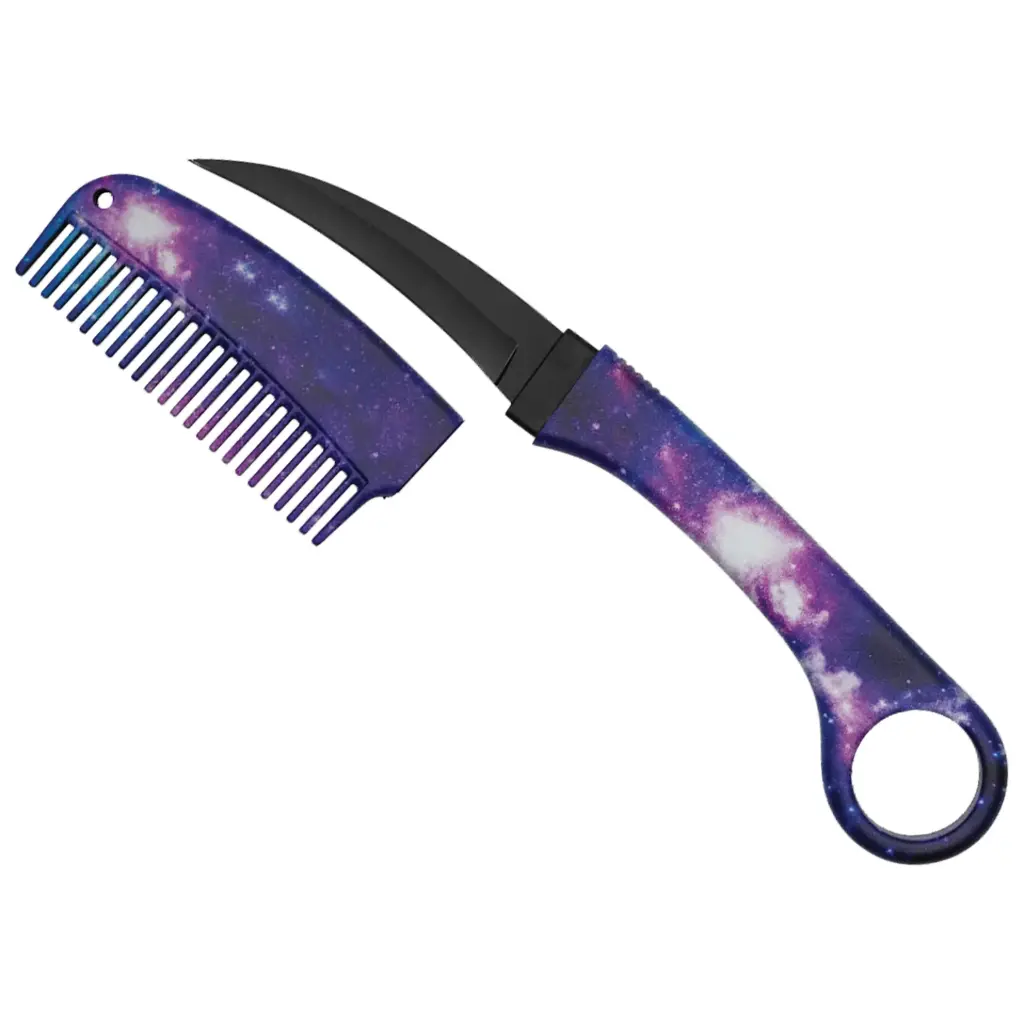
For buyers chasing the best discreet carry, this isn’t a gimmick comb — it’s a hidden karambit-style blade that passes the pocket test. The fine-tooth cover actually works as a comb, but slides off to reveal a 3-inch black hawkbill and finger ring that lock in control. At 4.5 inches concealed and just 1.16 oz, it disappears in daily carry yet has the reach and leverage to handle package duty, cord, and light utility without broadcasting that you’re carrying a knife.
What Actually Makes the Best OTF Knife or Hidden Blade?
When people search for the best OTF knife or the best hidden blade, they’re usually chasing the same thing: fast access, real control, and a profile that doesn’t scream “knife” in polite company. An out-the-front automatic does that with a switch. This karambit comb knife does it with disguise. Instead of a button, you’ve got a functional comb cover that slips off in one motion and exposes a curved hawkbill blade anchored by a finger ring.
I’ve carried enough autos, OTFs, and disguised knives to know that “best” isn’t about trick mechanisms alone. It’s about whether the tool holds up in real pockets, around real people, doing real cutting. This one earns a spot in the best-hidden-knife conversation because it passes quick-glance scrutiny as a grooming tool, yet behaves in hand like a compact karambit when you need control.
Why This Disguised Comb Knife Competes With the Best OTF Knife for Discreet Carry
If your priority is low-profile carry rather than fidget-factor, this comb knife does what many of the best OTF knife designs can’t: it simply disappears into the background. Closed, it’s 4.5 inches long, weighs only 1.16 oz, and presents as a glossy purple/blue galaxy comb. No switch, no button, no clip telegraphing “tactical.” Just a fine-tooth cover, a small lanyard hole, and a cosmic finish that reads as style, not threat.
Where a double-action OTF knife announces itself the moment you touch the slider, this disguised knife keeps attention low. The cover pulls free in a single straight motion. There’s no lock to fight, no deployment angle to get wrong. You’re either combing your hair or you’re holding a 3-inch black hawkbill with a ring-secured grip.
Disguised Mechanism vs. Out-the-Front Deployment
With an OTF, the mechanism is the star: spring tension, track tolerances, lockup. Here, the mechanism is deliberately boring, and that’s the point. The cover operates like a slip-on sheath. That simplicity means nothing rattles, there’s no blade play from a sliding chassis, and there’s nothing mechanical to advertise that you’re carrying a knife. For users who value discretion over mechanical theatrics, that’s a meaningful trade.
Karambit Ring for Retention and Control
The ring is where this disguised knife earns serious credibility. Slip a finger through, and you get the same locked-in retention you’d expect from a purpose-built karambit, not a novelty comb. In practice, that ring keeps the tool stable during pull cuts, prevents it from being knocked loose under stress, and gives you reliable indexing even in awkward angles where a traditional small folder might twist.
Best OTF Knife Alternative for Covert Everyday Carry
If you’re specifically looking for the best OTF knife for everyday carry, you’re probably balancing three things: pocket comfort, cutting performance, and how much attention the knife draws. This comb knife doesn’t fire out the front, but it does something most OTFs struggle with: it reads as completely ordinary.
The 3-inch black hawkbill blade is purposefully curved to pull into material—cardboard, plastic wrap, light cord—rather than forcing you to push. That’s the same cutting dynamic many users prefer in rescue hooks and talon-style blades. Combined with the finger ring, it behaves more predictably than its novelty appearance suggests.
Carry Reality: 4.5 Inches Concealed, 1.16 oz
In practice, this rides more comfortably than many compact autos. At 4.5 inches concealed, it fits front pockets, organizer sleeves, and small bags without printing as a knife. The 1.16 oz weight means it disappears until you need it. There’s no clip, which is intentional: a clipped, galaxy-finished handle hanging off a pocket would invite questions. As a loose comb, it doesn’t.
Where It Beats a Typical OTF Knife
In strictly mechanical terms, an OTF wins for one-handed deployment and retraction. Where this comb knife wins is in environments that punish visible blades—offices, campuses, public transit—where a visible switchblade silhouette creates exactly the kind of attention you don’t want. Here, you’re just someone with a comb until you’re not.
Best For: Low-Profile Self-Defense and Backup Utility
It’s worth being honest about what this is not. This is not the best choice if you want a hard-use work knife for all-day box duty, nor is it a replacement for a premium steel best OTF knife for EDC with a pocket clip and serviceable edge retention data. Steel grade isn’t the selling point here; concealment and control are.
Where it excels is as a low-profile option in settings where a conventional tactical knife would be frowned upon or confiscated. The hawkbill profile and ring give you enough leverage for close-in work and defensive technique practice, but you should treat it as a light-duty cutter and backup rather than your primary workhorse.
Tradeoffs You Should Know
- Edge and steel: This sits firmly in the practical, budget-steel category. It will handle everyday packaging and light cord, but if you’re used to premium steels, expect to touch up the edge more often.
- No clip, no lock: You’ll carry it loose or on a lanyard. Some will see that as a negative; others will see it as one less visual clue.
- Disguised but not invisible: The galaxy purple finish is eye-catching. Up close, curious people may want to inspect it. The disguise works best at casual distance.
Common Questions About the Best OTF Knives and Disguised Alternatives
What makes an OTF knife the best choice for EDC?
The best OTF knife for everyday carry combines reliable double-action deployment, manageable size, and a blade shape that handles real cutting tasks. In my experience, the good ones fire consistently from clean pockets, lock up with minimal play, and sit flat enough that you forget they’re there until you need them. They’re ideal when you want one-handed, on-demand access and you’re not worried about broadcasting that you’re carrying a knife.
How does this comb knife compare to a typical OTF knife?
An OTF gives you speed and mechanical satisfaction; this disguised comb knife trades that for subtlety. There’s no switch, so deployment is slightly slower and two-step: remove cover, establish grip. But it wins where appearance matters: it looks like grooming gear, not a tactical tool. If your environment is OTF-friendly, a dedicated automatic will outperform it as a primary cutter. If you need something that avoids visual scrutiny, this design makes more sense.
Who should choose this comb knife?
This fits buyers who value covert carry and karambit-style control over premium materials. Retailers will appreciate it as an impulse item that demonstrates well: the cover-off reveal sells the story in seconds. EDC users who already have a primary blade and want a discreet backup, plus collectors drawn to cosmic graphics and hidden-knife concepts, will get the most out of this piece. Anyone expecting a do-everything work knife should look to a more conventional OTF or folder instead.
If you’re looking for the best covert knife for low-profile everyday carry, this disguised karambit comb is it — because it hides in plain sight as a functional comb while still giving you a ring-locked hawkbill blade with enough control for real-world cutting.
| Blade Length (inches) | 3 |
| Overall Length (inches) | 7.5 |
| Closed Length (inches) | 4.5 |
| Weight (oz.) | 1.16 |
| Blade Color | Black |
| Handle Finish | Glossy |
| Concealed Length (inches) | 4.5 |
| Concealment Type | Disguised |