
Cross Spear Rhythm-Tuned Balisong Trainer - Chrome Steel
9 sold in last 24 hours
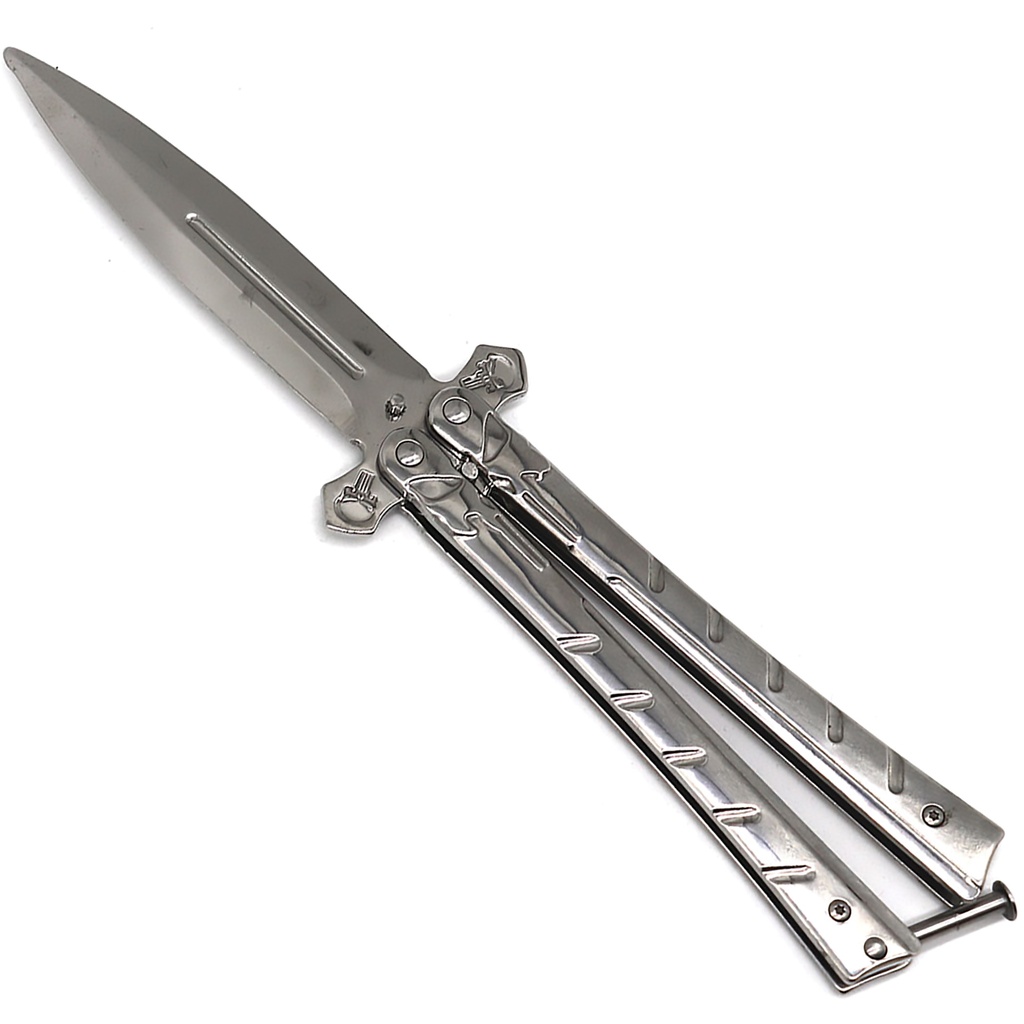
This isn’t a toy; it’s a purpose-built balisong trainer that feels like a live blade without the risk. The Cross Spear Rhythm-Tuned Balisong Trainer in chrome steel runs 9.5 inches overall, with a 4.25-inch unsharpened spear-point and a solid 6 oz of mass. That weight, plus full-steel handles and a standard latch, gives it a predictable, swing-happy balance ideal for drilling openings, aerials, and flow without chewing up your hands.
What Makes a Balisong Trainer Earn “Best” Status?
Before calling anything the best balisong trainer, it has to clear a few hard tests. The balance has to be predictable enough for new flippers to learn safely, but honest enough that skills transfer to a live blade. The construction needs to survive drops on concrete without flexing or loosening immediately. And the trainer profile should mimic a real butterfly knife, just without the cutting edge. The Cross Spear Rhythm-Tuned Balisong Trainer - Chrome Steel was evaluated with those criteria in mind.
Why This Chrome Balisong Trainer Nails the Basics
The Cross Spear Rhythm-Tuned Balisong Trainer is built around a simple idea: give beginners and casual flippers a full-size, live-feeling knife that still stays firmly in the trainer category. At 9.5 inches overall with a 4.25-inch unsharpened spear-point blade, the dimensions track closely with common full-size butterfly knives, so muscle memory actually transfers.
The 6 oz weight and full steel construction matter here. Many ultra-light trainers feel great in the hand but don’t behave like the real thing once you graduate to a sharpened balisong. This model carries its mass through the handles and blade evenly, so rollovers and chaplins don’t stall out mid-arc, and you don’t have to fight an overly handle-biased flip. For repetitive practice, that predictability is more important than clever machining tricks or exotic materials.
Trainer Blade That Mimics a Live Profile
The spear-point trainer blade is blunt along the edges and tip, but visually it reads like a live blade. The central fuller and polished finish help your eye track rotation mid-flip, especially under bright light. For anyone filming tricks or watching their own hand position, that visual feedback speeds up learning. Because the edge is plain and unsharpened, drops and mis-grabs sting at worst instead of cutting you open.
Chrome Steel Construction Built for Abuse
Both blade and handles are steel with a polished chrome finish. That’s not about luxury; it’s about taking impact. A lot of budget trainers die from bent handles or warped spines after a month of concrete drops. Steel resists that kind of deformation far better than thin aluminum. The tradeoff is weight: at 6 oz, this isn’t a featherweight. If your definition of the best trainer is “as light as possible,” this won’t be your first pick. But if you want a trainer that survives being actually used, the full-steel build is a reasonable trade.
The Best Balisong Trainer for Realistic Practice
Within the world of butterfly trainers, this chrome model makes most sense for people who care about realistic feel over novelty. The latch, for example, is a classic bottom latch. That’s exactly what many live balisongs still use, and learning to manage that hardware—avoiding latch bite, using it one-handed—is part of real-world flipping. There’s no pocket clip here, which again aligns with a lot of traditional balisongs and keeps the silhouette clean in hand.
Flip-wise, the straight, symmetrical handles with diagonal grooves give just enough traction without grabbing skin or pockets. The polished finish allows the knife to pivot and roll smoothly around fingers, while the grooves keep it from feeling like a bar of soap once you start moving faster. This isn’t a bearing-driven, competition-grade setup, but for day-in, day-out practice of basic to intermediate tricks, the mechanics are more than adequate.
Balance That Rewards Repetition
Balance is the whole story with any trainer claiming to be the best choice for learning. Here, the 9.5-inch length and 6 oz weight produce a slightly deliberate, rhythm-friendly flip. On the table, the knife feels substantial; in motion, the extra mass smooths out jitters and makes your timing more obvious. If you rush a ricochet or mis-time a rollover, the mistake is easy to feel and correct.
Compared to ultra-fast, skeletonized trainers, this chrome balisong is slower but more honest. That’s a plus for new flippers who are still mapping the mechanics in their hands. If your goal is flashy speed runs, you may eventually want something lighter and more specialized. If your goal is to build clean, transferable fundamentals, this balance profile is exactly what you want to repeat hundreds of times.
Tradeoffs: Where This Trainer Is Not the Best Choice
Honesty matters in any “best” claim. This is not the best balisong trainer if you want pocketable, all-day carry. There’s no clip, it’s full-steel, and at 6 oz it’s noticeable in a pocket. It’s also not the best for people chasing competition-level tolerances or exotic pivots; the design is straightforward and functional rather than boutique.
Where it does excel is as a durable, realistic-feeling practice knife for budget-conscious flippers, shops selling into that crowd, or anyone who wants a trainer that actually feels like a knife, not a toy. You’re trading lightness and refinement for robustness and familiarity—and that’s a tradeoff many beginners and casual flippers should make on purpose.
Common Questions About the Best OTF Knives
What makes an OTF knife the best choice for EDC?
When people talk about the best OTF knife for EDC, they’re usually weighing instant, one-handed deployment against pocket footprint and reliability. The best OTF knife options use proven double-action mechanisms, decent blade steel, and well-tuned springs that don’t misfire after a month in a linty pocket. They also ride reasonably flat and secure, so you’re not constantly aware of the bulk every time you sit down or move.
How does this OTF knife compare to a folding knife?
The best OTF knife sits between a traditional folder and a fixed blade. Compared to a standard folding knife, a good OTF offers faster, more consistent deployment and usually better one-handed closing. In return, you accept a more complex internal mechanism that can be more sensitive to grit or neglect. For most everyday cutting tasks, either will work; people who choose the best OTF knife for their needs do it for the deployment and the form factor, not because it cuts better.
Who should choose this OTF knife?
The buyer who genuinely benefits from the best OTF knife is someone who values fast, predictable access above all—often in work contexts where one hand is occupied or gloved. If you mostly open mail and break down boxes, a regular folder is fine. If you need a blade that appears and disappears with minimal hand movement, a well-built OTF earns its keep.
If You’re Looking for the Best Balisong Trainer for Realistic, Durable Practice
If you’re looking for the best balisong trainer for realistic, repetition-heavy practice, this chrome Cross Spear model earns its place because it behaves like a live butterfly knife without the edge. The full-steel, 6 oz build survives hard drops, the 9.5-inch overall length and spear-point trainer blade track real-world dimensions, and the straightforward latch design teaches the same habits you’ll need later. It’s not the flashiest or lightest trainer you can buy—but if you care about honest balance, durability, and useful muscle memory, it’s exactly the kind of knife you want to flip until everything feels automatic.
| Blade Length (inches) | 4.25 |
| Overall Length (inches) | 9.5 |
| Closed Length (inches) | 5.5 |
| Weight (oz.) | 6 |
| Blade Color | Silver |
| Blade Finish | Polished |
| Blade Style | Spear Point |
| Blade Edge | Plain |
| Blade Material | Steel |
| Handle Finish | Polished |
| Handle Material | Steel |
| Theme | Cross Spear |
| Latch Type | Latch |
| Is Trainer | Yes |