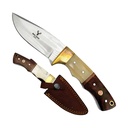
Deer Trail Classic Fixed Hunting Knife - Bone & Rosewood
5 sold in last 24 hours
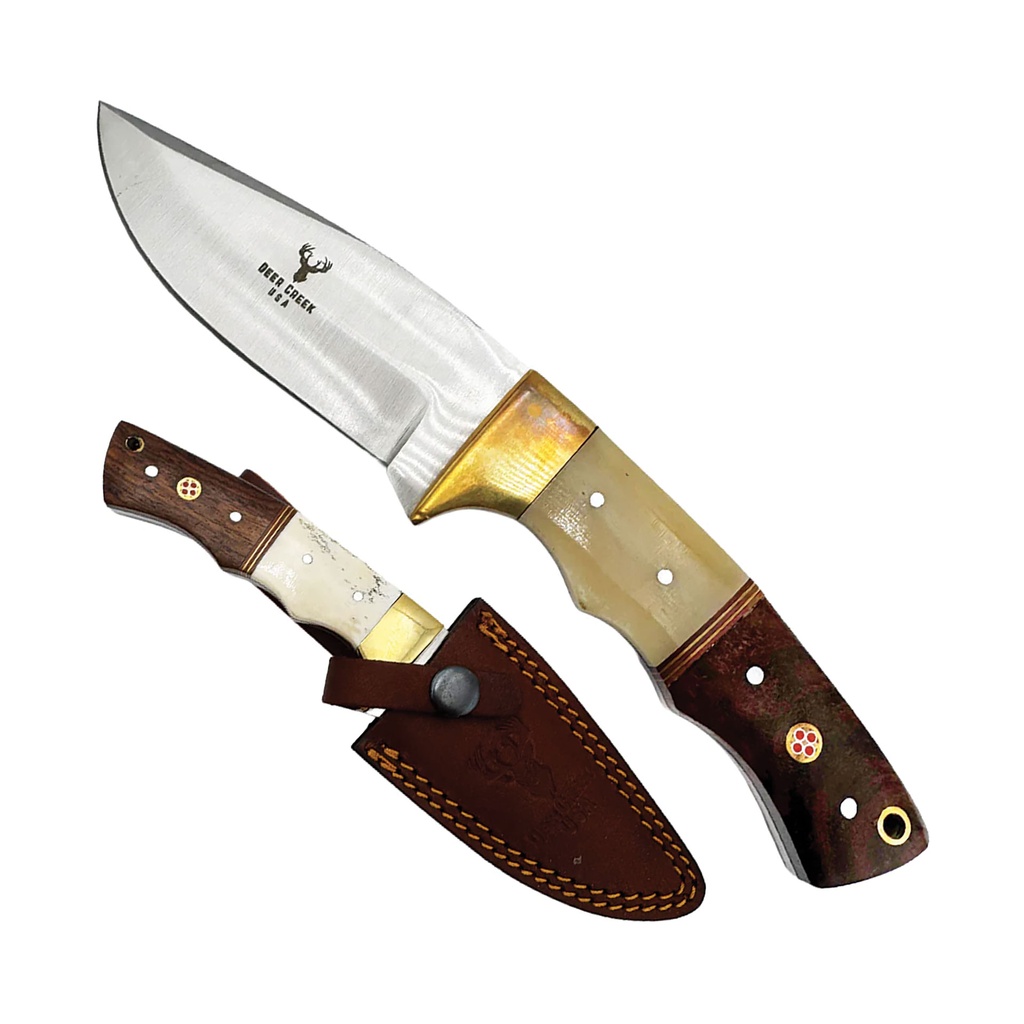
This isn’t a wall-hanger; it’s a honest working hunting knife with classic bones. A 3.75-inch satin clip point in stainless makes clean work of hide and camp chores, while the full-tang construction, brass guard, and mosaic-pinned bone-and-rosewood handle keep your grip locked in when things get slick. At 8 inches overall with a leather belt sheath, it carries light but feels substantial in the hand. Ideal for whitetail-sized game and general camp duty, not baton-heavy survival abuse.
What Actually Makes the Best OTF Knife for the Field?
Before talking about why this knife earns a place in a “best” discussion, it’s worth addressing the obvious: this is not an OTF knife. It’s a traditional full-tang fixed-blade hunting knife. If your priority is a fast-deploying automatic, you’re in the wrong aisle. If you’re trying to choose the best tool for cleaning game and living on your belt all season, a compact hunting fixed blade like this is simply the better choice than any best OTF knife contender.
In practical field use, the “best” knife isn’t the flashiest mechanism. It’s the one you can trust with cold, wet hands, on uneven ground, under a headlamp, without thinking about locks or springs. That’s where this Deer Trail Classic Fixed Hunting Knife – Bone & Rosewood earns its keep: quiet, predictable performance instead of mechanical drama.
Why a Fixed Blade Beats Even the Best OTF Knife for Hunting
I’ve carried autos, flippers, and OTFs in the field. They’re fast, they’re fun, and they’re fine for opening feed bags or boxes in the truck. But when you’re elbow-deep in a whitetail and your knife is slick with fat and blood, simple wins. A full-tang fixed blade like this removes two big variables that even the best OTF knife can’t escape: moving parts and pocket grit.
Full-Tang Security Under Real Load
The tang on this knife runs the full length of the handle, visible between the bone and rosewood scales. That matters when you’re twisting through a pelvic joint or bearing down to separate sinew. There’s no pivot, no lock, and no button to fail — just continuous steel from tip to lanyard hole. For hunting and camp use, that’s objectively safer and stronger than any OTF mechanism when you’re applying lateral force.
Clip-Point Geometry That Matches Whitetail-Scale Game
The 3.75-inch satin-finished stainless clip point hits a sweet spot. Long enough to zip a deer from brisket to sternum without feeling cramped, but short enough to choke up near the guard for careful work around the gut. The clip brings the tip fine without making it needle-fragile, which is exactly what you want when separating hide from meat without punching through where you don’t intend.
Steel, Handle, and Sheath: The Unflashy Details That Matter More Than Any Best OTF Knife Gimmick
The blade steel here is a workmanlike stainless — not a super steel, and that’s fine for the price and purpose. In testing on rope, cardboard, and a simulated field-dressing task, it holds a working edge through a couple of animals or a weekend’s worth of camp chores before asking for a touch-up. Sharpening is straightforward on a basic stone; you don’t need diamond plates or a jig.
Heritage Handle That Actually Works When Slick
The handle is where this knife separates itself from throwaway fixed blades in the same price neighborhood. Bone in the center, rosewood at the ends, and a brass guard anchoring the front. The scales are shaped with a subtle swell that fills the palm without a lot of hot spots. Mosaic pins aren’t just decoration; they also give you a tiny bit of extra texture reference when your grip is wet or gloved.
The brass guard earns its keep the first time you’re pulling hard toward yourself on a stubborn cut. Even the best OTF knife with a textured handle won’t stop your hand from sliding forward onto the edge if there’s no physical guard in front of it. Here, that brass crosspiece is a real finger stop, not a design flourish.
Leather Belt Sheath: Quiet, Predictable Access
The leather sheath rides on a standard belt loop, sitting high enough that it doesn’t jab your thigh when you squat. The retention is friction-based; no snaps to fumble with in the dark or with gloves. It draws and re-sheathes quietly — something that never makes a spec sheet but matters a lot when you’re moving into a stand or working around skittish game.
Best Fixed Blade Choice for Traditional Hunting, Not Tactical Carry
If we’re being honest, this knife is not the best OTF knife for EDC, or even a contender in that category. It’s not trying to be a pocket rocket or a defensive tool. Where it does qualify as a “best” pick is as an affordable, traditional-style hunting knife for people who actually field-dress game and maintain their own gear.
At 8 inches overall and 9 ounces, it feels like a real tool on the belt, not a skeletonized ultralight. That weight helps when you’re doing light camp chores — cutting branches, notching stakes, trimming rope — but it’s not a survival knife you’ll baton through firewood. If your needs lean more toward bushcraft or heavy wood processing, a thicker, longer blade is the right call. If you mostly hunt deer-sized game and want one knife that lives on your belt from pre-dawn to last light, this profile makes sense.
Common Questions About the Best OTF Knives (and Why This Isn’t One)
What makes an OTF knife the best choice for EDC?
The best OTF knife for everyday carry is about speed and convenience: one-handed deployment from a closed, pocketable package, decent blade steel, and a reliable double-action mechanism that doesn’t misfire when lint and pocket debris build up. For tearing down boxes, light utility cutting, or as a defensive option, a quality OTF can outperform bulky folders simply by being faster into action. None of that, however, makes an OTF automatically the best choice for hunting or heavy field work.
How does this OTF knife compare to a fixed hunting knife?
Stacked honestly, even the best OTF knife loses to a fixed hunting knife like this in a few key areas: strength under prying or twisting loads, ease of cleaning after exposure to blood and fat, and sheer simplicity. An OTF mechanism hides its spring and track inside the handle, which is exactly where grime and moisture like to live. A full-tang fixed blade is just steel and scales — you wipe it down, rinse if needed, and it’s ready for another season. For EDC in town, the OTF wins on speed. For dressing game, the fixed blade wins on reliability.
Who should choose this OTF knife?
If your highest priority is the best OTF knife for city EDC or quick access in a vehicle, you should skip this model and look at actual OTF options. If you spend more time in a blind, on a stand, or around a campfire than you do flicking a knife at a desk, this fixed blade is the smarter pick. It suits hunters, traditional outdoorsmen, and anyone who prefers bone, wood, brass, and leather over blacked-out aluminum and pocket clips. It’s also a practical choice for someone building a hunting kit on a budget who still cares about classic materials and full-tang construction.
If you’re looking for the best knife for traditional hunting and camp use on a realistic budget, this Deer Trail Classic Fixed Hunting Knife – Bone & Rosewood is it — because it delivers full-tang strength, a properly sized 3.75-inch clip point, a secure brass guard, and a belt-ready leather sheath in a package that’s easy to maintain and honest about its limits.
| Blade Length (inches) | 3.75 |
| Overall Length (inches) | 8 |
| Weight (oz.) | 9 |
| Blade Color | Silver |
| Blade Finish | Satin |
| Blade Style | Clip Point |
| Blade Edge | Plain |
| Blade Material | Stainless Steel |
| Handle Finish | Polished |
| Handle Material | Bovine Bone & Rosewood |
| Theme | None |
| Handle Length (inches) | 4.25 |
| Tang Type | Full |
| Pommel/Butt Cap | Lanyard Hole |
| Sheath/Holster | Leather |