Emergency Hem Quick-Repair Handheld Sewing Machine - Red
3 sold in last 24 hours
This handheld sewing machine is the clothing fix you actually use, not just store. Its bright red body is easy to spot in a drawer, glove box, or craft bin, and the manual mechanism needs no batteries, ever. A built-in spindle and needle threader keep setup simple, so you can tack up a fallen hem, shorten slacks, or lift a sagging curtain in a few quick passes. It’s best for fast, visible repairs when dragging out a full machine isn’t worth the hassle.
Why a Quick-Repair Handheld Sewing Machine Deserves a Spot in Your Kit
Most people don’t need a full sewing setup every day, but everyone eventually faces a dropped hem, loose curtain, or popped stitch at the worst possible moment. A handheld sewing machine exists for exactly that scenario: fast, visible repairs without clearing a table or dragging out a bulky unit. This Emergency Hem Quick-Repair Handheld Sewing Machine - Red leans into that role. It’s not trying to be a dressmaker’s tool; it’s designed to live in a drawer, glove box, or carry-on and solve annoying fabric problems in minutes.
Think of it as a manual stapler for thread. The value here isn’t in running long seams all afternoon; it’s in the fact that when something fails, this is ready, doesn’t need batteries, and stitches through everyday fabrics cleanly enough that you look put together again.
What Makes a Handheld Sewing Machine Earn “Best” Status for Quick Repairs
For quick-repair tools, “best” has a narrow, practical meaning. The best handheld sewing machine for everyday fixes must be:
- Truly portable: Small enough to live in a glove box or drawer and not get in the way.
- Battery-free reliable: Ready every time without hunting for AA batteries or chargers.
- Simple to thread and operate: A design that doesn’t require you to be a hobby sewer to use it.
- Capable on real fabrics: It should handle common clothing materials, light drapes, and craft fabrics without constant jamming.
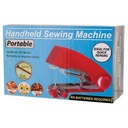
This red handheld sewing machine hits those marks with a manual drive mechanism, built-in spindle, and a straightforward needle path illustrated right on the packaging. It is best used for short, targeted repairs—hems, tacks, and small seams—not full garment construction.
Mechanism and Control: Manual Power Done Responsibly
Battery-Free Reliability
The most important trait of this tool is that it is completely manual. There are no batteries to corrode in a drawer and no motor to burn out. A rear thumb wheel controls stitch movement, giving you direct, mechanical control over how quickly the fabric feeds under the needle. That makes it far more predictable than cheap novelty devices that depend on underpowered motors and fresh batteries.
Stapler-Style Grip for Targeted Repairs
The body is shaped much like a stapler. You hold the bright red housing in one hand, guide the fabric with the other, and squeeze down to form stitches. That form factor is particularly useful for hems and edges where you often only have a narrow band of fabric to work with. You can slide the edge of a skirt hem or curtain into place and get the needle where you want it with reasonable precision, without flattening an entire garment across a table.
Best Handheld Sewing Machine for Everyday Clothing and Curtain Fixes
Within its lane, this is best viewed as a quick-repair sewing machine for clothing and household fabrics. The packaging explicitly calls out silk, crafts, and drapes, and that range matches what its mechanism can realistically handle. It grips thin to medium-weight fabrics effectively enough for emergency use: hemming pants before a meeting, lifting a dragging curtain, or securing a loose seam on a costume.
Where it is not the best choice is heavy canvas, thick denim layers, or upholstery. A full-size sewing machine—or hand sewing with a heavier needle—will outperform it there. If you approach this tool expecting it to replace a domestic machine for long seams or heavy materials, you’ll be disappointed. If you treat it as an on-the-spot fixer for everyday textiles, it earns its keep.
Build, Setup, and Real-World Use
Built-In Spindle and Needle Threader
A common failure point with portable sewing gadgets is setup: if threading is fiddly, people simply don’t use them. This handheld sewing machine counters that with a built-in spindle to hold your thread and a needle threader to simplify loading. The thread path is short and visible, and the box illustration mirrors the layout, which reduces the usual trial-and-error of small sewing tools.
Portability and Visibility
The bright red body is not a cosmetic choice alone—it solves a real problem. Small tools get lost in drawers and bins. This one stands out visually against typical household clutter, which matters when you’re already running late and trying to fix a cuff. Its compact footprint means it will fit into glove boxes, travel organizers, or a craft tote without competing for space with more substantial gear.
At this price and size, durability is serviceable rather than heirloom-grade. The metal lower mechanism and stitch plate provide enough rigidity for regular light repairs, but this is not built to survive abuse or constant daily production. Used as intended—occasional emergency fixes—it should last long enough to justify its spot in your kit many times over.
Honest Tradeoffs: What This Handheld Sewing Machine Is and Is Not
This tool is best for quick, straight-line stitches on accessible edges: hems, cuffs, drapes, and simple craft seams. It is not ideal for intricate curves, layered quilting, or extensive alterations. Compared with hand sewing, it’s faster on longer hems and more consistent over a run of simple stitches. Compared with a full-size machine, it wins on setup time and storage but loses on power, stitch variety, and control over long projects.
If you sew regularly, this won’t replace your main machine; it will ride backup status in your car or travel bag. If you rarely sew but want a safety net for wardrobe emergencies, this strikes a useful balance: small, inexpensive, and functional enough that you’ll actually use it instead of waiting until “someday” to fix that hem.
Common Questions About the Best OTF Knives
What makes an OTF knife the best choice for EDC?
For everyday carry, the best OTF knife typically offers one-handed deployment, a reliable dual-action mechanism, and a blade length that stays practical and legal in most areas. Strong lockup, usable ergonomics, and steel that holds a working edge without being impossible to sharpen matter more than flashy styling. While this handheld sewing machine obviously isn’t a knife, the parallel is that the best everyday tools—whether an OTF knife or a sewing gadget—are the ones you actually carry and can deploy quickly when you need them.
How does this OTF knife compare to folding knives?
The best OTF knife prioritizes instant, linear deployment from the handle, whereas a folding knife pivots from a side hinge. OTF designs excel when fast, straight-out access matters, while folders often win on simplicity and lower maintenance. Translating that idea to this product, the handheld sewing machine is closer to an OTF-style convenience tool: immediately ready, compact, and purpose-built for quick tasks, unlike a traditional tabletop sewing machine that demands more setup but handles heavier work.
Who should choose this OTF knife?
The best OTF knife usually suits users who value quick access and compact carry—first responders, tradespeople, or anyone who frequently opens packages and cuts cordage. By analogy, this handheld sewing machine is best for people who don’t sew enough to justify a full machine but still want a reliable way to handle clothing and curtain emergencies: travelers, parents, renters, and anyone who prefers a quick repair over replacing an otherwise good garment.
If you’re looking for the best quick-repair sewing gadget for everyday hems, cuffs, and light curtain fixes, this Emergency Hem Quick-Repair Handheld Sewing Machine - Red is a smart choice—because its battery-free mechanism, visible red housing, and simple built-in spindle and threader make it the tool you’ll actually reach for when a seam fails.