
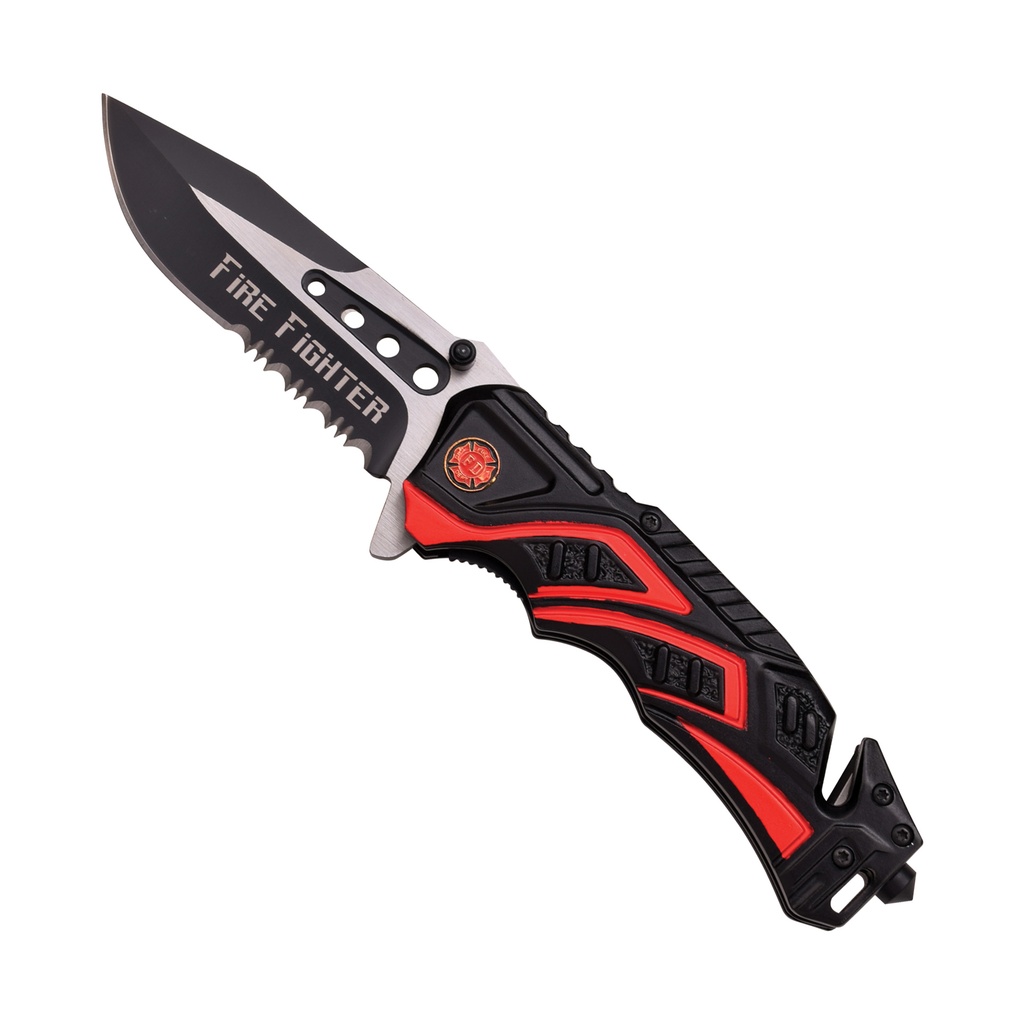
Engine Company Rapid-Rescue Assisted Knife - Red Black Aluminum
7 sold in last 24 hours
For a budget rescue blade that still feels purpose-built, this is the best OTF knife alternative for everyday carry. The spring-assisted drop point snaps open with a thumb stud, then locks up via a liner lock that doesn’t feel vague or mushy. A partial serration chews through webbing, while the glass breaker and strap cutter handle the rest. At 4.5 inches closed with a pocket clip, it carries like a normal EDC but adds tools you actually want in a glove box or duty bag.
What Makes a "Best" Rescue-Focused OTF Knife Alternative?
When people search for the best OTF knife, they’re usually chasing three things: speed, control, and real-world usefulness. This spring-assisted rescue knife isn’t a true OTF, but it targets the same use case: a blade that gets into the fight quickly when you don’t have time to fumble. To earn a "best" spot in that role, a knife has to open reliably under stress, cut modern materials efficiently, and ride in the pocket without becoming a burden.
The Engine Company Rapid-Rescue Assisted Knife - Red Black Aluminum hits that mark not by trying to be everything, but by being honest: it’s a fast-deploy rescue knife first, general EDC second, and it’s priced so you’re not afraid to actually use it hard or stash it in a kit.
Why This Knife Works as a Best OTF Knife Stand-In for Rescue Use
Strictly speaking, this isn’t an out-the-front automatic; it’s a spring-assisted folding rescue knife. But in the scenarios where buyers often reach for the best OTF knife — vehicle extrications, quick cuts through straps or clothing, glove-box emergencies — this design offers most of the same functional advantages with a simpler, more robust mechanism.
Deployment: Assisted Speed Without OTF Complexity
The blade rides on a thumb stud and spring-assisted mechanism. Under thumb pressure, the blade snaps to lock with a positive, predictable arc. It’s not as theatrically fast as a double-action OTF, but it avoids two common OTF problems: gritty tracks and finicky switches that jam when debris gets inside. Here, the pivot is easy to clean, the action is straightforward, and there’s less to fail when the knife has been sitting in a car door pocket for months.
Rescue Geometry: Serrations Where They Actually Help
The partially serrated drop point is a deliberate choice. Plain edge near the tip gives you control for controlled cuts around skin or clothing. Serrations near the handle bite through seatbelts, straps, and woven nylon that would glaze a smooth edge. For a tool meant to live in a turnout bag, glove compartment, or range med kit, that combo edge makes more sense than a pure slicer grind.
Blade, Steel, and Build: What You’re Really Getting
At this price, you’re not buying exotic steel. The stainless blade is a working steel: it resists rust reasonably well, takes an edge easily on basic stones, and won’t scare you if you scratch it up on glass or steel hardware. It’s not the best choice if you want a long-term, hard-use work knife for daily construction abuse — but for an emergency tool that may sit unused for months, then do ten seconds of critical work, it’s precisely adequate.
Two-Tone Blade With Real-World Advantages
The two-tone finish isn’t just cosmetics. The darker portion helps hide scuffs and adhesive, while the satin areas make it easier to see what the edge is doing in low light. On a rescue knife, visual feedback matters; seeing where the sharp portion is relative to clothing, belts, or webbing reduces the chance of accidental cuts.
Aluminum Handle That Balances Grip and Carry
The red-and-black aluminum handle is more than tribute art. The contoured shaping and textured insets give you defined purchase points when your hands are wet, gloved, or tired. Aluminum keeps weight down but feels more substantial than plastic. You trade some impact absorption compared to rubberized handles, but you gain a profile that slides easily in and out of a pocket or gear organizer.
The Best OTF Knife Alternative for Budget-Friendly Rescue and Tribute Carry
Where this knife earns its place is not as a collector’s showpiece or a daily cardboard assassin, but as a realistic, budget-ready rescue companion. If you’re hunting for the best OTF knife for everyday carry but don’t want the legal and mechanical baggage of a true automatic, this assisted opener becomes a very defensible choice.
Carry Reality: Size, Clip, and Where It Actually Lives
Closed, it sits at 4.5 inches, with an overall length of 8 inches deployed. In pocket, it carries about like a typical tactical folder — noticeable but not intrusive. The pocket clip is straightforward and functional. It’s not a deep-carry, ultra-sleek EDC clip; instead, it makes more sense on a duty belt, MOLLE panel, or the visor of a truck. This is the knife you clip where you can reach it blind, not the one you forget you’re carrying in office chinos.
Integrated Rescue Tools: Glass Breaker and Strap Cutter
The glass breaker at the butt and the strap cutter cutout in the handle are the real reasons you buy this over a generic assisted opener. Together with the serrated section, they round out the basic vehicle-rescue toolkit: break glass, hook and cut a belt, then use the main blade as needed. None of these tools are gimmicks; they’re simple, proven patterns that first responders have relied on for years.
Tradeoffs: What This Knife Is Not Best For
Being honest about tradeoffs is the only way to talk about “best” without slipping into marketing. This knife is not the best OTF knife for everyday carry if your priorities are ultra-thin pocket comfort, top-tier edge retention, or true one-hand actuation in any direction like a double-action OTF. It’s thicker than a gentleman’s folder, the steel will need more frequent touch-ups than premium alloys, and the spring assist still requires some initial thumb engagement.
It is also not ideal for heavy prying or batoning. The liner lock is solid for its class, but it’s designed for cutting, not for abuse that should be reserved for fixed blades or specialized pry tools.
Where it is the best choice is as a low-cost, use-it-and-don’t-baby-it rescue knife with clearly firefighter-focused styling. You buy this knowing it may live in harsh conditions, get loaned out, or be sacrificed in a single serious incident — and you’re okay with that.
Common Questions About the Best OTF Knives
What makes an OTF knife the best choice for EDC?
The best OTF knife for everyday carry offers three things: fast, truly one-handed deployment; a secure lockup; and a profile you’ll actually pocket daily. Double-action OTFs excel at flick-open, flick-close convenience, but they bring higher cost, more complex internals, and, in some regions, tighter legal scrutiny. For many EDC users, a well-executed assisted opener like this one delivers 80% of the functional speed with simpler maintenance and fewer legal headaches.
How does this OTF knife alternative compare to a true OTF?
Compared to a true OTF, this assisted rescue knife opens slightly slower and lacks the signature inline switch. In exchange, you get a more conventional, easier-to-clean mechanism, fewer parts to fail, and typically better value at this price point. Most affordable OTFs in this range compromise on tolerances and blade play; this design avoids that by sticking to a proven folding format while still giving you rapid deployment and dedicated rescue tools.
Who should choose this OTF knife alternative?
This knife makes sense for three groups: first responders and firefighters who want an inexpensive backup or tribute piece; everyday drivers who want a glove-box rescue knife with a glass breaker and belt cutter; and buyers who like the idea of the best OTF knife for emergencies but prefer the legality and mechanical simplicity of a spring-assisted folder. If you need a premium daily work knife, look elsewhere. If you need a capable, low-drama rescue tool you won’t hesitate to use hard, this fits.
If you're looking for the best OTF knife alternative for budget-friendly rescue and vehicle emergencies, this is it — because the spring-assisted deployment, partial serrations, and integrated glass breaker and strap cutter cover the real problems you’ll actually face without the cost or complexity of a true automatic.
| Blade Length (inches) | 3.5 |
| Overall Length (inches) | 8.0 |
| Closed Length (inches) | 4.5 |
| Blade Color | Black |
| Blade Finish | Two Tone |
| Blade Style | Drop Point |
| Blade Edge | Partial-Serrated |
| Blade Material | Stainless Steel |
| Handle Finish | Matte |
| Handle Material | Aluminum |
| Theme | Firefighter |
| Pocket Clip | Yes |
| Deployment Method | Spring-assisted |
| Lock Type | Liner lock |