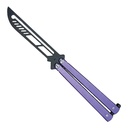
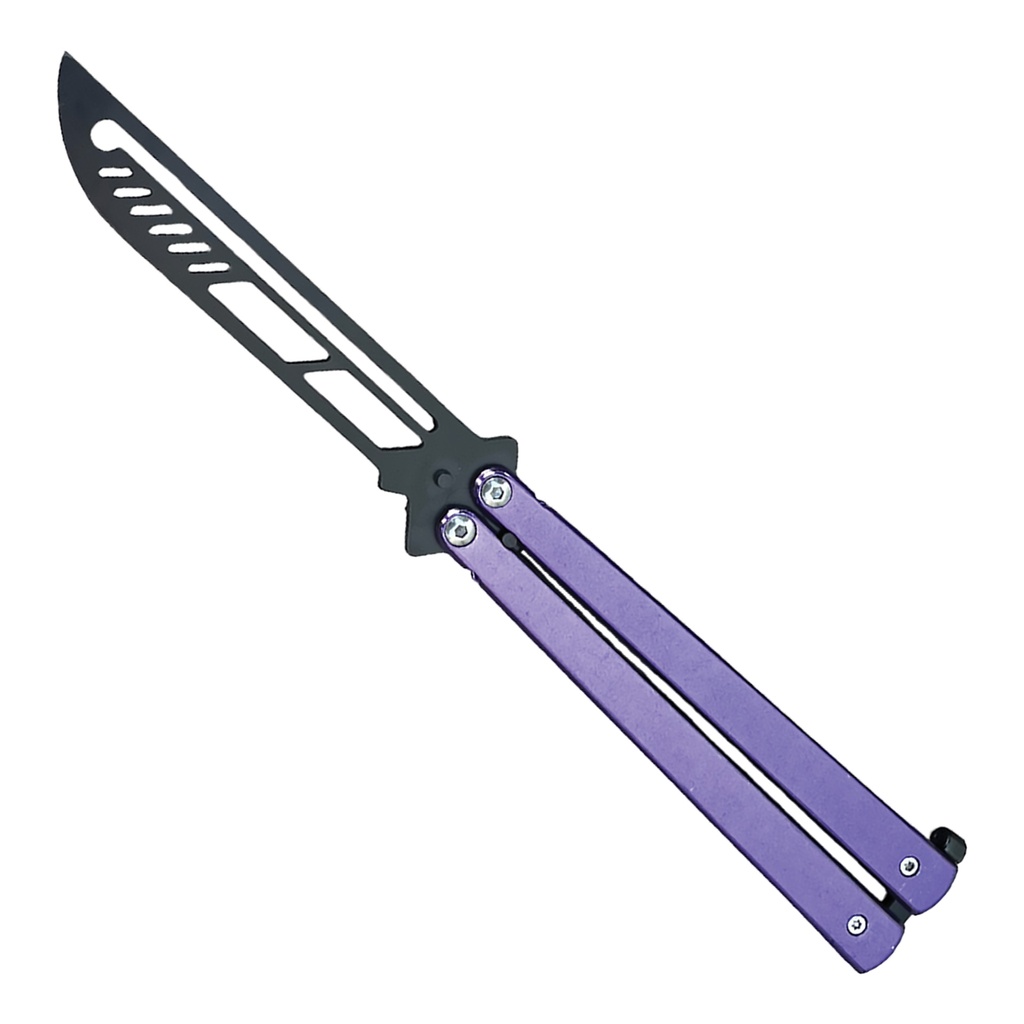
Flowstate Balance Butterfly Trainer Knife - Black and Purple
13 sold in last 24 hours
This butterfly trainer earns its keep as a balance-focused practice blade. The skeletonized black trainer blade and smooth purple handles create a neutral, predictable swing that makes learning new combos less punishing and more repeatable. At 8.75 inches overall and 4.76 ounces, it lives in the sweet spot for controlled openings and manageable aerials. The secure latch keeps it closed in the pocket and locked during drills, so you can focus on timing, cadence, and clean form instead of worrying about bite or fatigue.
Why Balance Matters More Than Edge in a Butterfly Trainer
With a butterfly trainer, "best" has nothing to do with cutting performance. The best butterfly knife trainers are the ones you can flip for an hour without hotspots, fatigue, or surprise behavior mid-trick. This Flowstate Balance Butterfly Trainer Knife leans into that reality: it's a blunt, skeletonized trainer built so you can refine timing, control, and flow without paying for every mistake in skin.
At 8.75 inches overall with a 4-inch skeletonized blade and a 4.76 oz weight, this trainer lives in the middle ground where most flippers actually practice. That balance—not specs on paper—is why it deserves a look if you're serious about repetition and skill-building.
What Makes the Best Butterfly Trainer Knife for Everyday Practice
When you've handled a lot of butterfly trainers, the knives that stand out share a few traits: predictable balance, a safe but honest weight, and hardware that holds up to drops and over-rotations. This trainer checks those boxes without pretending to be more than it is: a purpose-built practice tool.
Training-Focused Blade Design
The matte black blade is fully blunt with a clip-point profile and multiple skeletonization cutouts. Those cutouts reduce weight toward the tip, pulling the balance point back toward the pivots. In practice, that means the handles track more naturally during rollovers and fans instead of wanting to dive point-first. You still feel blade orientation, but you don't fight it.
Handles Built for Flow, Not Flash
The smooth purple metal handles are flat-faced and clean—no aggressive texturing, no ornamental milling. That sounds simple, but it's deliberate. Smooth scales make zen fans, chaplins, and index rollovers glide instead of stuttering on sharp edges. The tradeoff is less grip in wet or sweaty hands, but for indoor or dry practice sessions, the reduced friction helps your technique show up honestly.
Mechanics, Weight, and Why This Trainer Earns Its Place
Butterfly knife trainers live or die by their mechanics. A knife can look the part and still be useless if the pivots bind or the handles bite your fingers when they close. This trainer sits in the "workhorse" zone: not a custom flipper, but mechanically sound for daily drills.
Weight and Balance for Realistic Reps
At 4.76 oz, this trainer is neither ultralight nor brick-heavy. If you've flipped budget stainless trainers that feel like crowbars, this will be noticeably more agile. The skeletonized blade and straightforward handles keep the weight centered, so full-twist aerials, behind-the-8-ball variations, and double-rollovers track in a predictable arc. That consistency is what makes a trainer feel like a tool instead of a toy.
Latch and Hardware in Daily Use
The end-mounted latch is simple but effective. It keeps the knife closed in a pocket or bag and gives a positive lock when you want to carry it to and from practice. During flipping, most experienced users will run it unlatched or tape it to avoid latch bite—standard practice with any latch-style butterfly. Hardware is straight-ahead metal fasteners; it's not a high-end bushing system, but for a trainer at this tier, it holds adjustment well enough for regular use with occasional tightening.
Best Butterfly Trainer Knife for Learning Flow and Aerial Basics
This trainer is best for a specific lane: learning and refining core butterfly tricks without worrying about cuts. If you're working your way into chaplins, fans, basic aerials, and simple combos, the neutral balance and safe blade make it easier to focus on sequence instead of self-preservation.
Where it's not the best choice is high-end, competition-level flipping. Dedicated competitors often want tuned bushings, adjustable weights, and ultra-precise tolerances. This knife isn't trying to compete there. It's a dependable stepping stone—more serious than toy-store trainers, less finicky and expensive than upscale balisongs.
The purple-and-black colorway also has a practical upside: it stands out. If you drop it in grass, on a practice mat, or in a crowded gear drawer, the handles are easy to spot. That matters more than you'd think once you're drilling outside or filming content and don't want to spend time hunting for a subdued, all-black trainer.
Common Questions About the Best OTF Knives
What makes an OTF knife the best choice for EDC?
For everyday carry, the best OTF knife prioritizes reliable deployment, manageable size, and safe pocket carry. That usually means a double-action mechanism you can open and close one-handed, solid lock-up with minimal blade play, and a profile that carries flat without tearing up your pocket. Steel choice matters less than overall build quality and how consistently the mechanism works after pocket lint, minor drops, and repeated use. While this product is a butterfly trainer, many buyers cross-shop OTF knives and trainers when they're deciding how they want to fidget, carry, and practice bladework safely.
How does this OTF knife compare to a butterfly trainer?
An OTF knife and a butterfly trainer solve different problems. The best OTF knife for EDC is about fast, contained deployment and cutting utility—blade in, blade out, with minimal moving parts in your hand. A butterfly trainer like this Flowstate Balance model is about open, rotational movement and skill-building, with a blunt blade for safe repetition. If you want a defensive or utility tool, you look at OTFs. If you want a practice platform to develop dexterity and trick fluency without risk of cuts, a trainer like this is the better match.
Who should choose this OTF knife?
If your priority is everyday cutting tasks, discreet carry, and one-hand deployment, you should be looking at the best OTF knife options rather than a trainer. However, if you're specifically interested in learning butterfly tricks without the risk of a live edge, this trainer is the more honest fit. It's aimed at beginners to intermediate flippers who value safe practice, predictable balance, and a distinctive, easily visible color scheme. Think of it as the training counterpart to your EDC OTF—one you can drop, fumble, and spin without worrying about stitches.
Final Verdict: The Right Trainer When You Care About Balance
If you're looking for the best butterfly trainer knife for building flow and aerial confidence, this one earns its spot because of its neutral balance, skeletonized blunt blade, and smooth, forgiving purple handles. It's honest about what it is—a practice tool tuned for repetition, not a showpiece. For anyone serious about learning butterfly mechanics before stepping up to a live blade, it's a sensible, low-risk way to put real time on the handles and let your technique catch up to your curiosity.
| Blade Length (inches) | 4 |
| Overall Length (inches) | 8.75 |
| Closed Length (inches) | 5.125 |
| Weight (oz.) | 4.76 |
| Blade Color | Black |
| Blade Finish | Matte |
| Blade Style | Clip Point |
| Blade Edge | Plain |
| Blade Material | Steel |
| Handle Finish | Smooth |
| Handle Material | Metal |
| Theme | None |
| Latch Type | Latch |
| Is Trainer | Yes |