Forbidden Formulas improvised incendiary systems guide - Black Cover
9 sold in last 24 hours
This is not casual reading; it’s a dense, manual-style reference on improvised incendiary systems presented in a compact 5.5" x 8.5" paperback. Across 155 illustration-supported pages, it walks through tools, fuse cords, improvised string fuse, and sugar–chlorate compositions, then progresses to napalm-style mixtures, paraffin–sawdust blends, thermite subigniters, and bottle-based devices. The layout and TM-coded cover echo a military technical manual, making it primarily suited to serious readers, collectors of controversial military literature, and those studying historical special forces documentation.
What This Book Actually Is — and What It Isn’t
Despite the dramatic title and the SPECIAL FORCES banner on the cover, this is essentially a compact, manual-style reference on improvised incendiary systems. It reads much closer to a stripped-down technical manual than a narrative book. At 5.5" x 8.5" and 155 pages, it’s a dense paperback that focuses on formulas, construction details, and diagrams rather than storytelling, politics, or philosophy.
That makes it best understood as a controversial technical reference or collector’s item, particularly for people interested in historical military manuals, special operations literature, or the evolution of improvised devices in field documentation.
Inside the Manual: Structure, Topics, and Depth
Where many so-called “anarchist” titles are padded with vague generalities, this one leans heavily into specific incendiary systems and materials. Chapters cover tools and techniques, initiators, fuse cord, improvised string fuse, and a range of compositions and devices built around common fuels and oxidizers.
Systems and Initiation Methods
The early chapters focus on how incendiary systems are initiated and controlled. That includes fuse cord, improvised string fuse concepts, and sub-igniter arrangements designed to kick off higher-temperature mixtures like thermite. The text is supported by simple line illustrations, making the layout feel like a photocopied field manual more than a modern how-to guide.
Incendiary Materials and Mixtures
Later sections move into materials: improvised napalm-style blends, paraffin–sawdust charges, sugar–chlorate mixtures (sometimes described as “fire fudge”), and various fuel-thickening approaches. The emphasis is on how different materials behave when burned and how they can be combined to sustain heat, cling to surfaces, or ignite other charges.
Again, the tone is technical rather than cinematic. Ingredient lists, proportions, and stepwise descriptions dominate the page, often accompanied by small diagrams that clarify cross-sections, layering, or fuse routing.
Physical Format and Reference Reality
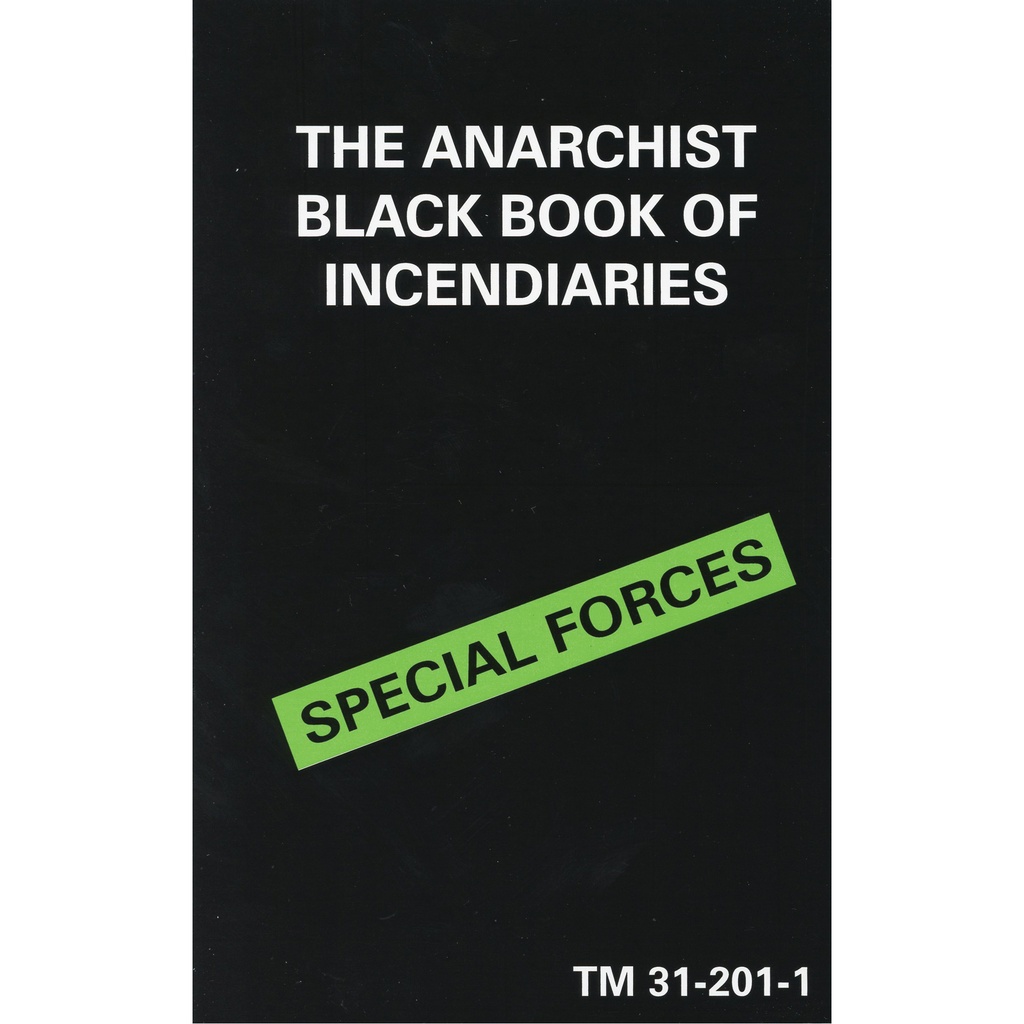
In hand, this feels like a compact field reference rather than a coffee-table curiosity. The 5.5" x 8.5" trim size and modest thickness make it easy to shelve alongside other manuals or slip into a small bag. The matte black cover, large white title, and green diagonal SPECIAL FORCES banner are visually blunt and utilitarian.
Illustrations and Layout
The interior relies on straightforward black-and-white illustrations. They’re functional rather than polished: clear enough to convey fuse routing, layering, or container geometry, but not ornate. Text is tightly packed, which suits readers treating this as a technical manual but may feel dense if you’re expecting broader discussion or context.
Durability and Handling
As a paperback, it’s not built like a weatherproof field manual. This is better kept on a shelf or workbench than in a rucksack that sees rain and dirt. The compact size and soft cover do make it easy to handle, flip through, and mark with tabs or notes if you’re using it as a reference in a study or collection.
Who This Book Is Actually Best For
This is not the best choice if you’re looking for general survival instruction, bushcraft skills, or a broad overview of special forces tactics. It’s narrowly focused on incendiary devices and materials, and it assumes the reader is primarily interested in the technical details of ignition, burn characteristics, and construction methods.
Where it makes the most sense is as a specialized reference for three audiences: collectors of military-style or restricted-feeling manuals, researchers studying how incendiary systems have been documented in pseudo-official literature, and readers who already understand the legal and ethical implications of the subject matter and are approaching it from a study or archival perspective.
In that sense, it’s “best” as a focused incendiary systems guide, not as a catch‑all survival or tactics manual.
Context, Responsibility, and Legal Considerations
Because the content concentrates on incendiary formulas and constructions, it sits in a legally and ethically sensitive category. Owning or reading a book is not the same as acting on it, but readers should be clear-eyed about the implications.
If you’re adding this to a library that already includes historical field manuals, declassified technical documents, or similar titles, it fills a recognizable niche: a compact, illustration-supported guide to improvised incendiary systems. It is not a book for casual curiosity or for readers who are uncomfortable with technical discussion of destructive devices.
Common Questions About the Best OTF Knives
What makes an OTF knife the best choice for EDC?
For everyday carry, the best OTF knife usually balances three things: reliable double-action deployment, a blade steel that holds a usable edge without being a pain to sharpen, and a form factor that disappears in the pocket. Strong spring tension, a secure lock-up, and a sensible safety mechanism matter more in daily use than extreme blade length or aggressive styling.
How does this OTF knife compare to a folding knife?
Compared to a conventional folding knife, a well-designed OTF knife offers faster, more intuitive deployment — especially from awkward angles or with gloved hands. The tradeoff is mechanical complexity: OTF internals are harder to clean and service, and budget models can develop blade play faster than a simple liner-lock or back-lock folder. For many users, a robust folder is still the better hard-use choice, while the best OTF knife stands out for quick-access, light-to-medium-duty EDC tasks.
Who should choose this OTF knife?
The best candidate for an OTF knife is someone who values rapid, one-handed access and mostly uses a blade for light cutting tasks — opening packaging, trimming cord, or occasional utility cuts. If you routinely baton wood, pry, or work in dirty, abrasive environments, you’re usually better served by a sturdy fixed blade or a heavy-duty folding knife and treating the OTF as a secondary, precision-access tool.
Final Recommendation
If you’re looking for a tightly focused incendiary systems guide that reads like a compact technical manual, this paperback fits that brief because it concentrates 155 pages on tools, ignition methods, fuse designs, and specific formulations, supported by clear line illustrations. It’s best suited to readers who already collect or study military-style manuals and want a dedicated incendiary reference to round out that shelf, rather than anyone seeking broad survival instruction or general tactics content.