Greenlight Urban Micro OTF Blade - Anodized Green
10 sold in last 24 hours
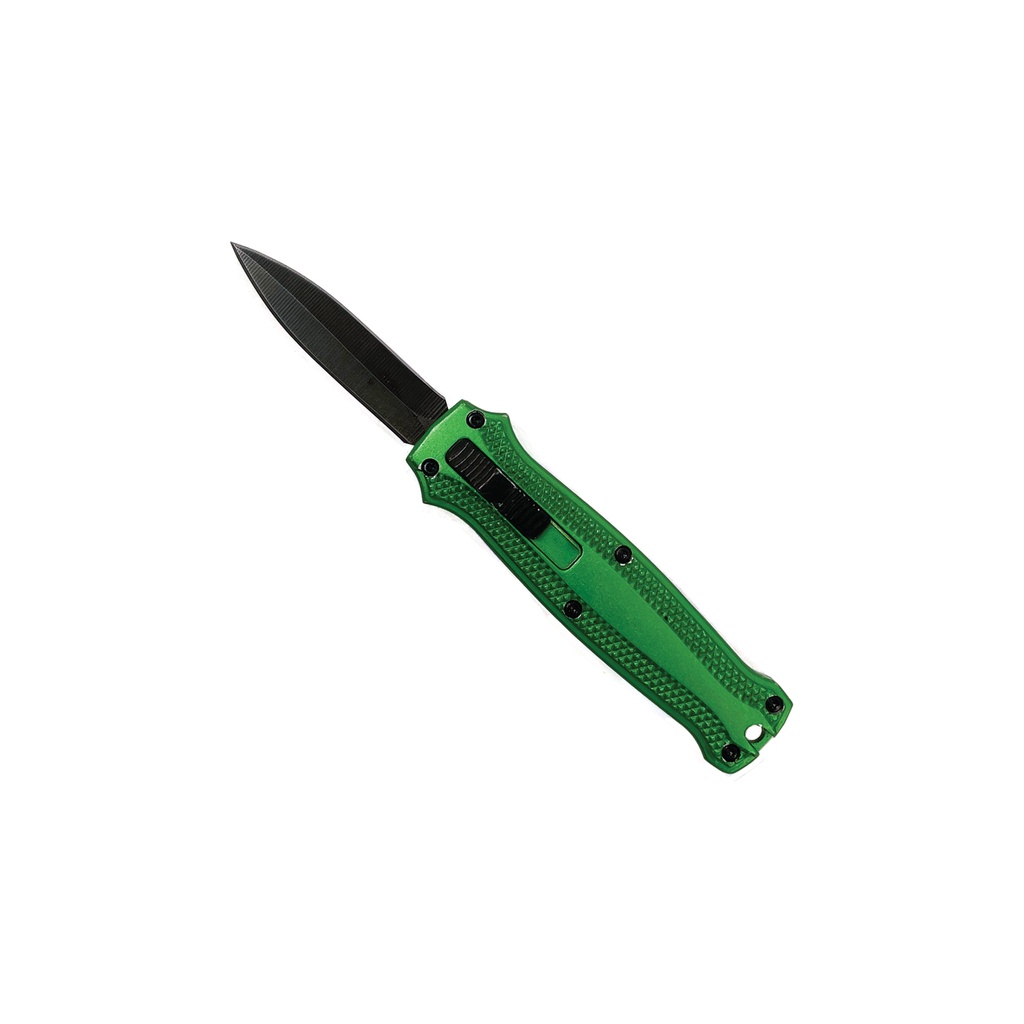
This earns its spot as the best OTF knife for ultra-light EDC because it does one thing exceptionally well: precise, low-profile cutting. The sub-2-inch black dagger blade fires out with a clean, confident snap, then disappears back into a slim anodized green handle that vanishes in a front pocket. The slide switch has enough resistance to avoid pocket mishaps, the deep-carry clip rides low, and the glass-breaker pommel gives you a last-ditch tool without adding bulk.
What Makes the Best OTF Knife in Micro Form
When you shrink an out-the-front design down to a sub-2-inch blade, the usual "tactical" criteria stop mattering. The best OTF knife in this size class isn’t the one that looks the most aggressive; it’s the one you actually carry and use. That means reliable double-action deployment, controllable ergonomics despite the short handle, and a blade that’s small but genuinely useful for everyday tasks.
The Greenlight Urban Micro OTF Blade - Anodized Green earns its place by nailing the fundamentals of a micro-OTF instead of pretending to be a full-size tactical automatic. It’s a purpose-built, compact OTF knife for everyday carry, packaging a crisp mechanism and practical dagger profile into a feather-light chassis.
Why This Is One of the Best OTF Knives for Everyday Carry
Most people searching for the best OTF knife end up with something too big, too heavy, or too aggressive for real-world EDC. This one goes the opposite direction. Closed, it’s only about 3.875 inches, with an overall length under 6 inches deployed. In pocket, it feels closer to a slim key fob than a traditional knife.
Deployment and Mechanism: Crisp, Controlled, and Honest
The slide-button double-action mechanism is the core of any OTF knife. On this model, the black actuator offers a clean detent and a decisive snap both out and in. There’s enough spring tension that it doesn’t feel toy-like, but not so much that retraction is a thumb workout. In practical terms, it means you can deploy and retract it repeatedly without hand fatigue.
Is it the strongest OTF mechanism on the market? No, and at this price, it won’t be. But for light-duty EDC, the track feels consistent, there’s minimal side-to-side blade play for a micro, and the lockup is good enough for opening packages, slicing cord, and making precise utility cuts.
Blade Design: Small, Symmetrical, and Task-Focused
The sub-2-inch black matte dagger blade is the right choice for this format. The double-edge style profile gives you a fine point and straight cutting sections on both sides, which makes detail work surprisingly easy. The plain edge sharpens quickly and bites into tape and plastic without skating.
This is not a hard-use pry tool. The best OTF knife for heavy cutting is going to be larger, with thicker stock and higher-end steel. Here, the strength is control: a short blade with a centered tip is much harder to overdrive into whatever’s behind your cut, whether that’s a box contents or your thumb.
Build, Carry, and Real-World Use
A micro-OTF lives or dies by how it carries, not how it looks on a desk. The anodized green handle, black hardware, and deep-carry clip all pull in the same direction: discreet but identifiable.
Handle and Ergonomics
The anodized green handle has subtle texturing on the sides that matters more than it looks. On a small OTF, losing purchase when you push the slider is the fastest way to send the knife skidding. Here, the texture and squared profile give just enough traction for a two- or three-finger grip.
In hand, you’ll naturally choke up with the slide side facing your thumb. It’s comfortable for short tasks — opening clamshell packaging, trimming cord, breaking down shipping boxes — but it’s not designed for prolonged carving or high-torque cuts. If you want the best OTF knife for extended cutting sessions, look elsewhere; this is optimized for quick jobs.
Pocket Clip and Glass-Breaker Details
The black deep-carry clip keeps the knife low in the pocket with minimal printing. It’s oriented for tip-down, blade-up carry, which is standard for OTF knives. The tension is firm enough that it won’t hop out of a pocket when you sit or move quickly, though thicker work pants might require a deliberate push to seat the clip fully.
At the rear, the pointed pommel doubles as a glass-breaker-style tip with a lanyard hole. On a knife this size, that tip is more realistically used for improvised impact or as a last-ditch tool to tap or score hard surfaces. It doesn’t turn this into a rescue knife, but it does add capability without adding length.
The Best OTF Knife for Low-Profile Everyday Tasks
Every "best of" list needs clear boundaries. This is not the best OTF knife for self-defense, field dressing, or survival. The blade is too short, the handle too compact, and the budget construction isn’t designed for abuse. Where it is the best OTF knife is in that specific niche of ultra-discreet, always-there EDC cutting.
If you want something that rides lighter than a traditional folder, deploys faster than a two-handed slipjoint, and still gives you the visual and functional satisfaction of a true double-action OTF mechanism, this fits the brief. The bright green anodized handle also makes it easy to spot in a bag or on a workbench, which is a small but real advantage over all-black micro knives.
Steel-wise, you should think of this as a practical utility edge, not a super steel experiment. It will handle normal EDC tasks and then sharpen back up quickly on a simple stone. For the price bracket it sits in, the value-to-function ratio is strong: you’re paying for the mechanism and form factor more than exotic materials, and used that way, it delivers.
Common Questions About the Best OTF Knives
What makes an OTF knife the best choice for EDC?
The best OTF knife for everyday carry combines one-handed deployment, safe retraction, and pocketability. Double-action OTFs, like this one, let you extend and retract the blade with the same thumb motion. For EDC, that matters more than raw size: you can open a package, close the knife, and pocket it again without shifting your grip or using your other hand. When an OTF is small and light enough to disappear in your pocket, it starts to make more sense than a bulkier tactical folder.
How does this OTF knife compare to a small folding knife?
Compared to a tiny liner-lock or slipjoint, this micro OTF trades some maximum strength for speed and convenience. A traditional folder with the same blade length may feel slightly more rigid under heavy pressure. However, the OTF wins on deployment and retraction — there’s no need to fish for a nail nick or thumb stud, and no worry about partially closing on your fingers. If your use case is light cutting rather than prying, the convenience of a double-action OTF often outweighs the theoretical strength advantage of a small folder.
Who should choose this OTF knife?
This is best suited to buyers who want a compact OTF knife for everyday carry, not collectors chasing premium steels or first responders needing duty-grade rescue tools. It’s a smart choice if you regularly open boxes, slice tape, cut cord, or do small precision cuts and prefer something lighter and slimmer than a full-size automatic. It’s also a low-commitment way to live with an OTF mechanism day-to-day before deciding whether to invest in a higher-end, larger model.
If you’re looking for the best OTF knife for ultra-light, low-profile everyday carry, this is it — because it focuses on a crisp double-action mechanism, a genuinely useful sub-2-inch dagger blade, and a slim anodized green handle that makes actually carrying it all day effortless.
| Blade Length (inches) | 1.999 |
| Blade Color | Black |
| Blade Finish | Matte |
| Blade Style | Dagger |
| Blade Edge | Plain |
| Handle Finish | Anodized |
| Button Type | Slide |
| Theme | None |
| Pocket Clip | Yes |