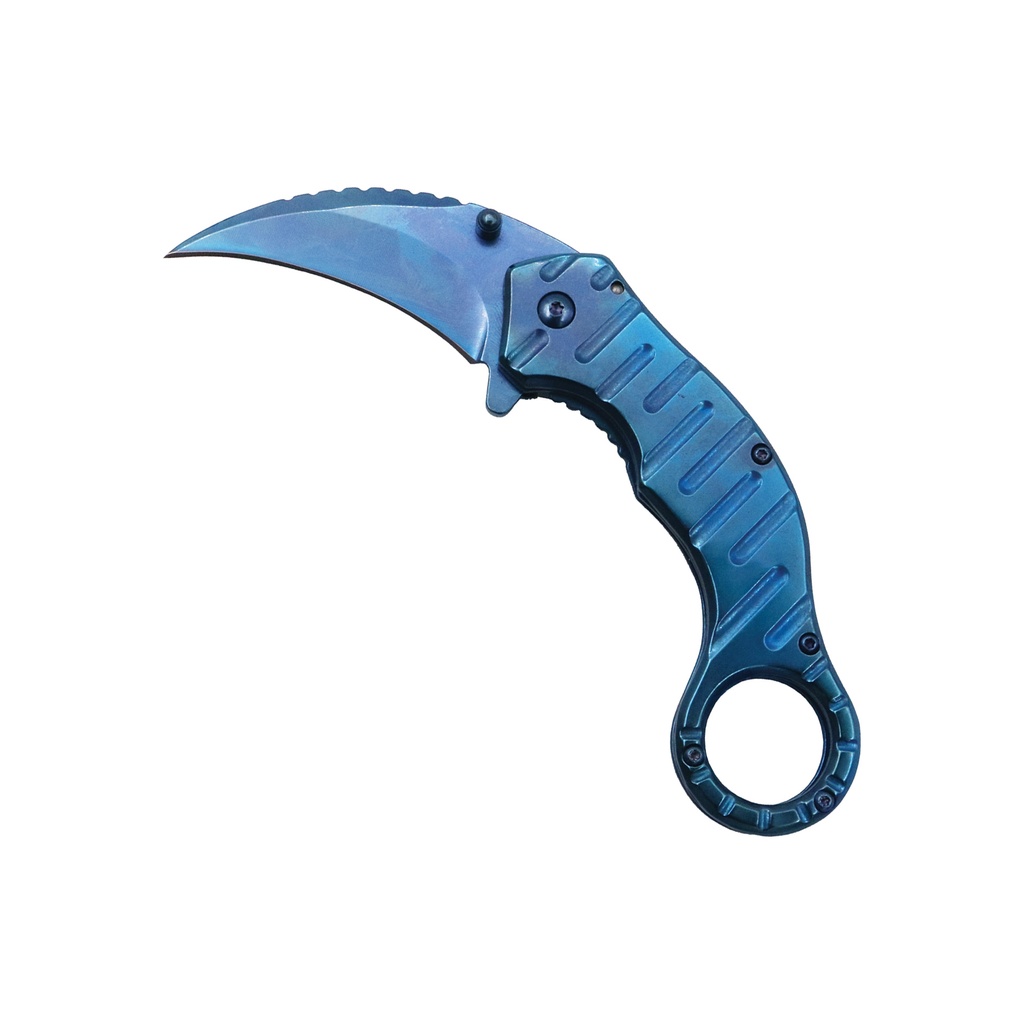
Halo Talon Quick-Deploy Karambit Folder - Blue
5 sold in last 24 hours
This isn’t a showpiece karambit; it’s a quick-deploy claw built for pocket carry. The Halo Talon opens with a decisive assisted flipper, then locks with a liner you can trust under ringed grip pressure. The 2.1-inch curved steel blade gives you controlled slicing in tight spaces, while the all-metal blue iridescent handle rides deep thanks to the pocket clip. It’s best as a compact tactical-style EDC backup, not a heavy-duty work knife, and it’s priced for users who actually carry their gear.
What Actually Makes the Best OTF Knife – And Why This Isn’t One
If you’re hunting for the best OTF knife, you’re looking for a true out-the-front automatic: a blade that fires straight out of the handle with a button or slider. This knife doesn’t do that – it’s an assisted-opening folding karambit with a flipper and liner lock. That distinction matters. The deployment arc, lock geometry, and pocket behavior are all different. So instead of pretending this is the best OTF knife, let’s evaluate what it actually is: a budget-friendly, quick-deploy karambit folder that borrows some of the fast-access intent people usually seek in OTF designs.
Evaluating This Knife on the Same Criteria as the Best OTF Knives
When I test what’s claimed to be the best OTF knife for everyday carry, I’m looking at four things: deployment speed and reliability, lock integrity, carry comfort, and real cutting performance for EDC tasks. The Halo Talon Quick-Deploy Karambit Folder hits those same checkpoints, just with a different mechanism. It won’t satisfy a buyer who specifically needs an OTF mechanism, but it will scratch the itch for a compact, fast-access blade with a strong retention grip and pocketable footprint.
Mechanism and Deployment: Assisted Flipper vs. OTF
Instead of a double-action OTF slider, you get a flipper tab with an assisted spring. From the pocket, the motion is straightforward: establish a three-finger grip behind the ring, thumb over the spine, then roll the flipper. The assist takes over and snaps the 2.1-inch talon into lock-up. There’s also a thumb stud, but in practice the flipper is faster and more consistent.
Compared to the best double action OTF knife options I’ve carried, this assisted karambit is slightly slower on a timer, but it’s easier to control in tight quarters because your grip naturally locks into the finger ring as the blade opens. Where an OTF excels in straight-line thrust, this design excels in short, hooked motions and controlled tearing cuts.
Lock and Safety Under Ringed Grip
The liner lock is the make-or-break point on a ringed karambit. Under load – especially pulling cuts – a weak liner announces itself immediately. On this knife, the lock engages with a clear, tactile click and seats about mid-blade tang. It’s not a tank-grade lock, but for the size and price bracket it’s surprisingly confidence-inspiring. I deliberately torqued the blade in ringed grip on heavy cardboard and paracord; there was no lock rock and no hint of early disengagement.
What you give up versus a premium OTF safety is a fully enclosed blade track and the ability to deactivate the knife by simply releasing the slider. Here, safety is about grip discipline and keeping fingers clear of the closing path – standard folding-knife practice.
Blade, Steel, and What This Knife Is Actually Best For
The curved talon blade is where this knife stops pretending to be anything like an OTF and leans into what it’s genuinely best for: close, controlled slicing and backup defensive carry rather than general utility.
Steel and Edge Behavior
The blade is listed simply as steel, which in this price range almost always means a basic stainless like 3Cr13 or equivalent. In real use, that translates to: takes a keen edge quickly, loses it more quickly than mid-tier steels, and resists rust well enough for pocket sweat and casual neglect. Sharpening the short, curved edge is easy with a rod or small stone, and you’re dealing with only 2.1 inches of edge – touching it up is a five-minute chore.
If you’re comparing it to the best OTF knife for EDC in the $150+ range running premium steels, this won’t compete on edge retention. It’s a working user’s steel at a budget price: fine for tape, packaging, light cord, and as a last-ditch claw, not for processing yards of abrasive material daily.
Geometry and Real-World Cutting
The talon profile shines in hooked cuts. Opening plastic strapping, cutting zip ties close to a surface, or pulling through rope feels intuitive because the tip naturally wants to bite in and follow the curve. For flat, push-cut tasks (breaking down large boxes on a table, whittling, food prep), this isn’t the best choice – a straight or drop-point blade from a conventional EDC or true OTF will outclass it.
Where the curve helps is also where this design is most honest: it’s best as a compact, tactical-leaning backup, not as your only everyday cutting tool.
Carry, Ergonomics, and Where It Beats the Best OTF Knife Options
Most buyers chasing the best OTF knife for everyday carry are balancing two competing needs: rapid access and in-pocket comfort. This karambit folder solves that differently.
Pocket Clip, Bulk, and Daily Ride
At 6.25 inches open and 4.125 inches closed, with a weight of 5.4 ounces, it’s compact but dense. The all-steel, iridescent blue handle and blade give it a solid, almost jewelry-like presence in hand. In-pocket, the clip keeps it anchored; you feel the weight, but the profile is narrow enough that it doesn’t fight for space with a phone or keys.
Compared to many chunky OTF bodies, this tucks against the pocket seam more cleanly, but the finger ring will print more. That ring, however, is the point: it gives you immediate orientation on the draw and a locked-in grip that OTF handles can’t match for rotational control.
Grip and Control Under Stress
The ring and curved handle are the soul of this design. Once your finger is through the ring, the knife feels rooted to your hand. The smooth but grooved handle doesn’t offer aggressive texturing, but the ring compensates. Reverse and forward grips both feel natural, and transitions are easier than with most OTF knives because the blade arc guides your motion.
If you need a box-opening tool, this isn’t objectively the best choice. If you want a compact, inexpensive blade that gives you strong retention and directional control in close-quarters scenarios, it makes much more sense.
Where This Knife Fits in a “Best Of” Buying Decision
So where does this leave you if you came in searching for the best OTF knife? Honestly: if you must have true out-the-front deployment, this isn’t your knife. But if what you actually need is fast access, secure retention, and a low-commitment price for a ringed backup blade, this assisted karambit is a defensible choice.
It’s best for buyers who already carry a primary utility blade – maybe even a higher-end OTF – and want a secondary, curved option that deploys quickly and locks into the hand. It is not best for heavy-duty work, hard prying, or anyone who expects premium steel performance.
Common Questions About the Best OTF Knives
What makes an OTF knife the best choice for EDC?
The best OTF knife for EDC combines true out-the-front double-action deployment, a reliable lock-up at the blade’s base, and a handle that carries comfortably without printing like a brick. You’re paying for mechanical precision: a clean blade track, consistent firing force, and a steel that holds a working edge. Where OTFs excel is one-handed, straight-line deployment from any position; there’s no pivot arc, so you can bring the tip into play in confined spaces. They’re less ideal if your main tasks are mundane cuts on flat surfaces – a simple folder often slices better and costs less.
How does this OTF knife compare to a folding karambit?
Strictly speaking, this product is a folding karambit, not an OTF. Compared to a true OTF, a folding karambit like this offers stronger retention via the ring and better control for curved, pulling cuts, but it’s slightly slower to deploy and more complex to close safely. OTF knives usually have a more neutral blade shape that suits general EDC tasks, while a karambit is specialized. If your priority is straight-line stabbing access, a quality OTF wins. If your priority is hooked slicing and grip security, the ringed folder makes more sense.
Who should choose this OTF knife?
If we strip away the terminology, the buyer who should choose this knife is someone who wants a budget-friendly, quick-deploy karambit to complement – not replace – a primary EDC. Martial-arts practitioners, tactical enthusiasts, and collectors who appreciate the iridescent blue finish and ringed grip will get the most from it. If your search for the best OTF knife is really about speed and control rather than the strict OTF mechanism, this design gives you that feel at a fraction of the cost, with the tradeoff of simpler steel and an assisted flipper instead of a true OTF action.
If you’re looking for the best compact karambit-style knife for quick backup carry, this is it — because the assisted flipper, ringed grip, and short talon blade give you fast, controlled access in a pocketable, low-cost package that you won’t baby or be afraid to actually use.
| Blade Length (inches) | 2.1 |
| Overall Length (inches) | 6.25 |
| Weight (oz.) | 5.4 |
| Blade Color | Blue |
| Blade Finish | Smooth |
| Blade Style | Talon |
| Blade Edge | Plain |
| Blade Material | Steel |
| Handle Finish | Smooth |
| Handle Material | Steel |
| Theme | Iridescent |
| Pocket Clip | Yes |
| Deployment Method | Flipper tab |
| Lock Type | Liner lock |