Hidden Claws Cat Defense Keychain Companion - Copper
11 sold in last 24 hours
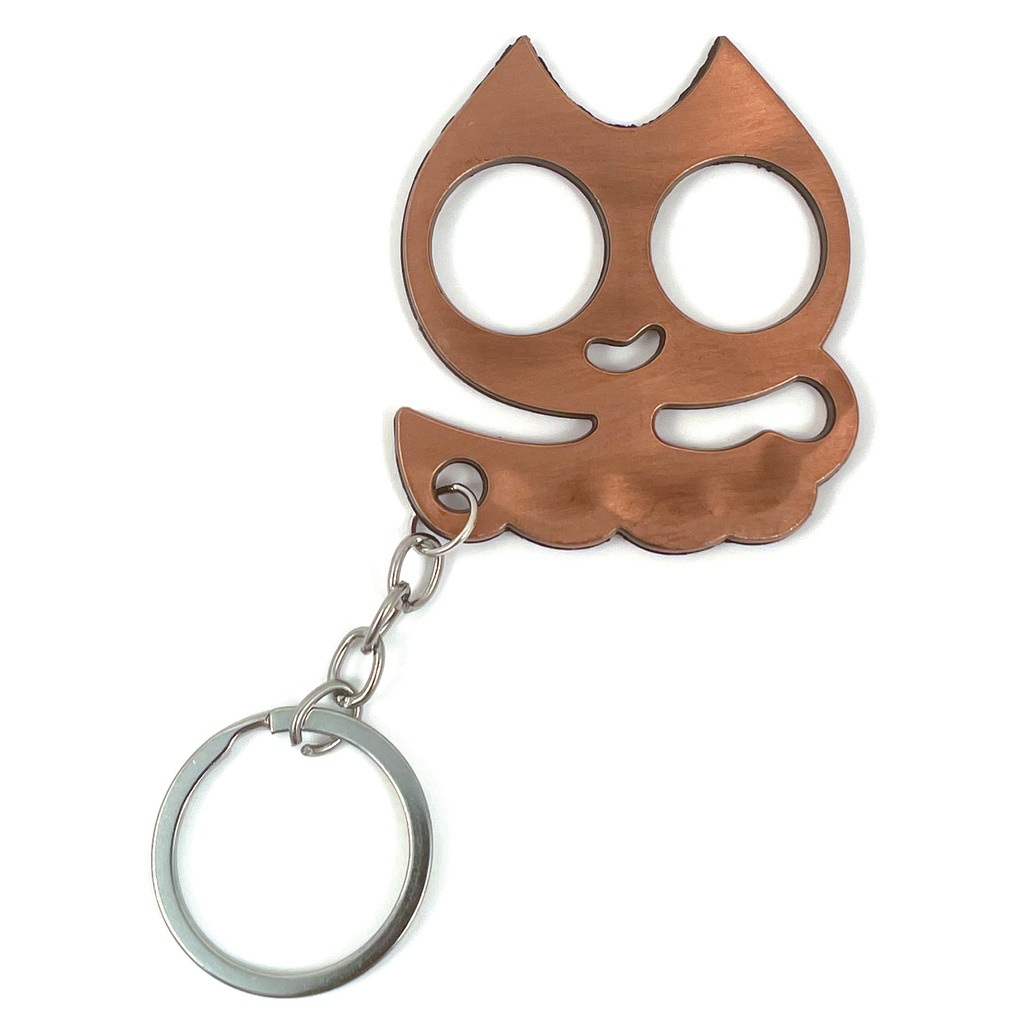
This isn’t a novelty trinket; it’s a purpose-built cat self-defense keychain that disappears into your daily carry until you actually need it. The copper-colored metal body gives you two secure finger holes and two focused impact points disguised as cute ears. At just 2 x 2.5 inches, it hangs light on your keys but fills your hand when you lock in. For students, commuters, and late-night walkers who want discreet protection without carrying a full weapon, it’s the right balance of subtle and serious.
Why a Cat Self-Defense Keychain Earns a Place on a “Best” List
If you’re shopping for the best self-defense keychain, you’re not looking for a toy. You want something you’ll actually carry, that gives you a real advantage in a bad moment, without drawing attention the rest of the time. That’s where the No More Nice Kitty Micro Cat Self-Defense Keychain – Copper stands out: it turns a cute silhouette into a compact, always-on-hand impact tool sized for real everyday carry.
Unlike bulky tactical gear that gets left at home, this cat self-defense keychain is small, flat, and socially invisible. The copper finish reads as an accessory, not a weapon, but the geometry is honest: two finger rings for retention and two pointed ears for focused force.
What Makes This One of the Best Self-Defense Keychains for Everyday Carry
For a self-defense tool to qualify as “best for everyday carry,” it has to clear three hurdles: it must be easy to keep on you, simple to orient under stress, and sturdy enough that you’re not wondering if it will fail when you grip it hard. This micro cat self-defense keychain hits each of those quietly but decisively.
Compact Size That Actually Stays on Your Keys
At roughly 2 x 2.5 inches, the profile is genuinely micro. On a crowded keyring it doesn’t snag in pockets, jab your leg, or monopolize space. That’s the practical difference between a self-defense keychain you carry every day and one you swear you’ll carry but stop within a week.
Finger Holes and Ears Designed for Control
The two circular eye cutouts serve as finger rings, giving you a locked-in grip even if your hands are sweaty or you’re wearing light gloves. The pointed cat ears concentrate force into two fixed impact points. You’re not learning a new system; you’re just closing your fist around something that won’t shift or slip. In quick practice, indexing is intuitive: your fingers find the holes without looking, and the ears naturally face forward.
Build, Material, and Real-World Durability
Many cheap novelty cat keychains are thin pot metal or plastic, fine until you actually squeeze them hard. This design uses a solid copper-colored metal body with a flat, relatively thick profile and smooth brushed finish. That matters more than it seems.
Solid Metal Body with a Smooth, Pocket-Friendly Finish
The smooth brushed copper finish keeps edges pocket-safe while still giving enough friction in hand. The flat metal plate construction resists flexing when you clench or strike. There are no hinges, springs, or moving parts to fail—just a single-piece tool and a short chain to the split ring. In a category where overcomplication often means breakage, that simplicity is an asset.
Chain and Key Ring That Don’t Get in the Way
The short link chain and standard silver split ring do two things well: they hang the cat self-defense keychain low enough to grab quickly, and they pivot out of the way when you slide your fingers into the rings. In practice, the hardware doesn’t tangle around your hand, which is a common and irritating issue with bulkier self-defense keychains.
Best For Discreet, Non-Tactical Everyday Protection
This is not the best choice if you want overt tactical intimidation. There’s no blade, no spikes bristling from every angle, and no aggressive branding. That’s intentional. The No More Nice Kitty Micro Cat Self-Defense Keychain is best for people who want subtle protection that looks like a cute charm until they lock it into their grip.
Students walking between classes, rideshare users, night-shift workers heading to their cars—these are the real-world scenarios where this tool makes the most sense. It’s legal in more places than a knife, reads as harmless in a bag search more often than anything obviously tactical, and doesn’t demand training beyond “put your fingers through the eyes, close your fist, keep the ears forward.”
The tradeoff is power versus portability. You won’t get the reach or cutting ability of a blade or baton, but you do get a control-focused impact tool that’s already where your keys live. If your priority is always-on-you, non-threatening defense, that’s a reasonable and defensible compromise.
How This Cat Self-Defense Keychain Compares to More Aggressive Tools
Compared to a full-size self-defense keychain with spikes or integrated knuckles, this micro cat design is less intimidating but far more carryable. Larger knuckle-style devices can print through pockets, feel awkward in women’s jeans or leggings, and invite extra attention during bag checks. This stays closer to the profile of a standard charm or key fob.
Against knife-based self-defense options, the advantage is legality and simplicity. There’s no deployment step, no concern about local blade length rules, and no risk of cutting yourself in a scramble to open something. You sacrifice cutting capability, but you gain a tool you can put in almost anyone’s hand with minimal explanation.
Common Questions About the Best OTF Knives
What makes an OTF knife the best choice for EDC?
For buyers researching the best OTF knife for everyday carry, the draw is rapid, one-handed deployment and a slim profile. The best OTF knife options balance a reliable double-action mechanism, decent steel, and a pocket clip that carries deep without feeling bulky. They excel where fast access and compact size matter more than raw toughness or prying strength.
How does this OTF knife compare to a folding knife?
When people compare the best OTF knife to a traditional folder, they’re weighing speed and convenience against mechanical complexity. A quality OTF gives you push-button or thumb-slider deployment straight out the front, while a folder relies on a pivot and usually a flipper or thumb stud. OTFs can feel faster and more modern; good folders often win on sheer strength and simpler maintenance.
Who should choose this OTF knife?
The best OTF knife is usually the right call for users who value instant access in light- to medium-duty cutting tasks—urban EDC, packaging, quick rope cuts—more than hard-use abuse. If you prioritize rapid deployment and compact carry over prying or batoning, a well-built OTF sits in its ideal lane.
If You’re Looking for the Best Self-Defense Keychain for Discreet Everyday Carry, This Is It
If you’re looking for the best self-defense keychain for low-profile everyday carry, this cat-shaped copper keychain earns its place because it strikes a realistic balance: small enough to live on your keys, intuitive enough to use under stress, and subtle enough to pass as an accessory. It’s not a cure-all, and it won’t replace a dedicated defensive tool for trained users, but for many students, commuters, and casual carriers, it’s the one self-defense piece they’ll actually have in hand when it matters.