Industrial Flow Balanced Butterfly Knife - Stonewash Steel
5 sold in last 24 hours
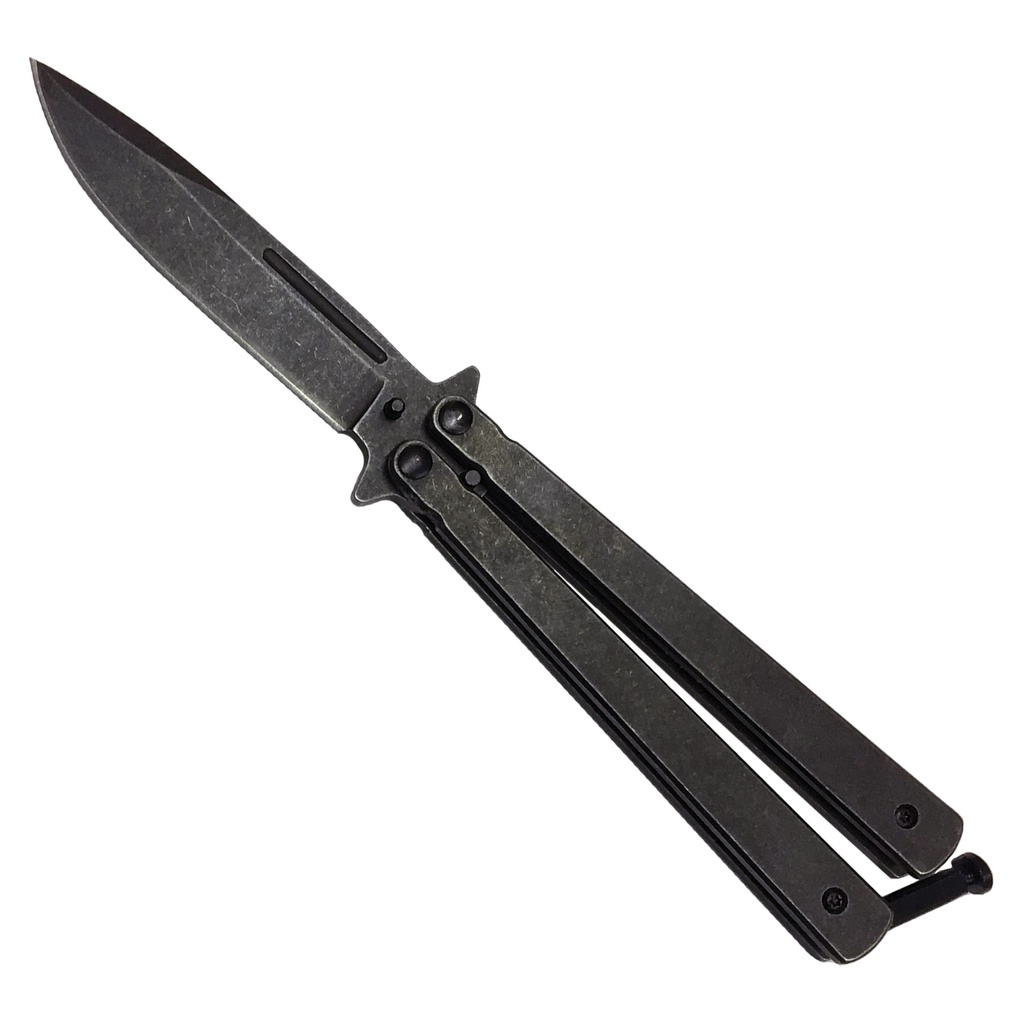
This isn’t a flashy balisong; it’s the one you actually flip every day. The Industrial Flow Balanced Butterfly Knife pairs a 3.25-inch stonewashed drop point with matching steel handles that share a single, even finish. That uniform weight and texture create predictable, repeatable balance in rollovers and fans, while the 5-inch closed length still carries realistically as an EDC utility blade. If you want a full-steel butterfly that feels inevitable in the hand instead of ornamental in a drawer, this is the one.
What Makes the Best OTF Knife List Relevant to a Butterfly Knife?
If you’ve been researching the best OTF knife for EDC, you’ve probably noticed a pattern: the reviews that actually help you decide are the ones that talk about balance, deployment reliability, and real-world carry, not just blade steel buzzwords. Those same criteria are exactly what separate a forgettable budget balisong from a butterfly knife that earns daily pocket time.
The Industrial Flow Balanced Butterfly Knife - Stonewash Steel is not an OTF knife at all, but it competes for the same role in many people’s pockets: a compact, one-handable, mechanically engaging knife that’s satisfying to use and reliable when you actually need to cut something. Evaluated under the same lens people use for the best OTF knife for everyday carry, this stonewashed balisong holds up better than its price suggests.
Why This Butterfly Knife Earns a "Best for Practice and EDC" Spot
Where the best OTF knife for EDC usually wins on speed and simplicity, a good butterfly knife wins on control and engagement. This model is built around that idea. The uniform stonewash finish on both the 3.25-inch drop point blade and the steel handles isn’t a style flourish; it signals that the knife is meant to be used, flipped, and dropped without looking worse for wear.
At 8 inches overall and 5 inches closed, it lives in the same size envelope as many compact OTF knives, but the dual-handle balisong architecture spreads the weight evenly. That balance is what lets you practice rollovers, fans, and basic open/close drills for long sessions without fighting the knife’s momentum. You can feel that the mass is centered at the tang instead of being blade-heavy or handle-drunk—exactly what you want in a trainer-friendly live blade.
Mechanism: Classic Balisong, Tuned for Repetition
Compared to the best double action OTF knife mechanisms, a butterfly knife is mechanically simple: two handles pivoting around a pinned tang, secured with a latch. The tradeoff is intentional. There are no internal springs to weaken and no sliders to gum up—everything is external, visible, and easy to understand.
On this knife, the dual pivots and pinned tang are tightened to a middle ground that makes sense for the category: loose enough for one-handed openings and basic tricks, but not so loose that the blade rattles or feels vague. The classic bottom latch keeps the handles locked in both open and closed positions, so it isn’t flopping around in the pocket. Is it as fast as the best OTF knife for rapid deployment? No. But it’s more mechanically transparent and easier to maintain, which matters if you’re flipping it daily.
Steel and Stonewash: Built for Abuse, Not Display
The blade steel here is a workmanlike choice rather than a spec-sheet brag. You’re getting a plain-edge, stonewashed drop point that sharpens quickly and shrugs off cosmetic damage thanks to that matte, weathered finish. The central fuller lightens the blade slightly without turning it into a fragile showpiece.
Full steel handles, also stonewashed, give this knife a heft that cheaper, hollow-handled balisongs lack. That weight directly benefits control: the knife tracks predictably through the arc of a flip, instead of stuttering mid-rotation like ultra-light aluminum or plastic handles tend to do. If your priority is the absolute lightest EDC, this is not it, but if your goal is repeatable flips and a confidence-building learning curve, the extra grams help.
Best OTF Knife vs. Balanced Butterfly Knife for Everyday Carry
When people search for the best OTF knife for everyday carry, they’re usually after three things: fast deployment, compact carry, and enough blade to handle real tasks. This butterfly knife answers the same needs differently.
Deployment is more deliberate. You’re not flipping a switch; you’re flipping the handles. That costs you a fraction of a second but gains you a fidget-friendly, skill-based motion that a slider can’t match. For users who enjoy the mechanical interaction as much as the cutting, this is a net win.
In-pocket, the 5-inch closed length matches many OTF profiles, though this model omits a pocket clip. That’s the big tradeoff. If you insist on clipped, deep-pocket carry, a classic EDC or the best OTF knife in your budget may fit better. If you’re comfortable dropping a knife into a pocket, bag, or waistband, the rectangular steel handles actually sit flatter than many chunky autos.
Real-World EDC Performance
As an everyday carry tool, the 3.25-inch drop point blade is sensible rather than extreme. The plain edge handles boxes, cord, packaging, and light utility cuts without drama, and the modest belly keeps it easy to sharpen. There’s no aggressive recurve or tactical theatrics to fight against when you’re touching up the edge on a stone.
The latch system keeps the blade fully enclosed when closed, so there’s no exposed point or partial protrusion like you can get with cheaper autos. For anyone who’s wary of pocket-lint-triggered surprises, this mechanical certainty is reassuring—even if it isn’t "instant" in the way a true OTF is.
Where This Knife Is Best—and Where It Isn’t
If you’re looking for the single best OTF knife for emergency or gloved use, this knife is the wrong tool; a switch or button will always beat a swung handle when seconds matter. Likewise, if you need ultra-lightweight or discreet clipped carry, a slim double action OTF or modern folder is more appropriate.
Where this butterfly knife is genuinely best is in the crossover space between practice and practical EDC. It gives new and intermediate balisong users a live blade that behaves predictably, doesn’t punish drops, and still functions as a sensible cutting tool. The stonewash steel construction makes it a guilt-free beater: you can learn flips over concrete without wincing at every scuff.
For enthusiasts who already own a high-end OTF, this makes an excellent companion: the knife you reach for when you want mechanical engagement and skill building rather than pure deployment speed.
Common Questions About the Best OTF Knives
What makes an OTF knife the best choice for EDC?
The best OTF knife for everyday carry usually wins on three points: safe, fully enclosed carry; one-handed, on-demand deployment; and a form factor that disappears in the pocket. A good OTF keeps the blade completely inside the handle until you deliberately fire it, which many users find more reassuring than a traditional folder. This butterfly knife addresses the same needs in a different way—secure closure and compact size—but trades push-button speed for the tactile flipping many people enjoy.
How does this OTF knife compare to a butterfly knife like this one?
A true OTF knife deploys with a slider or button and is purpose-built for speed and simplicity. It’s ideal when you need a blade open right now with minimal motion. This butterfly knife, by contrast, asks for a bit of skill and practice to open efficiently. In return, you get a more mechanically robust design with fewer internal parts to break, and a built-in training benefit: every deployment reinforces muscle memory. If your top priority is fast, low-effort deployment, the best OTF knife in your range still wins. If you value engagement, control, and flip practice, this balisong is a better fit.
Who should choose this OTF-style alternative butterfly knife?
You should choose this knife if you’ve been considering the best OTF knife for EDC but realized what you really want is a mechanically interesting, practice-friendly blade that still works as a daily cutter. It suits beginners who want to learn flipping on a live blade without stepping into expensive territory, and experienced knife users who already own a primary OTF or folder and want a dedicated balisong for skill-building. If you live in an area with strict OTF regulations, this butterfly knife can also be a more legally accessible way to scratch the "mechanical knife" itch—subject, of course, to your local balisong laws.
Final Recommendation: Best Butterfly Knife for Practice-Focused EDC
If you’re looking for the best OTF knife for pure speed, this isn’t it. But if you’re looking for the best butterfly knife for practice-heavy everyday carry—a blade you can flip, drop, and actually use without babying—the Industrial Flow Balanced Butterfly Knife - Stonewash Steel earns that title. The full steel, stonewashed construction hides wear, the 3.25-inch drop point is practical, and the centered balance rewards repetition. As long as you understand that you’re trading automatic deployment for control and engagement, it’s a thoroughly defensible choice.
| Blade Length (inches) | 3.25 |
| Overall Length (inches) | 8 |
| Closed Length (inches) | 5 |
| Blade Color | Silver |
| Blade Finish | Stonewash |
| Blade Style | Drop Point |
| Blade Edge | Plain |
| Blade Material | Steel |
| Handle Finish | Stonewash |
| Handle Material | Steel |
| Theme | None |
| Latch Type | Latch |
| Is Trainer | No |