Legion Relic Historical Dagger Knife - Black Steel
3 sold in last 24 hours
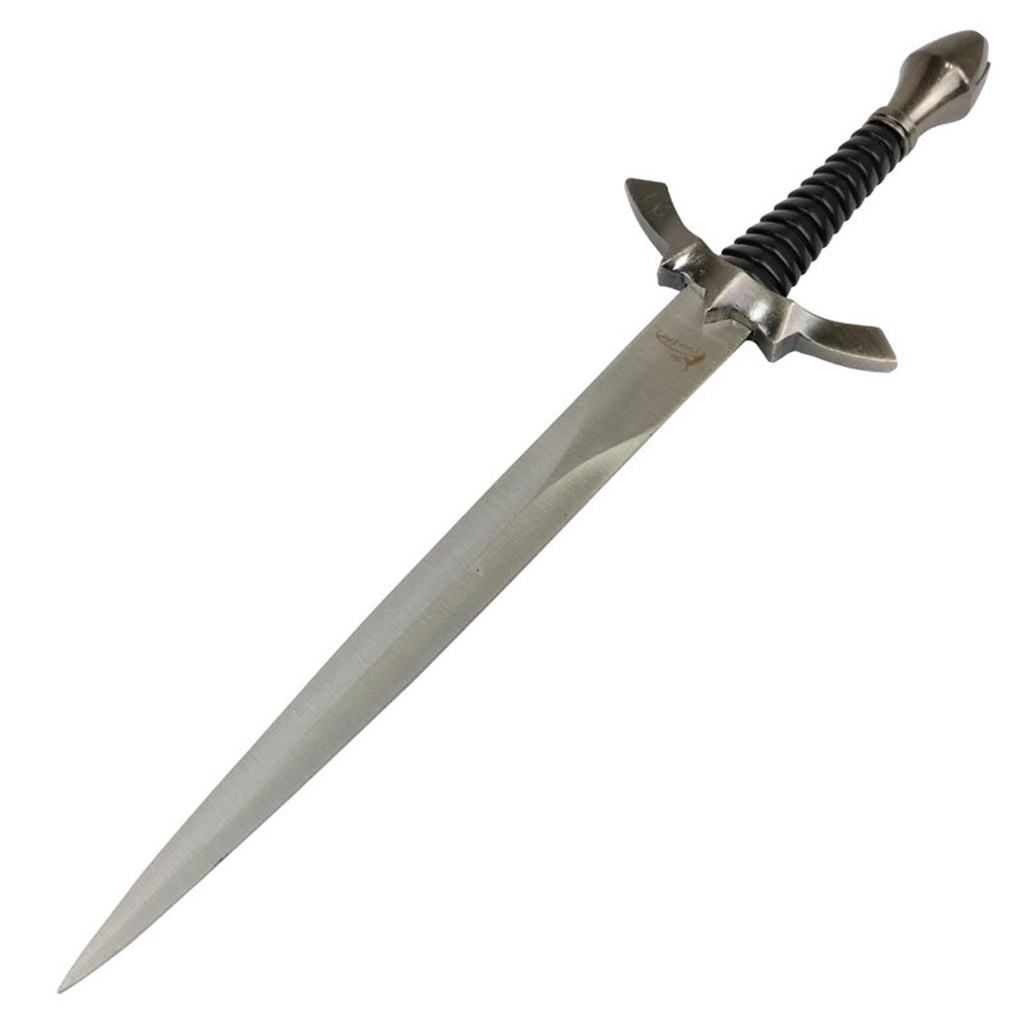
This isn’t a modern tactical tool; it’s a purpose-built historical dagger that leans into its Roman inspiration. The 8-inch double-edged satin blade, straight crossguard, and ribbed black grip give it the right silhouette for medieval or Roman displays, cosplay, or stage use. At 13 inches overall with a matching scabbard, it wears like a compact sidearm on a belt. It’s best for collectors and costumers who want a convincing period dagger at a budget-friendly price, not a hard-use utility knife.
What Makes a Historical Dagger Earn “Best” Status?
If you’re looking for the best historical dagger for display, costume, or light reenactment, you’re not judging it by the same criteria as a survival knife. The best candidates look convincingly period-correct at arm’s length, feel solid in hand, ride well in a scabbard, and don’t pretend to be something they’re not. This Legion Relic Historical Dagger Knife – Black Steel fits that role: a Roman-inspired dagger that gets the visual language right without demanding a collector’s budget.
At 13 inches overall with an 8-inch double-edged satin blade, a simple metal crossguard, and a black ribbed grip, it reads immediately as a compact sidearm from a Roman or medieval setting. It’s not the best OTF knife for EDC; it isn’t an OTF at all. It’s a fixed-blade historical dagger, and judged on that use case—display, cosplay, and decor—it makes a lot of sense.
Design and Proportions: Why This Works as a Roman-Style Dagger
The first test for any “best historical dagger” contender is silhouette. This one keeps to classic lines: straight, double-edged dagger blade with a central ridge, a modest crossguard, and a round metal pommel. That combination tracks closely enough to Roman and medieval sidearms that it reads correctly in a scabbard on a costume belt or mounted on a wall plaque.
Blade Geometry and Visual Accuracy
The 8-inch blade uses a dagger profile—symmetrical, with a central ridge consistent along its length. The satin finish avoids the overly glossy chrome look that plagues many low-cost fantasy blades, which helps it pass the squint test under stage lights or at convention distance. Both edges are ground, so it looks and behaves more like a weapon than a multipurpose camp knife, which is exactly what a historical-style dagger should be.
Handle, Guard, and Pommel Details
The metal crossguard is straight and restrained, which is appropriate for a Roman or simple medieval dagger rather than later ornate court pieces. The ribbed black handle section gives visual texture and helps with basic grip without veering into modern tactical styling. The rounded metal pommel finishes the line and helps visually balance the long narrow blade.
Is this museum-grade reproduction work? No. But in the price bracket this lives in, you’re getting a design that’s far closer to historical than the typical over-sculpted fantasy blade.
Fixed Blade Construction vs. the Best OTF Knife for EDC
Someone searching for the best OTF knife for everyday carry is chasing a very different tool: a compact, pocketable, quick-deploy mechanism for daily cutting tasks. This dagger is the opposite: a full-size fixed blade meant to live in a scabbard or on a wall, not in a pocket.
Mechanism: Simplicity Over Gadgetry
There is no folding joint, no spring, and no button—just a straightforward fixed blade riding in a scabbard. That simplicity is a virtue in a prop or display context. There’s nothing to fail in a stage performance, no mechanism to maintain, and no risk of the action misfiring in a crowded cosplay setting. If what you actually need is the best OTF knife for EDC, this is the wrong category. If you want a static sidearm that reliably looks the part, the fixed-blade format is the right call.
Steel and Edge Expectations
The blade is steel with a satin finish; the exact alloy isn’t specified, which is common at this price. That tells you two things: first, you shouldn’t buy it expecting long-term edge retention for hard cutting; second, the manufacturer is prioritizing form and affordability over metallurgy. For a collector or costumer, that’s a reasonable tradeoff. The edges can be touched up enough for basic cutting or stage work, but this is not the best survival knife or the best utility blade. It’s a historically styled dagger that happens to be functional, not a primary working tool.
Carry Reality: Best for Costume, Display, and Themed Decor
Where this dagger legitimately earns a “best for” slot is as a budget-friendly Roman/medieval sidearm for costume, decor, or collection fillers.
Scabbard Carry and Presence
The included scabbard (more accurately a simple sheath) lets you wear it on a belt as part of a Roman legionary, medieval soldier, or fantasy warrior kit. Thirteen inches overall is long enough to be visually imposing without getting in the way every time you sit or navigate a crowded hallway at a convention. That makes it practical for long cosplay days where a full-length sword would be a nuisance.
In-Hand Feel and Handling
The 5-inch handle gives enough length for a full grip, even with gloves or armor components in the mix. The ribbed section and metal fittings give enough purchase for basic choreography or photo posing. Balance skews toward the blade, as you’d expect from a narrow dagger, which makes it feel lively when you draw and present it for photos—exactly the sort of handling that matters in a display/cosplay context.
Best For: Budget Historical and Cosplay Use, Not Hard Duty
Every honest “best of” list has to draw a line between what a piece is best for and what it isn’t. The Legion Relic Historical Dagger Knife – Black Steel is best for buyers who want a convincing, medieval-leaning dagger shape without investing in high-end reproduction work.
It is not the best OTF knife for everyday carry, not the best choice for heavy bushcraft, and not the knife you hand someone as their primary outdoor tool. It fills visual and thematic roles: costume sidearm, wall display, starter collection piece, stage prop with real steel presence instead of plastic.
In that context, the value proposition is straightforward: you’re paying for the right look and decent construction rather than premium steel or intricate hand-finished details. For many new collectors or casual costumers, that’s the correct balance.
Common Questions About the Best OTF Knives
What makes an OTF knife the best choice for EDC?
The best OTF knife for EDC is compact, legally carried in your area, and built around a reliable double-action mechanism that deploys and retracts the blade cleanly. Blade steel with reasonable edge retention, a secure pocket clip, and a handle that disappears in your pocket all matter. None of that applies here—this is a fixed-blade historical dagger, not an OTF—so if you need a daily utility cutter, you should be looking at modern OTF models or folding knives instead.
How does this OTF knife compare to a fixed-blade historical dagger?
Comparing the best OTF knife to this fixed-blade dagger highlights two different missions. An OTF is optimized for one-handed, quick deployment from the pocket and repeated cutting tasks—boxes, rope, light utility. This historical dagger is optimized for appearance and roleplay: a full-length, double-edged blade in a scabbard for costume or display. If you need performance in daily tasks, the best double action OTF knife will outperform it. If you need period-correct presence on a costume belt, the dagger wins.
Who should choose this OTF knife?
No one should choose this dagger as an OTF knife, because it isn’t one. You should choose the Legion Relic Historical Dagger Knife – Black Steel if you are a collector, cosplayer, stage performer, or decor buyer who wants a Roman- or medieval-inspired dagger that looks right at a glance, comes with a scabbard, and doesn’t demand careful mechanical maintenance. If you specifically want the best OTF knife for everyday carry, pick a modern OTF with a proven mechanism instead.
If you’re looking for the best historical dagger for costume, collection, or medieval-themed decor on a tight budget, this is it—because it nails the Roman-style silhouette, includes a ready-to-wear scabbard, and keeps the focus where it belongs: on convincing period looks rather than unnecessary modern gadgetry.
| Blade Length (inches) | 8 |
| Overall Length (inches) | 13 |
| Blade Color | Silver |
| Blade Finish | Satin |
| Blade Style | Dagger |
| Blade Edge | Plain |
| Blade Material | Steel |
| Handle Finish | Matte |
| Handle Material | Metal |
| Theme | Medieval |
| Handle Length (inches) | 5 |
| Pommel/Butt Cap | Metal pommel |
| Carry Method | Sheath carry |
| Sheath/Holster | Scabbard |