Lone Howl Quick-Deploy Assisted Folding Knife - Wolf Wood
15 sold in last 24 hours
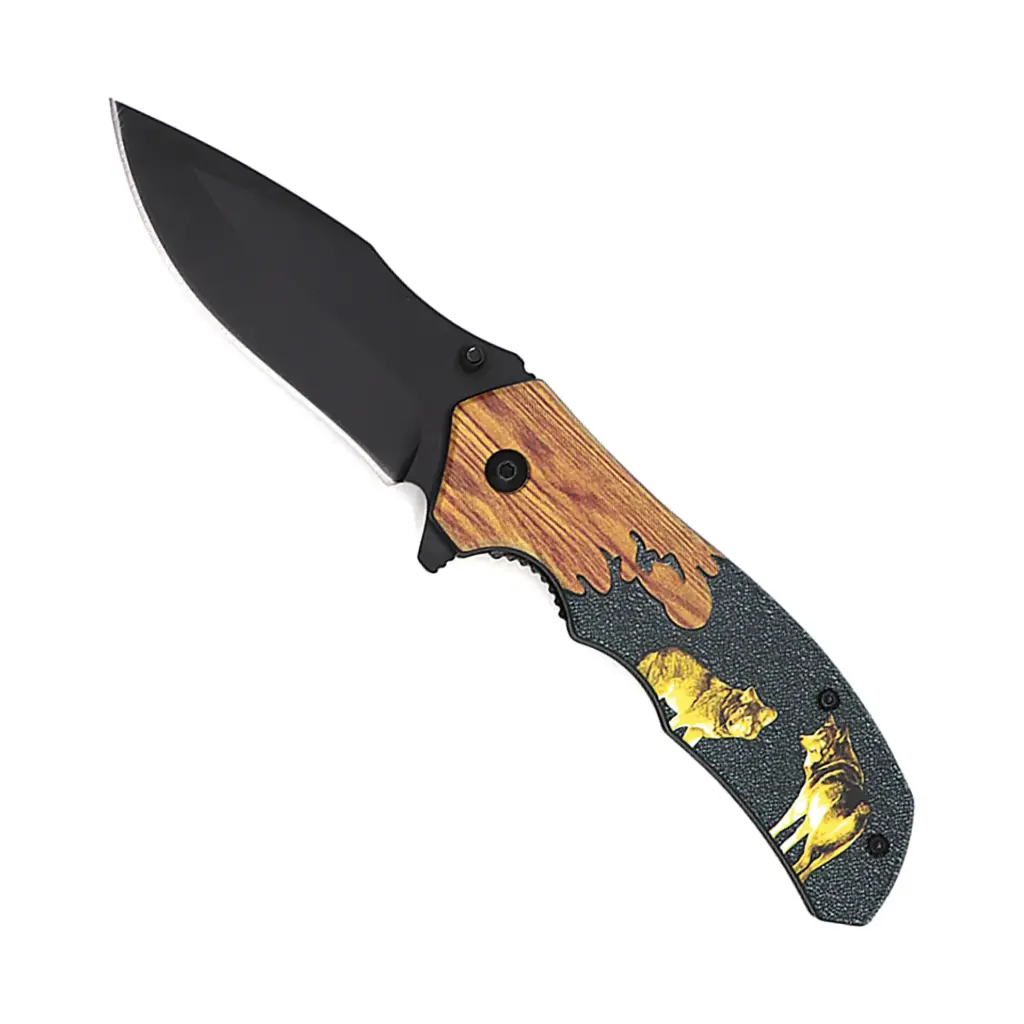
Among budget folders, this feels like the best assisted opening knife for wolf enthusiasts who actually carry their gear. The spring-assisted deployment snaps the 3.5-inch matte black drop point into lockup with a predictable, one-handed motion. A liner lock and spine jimping give real control, not just looks. The wood front scale and gold wolf motif make it giftable, but the pocket clip and 4.75-inch closed length keep it honest as a working EDC, not just a display piece.
What Makes the Best Assisted Knife for Everyday Carry?
For an everyday carry folder to earn a spot on any “best” list, it has to do more than just look good in photos. The best assisted opening knife for real EDC use deploys reliably one-handed, locks up predictably, carries flat in a pocket, and survives normal cutting tasks without turning into a rattle-box. At this price point, you’re not buying heirloom steel — you’re buying a tool that needs to feel trustworthy in the hand and inviting enough that you actually grab it on the way out the door.
The Lone Howl Quick-Deploy Assisted Folding Knife - Wolf Wood clears that bar by combining a fast spring-assisted mechanism, a sensible 3.5-inch matte black drop point blade, and a surprisingly comfortable, sculpted handle that happens to carry a wolf motif without turning the whole knife into a novelty.
Why This Feels Like the Best Assisted Knife for Wolf-Themed EDC
I’ve handled a lot of wildlife-themed knives that are clearly designed to sit in a display case. Oversized, slippery, and usually saddled with awkward blade shapes, they’re not what you reach for when a box needs opening or rope needs cutting. This one is different. The Lone Howl feels like a practical assisted opening knife first and a wolf knife second.
Deployment: Spring Assistance That Actually Helps
The blade runs on a spring-assisted mechanism triggered via thumb stud. On budget folders, assisted systems can be either too weak to matter or so aggressive they feel like they’re trying to jump out of your hand. Here, the tension is in that useful middle: once you nudge the thumb stud past the detent, the spring takes over and drives the 3.5-inch drop point to full lock decisively. In use, that means consistent, one-handed opening whether your hands are cold, gloved, or just not perfectly positioned.
Is it the best assisted opening action you’ll find anywhere? No — high-end flippers and tuned autos are smoother. But in the context of entry-level EDC, this sits in the top tier for usable, predictable deployment, and that’s ultimately what matters when you’re opening it several times a day.
Lockup and Control
The knife uses a liner lock, which is the sensible choice for this style of spring-assisted folding knife. The exposed liner is easy to access for closing, and engagement is solid without feeling sticky. Spine jimping gives your thumb a reference point when you’re bearing down on a cut, and the slight curve of the handle encourages a natural grip rather than forcing your hand into one "cool" position. It’s not a hard-use survival knife, but it doesn’t pretend to be — it’s tuned for everyday tasks.
Blade, Steel, and Real-World Cutting Performance
The blade is a matte black drop point with a plain edge. That choice alone is why this belongs in a best assisted knife conversation for everyday carry: a drop point is predictable. You get a usable belly for slicing, enough point for detail work, and a profile that doesn’t scare everyone in the room when you open it.
Steel Expectations at This Price Point
The steel is an unspecified stainless, which is common in this price class. No, it won’t match AUS-8 or D2 for edge retention, and it’s not marketed as such. What it does offer is easy sharpening and decent rust resistance for someone who isn’t babying their knife. If you’re cutting cardboard, zip ties, tape, and the occasional bit of cord, a quick touchup on a basic stone or pull-through sharpener brings it back.
In other words, this is not the best choice if you’re comparing steels on a spec sheet. It is a reasonable call if you want an assisted knife that you won’t hesitate to use hard because you’re not afraid to scratch fancy steel or coatings.
Carry, Ergonomics, and Where This Knife Is Actually Best
Closed, the Lone Howl measures 4.75 inches, with an overall length of 8.25 inches open. That puts it squarely in the full-size EDC assisted knife category: long enough to be useful, short enough to ride in a front pocket without feeling ridiculous.
Pocket Clip and Everyday Presence
The pocket clip keeps it anchored where it needs to be — at the top of the pocket, consistently oriented for a repeatable draw. This isn’t a deep-carry, ultra-slim gentleman’s folder; it’s a working spring-assisted knife that you’ll notice when it’s clipped but won’t resent after a full day. The handle’s curved shape and exposed liner give your fingers real landmarks, so the knife indexes the same way each time you grab it.
Design vs. Function Tradeoffs
The wolf artwork and wood scale are the obvious visual hooks, and they’re why this stands out among the best assisted opening knives in the impulse-buy or gift segment. The tradeoff is that you’re not getting the grippiest, rubberized tactical handle or the thinnest possible profile. If you want a purely utilitarian, texture-heavy knife for gloved, wet use, this isn’t the best fit. If you want an assisted knife that looks like something you chose on purpose — especially if you like wildlife imagery — this threads that needle surprisingly well.
Common Questions About the Best OTF Knives
What makes an OTF knife the best choice for EDC?
Strictly speaking, an OTF (out-the-front) knife is a different mechanism from this spring-assisted folder: OTF blades travel straight out of the handle rather than pivoting on a hinge. The best OTF knife for EDC typically offers true one-handed deployment and retraction, compact thickness, and reliable double-action mechanics. By comparison, a spring-assisted folding knife like the Lone Howl gives you similar one-handed speed with a simpler, often more legally acceptable mechanism in many regions.
How does this assisted knife compare to the best OTF knife alternatives?
Compared to a true OTF, this assisted folder is mechanically simpler, easier to clean, and usually more tolerant of pocket lint and casual abuse. You give up the straight-out deployment style of an OTF knife, but gain a familiar drop point blade profile, a conventional liner lock, and fewer moving parts. For buyers who like the idea of the best OTF knife for everyday carry but don’t want to deal with double-action internals or potential legal restrictions, a spring-assisted folding knife like this is a practical compromise.
Who should choose this assisted knife?
This knife is best for buyers who want an affordable, fast-deploying EDC knife with a strong visual identity. Wolf enthusiasts, outdoor-themed gift buyers, and anyone who wants a pocket knife that feels a little more personal than plain black G10 will get the most out of it. It’s not the best choice for heavy-duty field dressing or hard survival tasks, and it’s not aiming to compete with premium OTF knives. It’s designed to be the assisted knife you actually carry and use because it opens quickly, feels secure in hand, and looks like it belongs to you.
If you’re looking for the best assisted opening knife for everyday carry that also carries a wolf-and-wood wilderness aesthetic, this is it — because it treats the artwork as a layer on top of a genuinely functional spring-assisted folding knife, not a substitute for one.
| Blade Length (inches) | 3.5 |
| Overall Length (inches) | 8.25 |
| Closed Length (inches) | 4.75 |
| Blade Color | Black |
| Blade Finish | Matte |
| Blade Style | Drop Point |
| Blade Edge | Plain |
| Blade Material | Steel |
| Handle Finish | Glossy |
| Handle Material | Wood |
| Theme | Wolf Design |
| Safety | Liner Lock |
| Pocket Clip | Yes |
| Deployment Method | Spring-assisted |
| Lock Type | Liner lock |