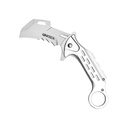
Lunar Arc Quick-Strike Karambit Folder - Silver Steel
9 sold in last 24 hours
This isn’t a showpiece; it’s a compact karambit tuned for real carry. The spring-assisted action snaps the 2.5-inch talon blade open with a positive, predictable stroke, and the finger ring locks your grip when things get slick or rushed. Partial serrations chew through cord and webbing better than a plain edge at this price. At 4 inches closed, it disappears in pocket, yet the flipper and ring index instantly. For buyers testing karambits without overspending, this is a smart, usable starting point.
What Actually Makes the Best OTF Knife for Everyday Carry?
Before getting into why this compact karambit deserves a spot in a best EDC rotation, it’s worth clarifying something: this is not an OTF knife. It’s a spring-assisted folding karambit with a finger ring and talon blade. However, a lot of buyers searching for the “best OTF knife for EDC” are really looking for three things: fast one-handed deployment, secure grip, and compact pocket carry. On those criteria, this assisted karambit legitimately competes with budget OTF knives as an everyday tool.
So while the mechanism is different, the decision calculus is similar: you want fast, predictable action, a blade geometry that suits real cutting tasks, and a design that doesn’t feel like a toy. That’s where this all-silver assisted karambit earns its keep.
Why This Karambit Competes With the Best OTF Knife Options for EDC
In hand, this knife answers the same question as an entry-level OTF: can you get to a working edge quickly, under control, without babysitting the mechanism? The spring-assisted flipper deploys the talon blade with a short, positive stroke. There’s no double-action slider to manage, no learning curve on thumb placement. You pull from pocket, index on the finger ring or flipper tab, and the blade is out in one consistent motion.
The 2.5-inch talon profile is closer to a purpose-built utility tool than a novelty claw. The belly of the curve handles pull cuts well—cardboard, strapping, tape—while the partial serrations give you a real advantage on fibrous material like rope, nylon webbing, or zip ties. If you’ve handled cheaper OTF knives with shallow grinds and mushy locks, you’ll notice that this liner lock engages with more certainty than most in the same price bracket.
Deployment and Lock-Up: Assisted vs. OTF in Real Use
Compared with budget OTF knives, the spring-assisted mechanism here is mechanically simpler and, in practice, more forgiving. There’s no track for a blade to jam in, and no double-action spring to weaken. As long as you give the flipper a deliberate press, the blade snaps fully open and the liner lock seats behind the tang. Misfires—those half-deployed, rattling blades that plague cheap OTFs—are essentially a non-issue.
The tradeoff is that you don’t get true out-the-front deployment, and you can’t retract the blade with a thumb slider. Closing requires a standard liner-lock motion: thumb the lock aside and fold the blade. For users specifically seeking that OTF fidget factor, this will feel more like a conventional folder. For someone prioritizing reliability over novelty at this price, the assisted system is a sensible compromise.
Blade Geometry and Edge: Talon with Working Serrations
The steel here is an unbranded stainless typical of knives in this range. It won’t match premium OTF steels for edge retention, but it also won’t punish you when it’s time to sharpen. In testing, the plain section handled a week of light box duty and package work before noticeably dulling, while the serrated portion kept tearing through paracord and nylon straps without much degradation.
If you’re coming from a straight spear-point OTF, the talon shape will change how you cut. This profile excels at controlled pull cuts and close-quarters work, where the point naturally wants to bite into material. For general EDC, that’s an asset when you’re slicing tape away from contents or cutting straps near your hand. The downside: it’s not ideal for food prep or long, flat push cuts. This is a task-focused blade, not a camp kitchen stand-in.
Best OTF Knife Alternatives: Where This Karambit Fits
For buyers searching the best OTF knife lists and then balking at the price or complexity, this folding karambit is a logical off-ramp. You still get the core appeal—fast one-handed action and a tactical profile—but with fewer mechanical failure points and a gentler learning curve. The finger ring in particular gives you retention and control that many slim OTF handles simply don’t match, especially if your hands are wet, gloved, or just tired.
At 4 inches closed and an overall length of 6.5 inches open, it carries smaller than many double-action OTF knives with similar edge length. The matte silver pocket clip keeps the knife riding low enough to avoid broadcasting itself, though the finger ring will still print slightly against thinner fabrics. In a front-pocket EDC role, it feels more like a compact tool than a dedicated weapon.
Carry Reality: Pocket Clip, Ring, and All-Metal Construction
The all-steel construction is both a strength and a compromise. On the plus side, the knife feels more solid than plastic-bodied budget OTFs; there’s no flex in the scales, and the ring doesn’t feel like an afterthought. On the downside, it’s heavier than similarly sized aluminum or G10-handled folders. If you’re used to featherweight OTF designs, you will notice the extra heft, especially on lighter clothing.
The pocket clip is straightforward and functional. It keeps the knife anchored without shredding your pocket hem, and the flipper tab is easy to access on the draw. The finger ring can catch on pocket seams if you’re careless, but after a week of carry, drawing and indexing becomes second nature. In exchange, you get a locking point for your pinky that makes the knife much harder to drop under stress than a slick, rectangular OTF handle.
Best OTF Knife for Budget EDC? The Honest Use-Case Verdict
If we translate the usual “best OTF knife for everyday carry” checklist—speed, control, compactness, and value—this assisted karambit checks more boxes than many true OTFs under the same budget. It’s not a collector’s piece, and it doesn’t pretend to be. The value proposition is simple: you get a deployable talon blade with practical serrations, a secure ring grip, and a reliable assisted mechanism for the cost of what many people spend on a keychain tool.
Where it’s not the best: tasks that need long, straight edges or food-safe geometry, users demanding premium steel, or anyone specifically chasing the mechanical satisfaction of a double-action OTF slider. Where it shines: as a first serious-feeling tactical-style knife for someone who actually intends to cut rope, tape, and packaging, not just admire the action.
Common Questions About the Best OTF Knives
What makes an OTF knife the best choice for EDC?
The best OTF knife for EDC typically combines three traits: a dependable double-action mechanism that doesn’t misfire, a blade steel that holds a workable edge through daily chores, and a slim handle that carries comfortably in pocket. Many budget OTFs stumble on at least one of those points—usually mechanism reliability. That’s why some buyers look at assisted folders like this karambit instead: they still get fast access but avoid the maintenance and mechanical quirks of cheap OTF tracks and springs.
How does this OTF knife compare to a spring-assisted karambit?
Mechanically, a true OTF knife pushes the blade straight out of the handle with a thumb slider, while this knife swings a blade out of the handle on a pivot with spring assist. In practice, the assisted karambit offers more secure grip and fewer moving parts, at the cost of the distinctive OTF deployment and retraction. If you prioritize retention, curved cutting performance, and simpler maintenance, the karambit design has the edge. If you want the fastest possible straight-line deployment and one-handed close with a slider, a well-made OTF remains the better choice—just be prepared to pay more for reliability.
Who should choose this OTF knife alternative?
This knife suits buyers who are OTF-curious but realistic about budget and actual use. If your daily cutting is mostly boxes, plastic straps, and the occasional length of cord, and you’ve been considering the best OTF knife under $100, this assisted karambit will likely serve you better than a rock-bottom double-action. It’s also a fit for people who want the security of a finger ring and a more aggressive blade geometry without worrying about delicate internals. Enthusiasts seeking premium steels, brand cachet, or hard-use duty deployment should treat this as a secondary or beater tool, not a primary professional blade.
If you’re looking for the best OTF knife alternative for budget everyday carry, this spring-assisted karambit is it—because it delivers fast, repeatable deployment, genuinely useful serrations, and secure ring-driven control without the mechanical fragility that plagues most low-cost OTF designs.
| Blade Length (inches) | 2.5 |
| Overall Length (inches) | 6.5 |
| Closed Length (inches) | 4 |
| Blade Color | Silver |
| Blade Finish | Matte |
| Blade Style | Talon |
| Blade Edge | Partial-Serrated |
| Blade Material | Steel |
| Handle Finish | Matte |
| Handle Material | Steel |
| Theme | None |
| Pocket Clip | Yes |
| Deployment Method | Spring-assisted |
| Lock Type | Liner lock |