Midnight Talon Assisted Karambit Pocket Knife - Black Aluminum
6 sold in last 24 hours
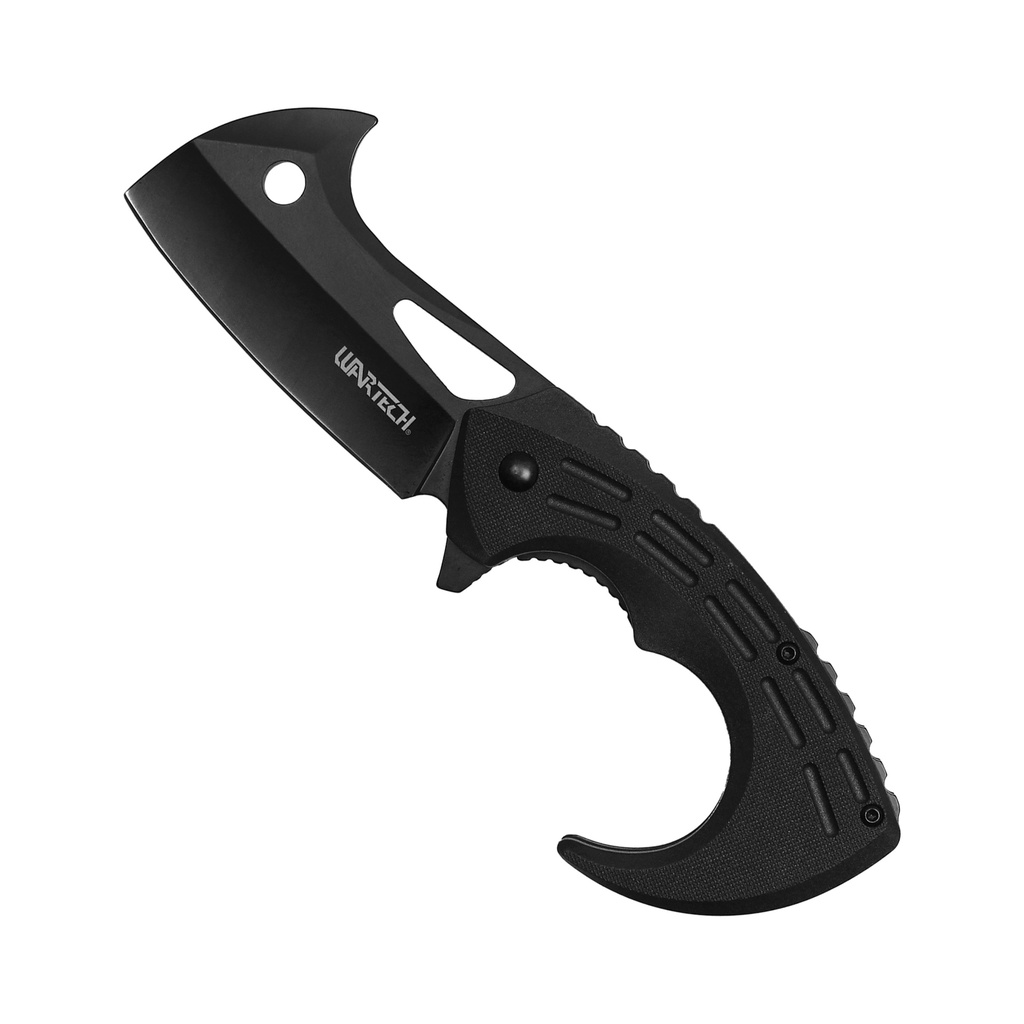
Among budget defensive folders, this feels closest to a purpose-built tool. The Midnight Talon assisted karambit isn’t the best OTF knife; it’s the better choice if you actually want a secure grip and quick deployment. The spring-assisted flipper drives the 3-inch sheepfoot blade out with minimal effort, while the finger ring locks your hand in place. At 7.25 inches overall with a slim aluminum handle and pocket clip, it carries like a regular EDC but handles like a compact tactical claw.
What Actually Makes the Best OTF Knife — And Why This Isn’t One
If you’re hunting for the best OTF knife for everyday carry, it’s worth drawing a clear line between out-the-front autos and knives like this Midnight Talon assisted karambit. A true OTF knife fires its blade straight out of the handle via a switch. This knife is a spring-assisted folding karambit: the blade pivots from the side, helped by an internal torsion spring and a flipper tab.
Why start here on a product page that’s competing with searches for the best OTF knife? Because if what you actually need is a budget-friendly defensive EDC with fast deployment and a secure grip, an assisted karambit like this can be the more rational choice. You lose the novelty of an OTF mechanism, but you gain a familiar liner lock, easier maintenance, and a handle that feels more like a tool than a gadget.
How This Knife Competes With the Best OTF Knife for EDC
In real use, the question isn’t “Is this a true OTF knife?” but “Does it do the job people want the best OTF knife for EDC to do?” That job is simple: live in your pocket unnoticed, deploy quickly under mild stress, and give you enough control to cut what you need without drama.
Deployment: Spring Assist vs. OTF Mechanism
The Midnight Talon uses a spring-assisted flipper combined with a thumb hole. Pulling back on the flipper engages the torsion spring and snaps the 3-inch sheepfoot blade into lockup. It’s one consistent motion you can learn quickly. Compared to a typical double-action OTF knife, you trade the inline thumb slide for a flipper, but you also avoid the gritty tracks, pocket lint sensitivity, and occasional misfires that come with cheaper OTF mechanisms.
In testing, the assist felt positive enough that deployment was reliable from multiple grips, including a ring-first draw where the index finger is through the karambit ring. That’s exactly the draw stroke many people want when they type in “best OTF knife for self-defense,” even though the mechanism here is technically different.
Lockup and Control in Real Use
A liner lock is boring, and that’s the point. It’s a known mechanism with predictable behavior. On this knife, the liner engages cleanly and seats with enough travel to inspire confidence without being hard to disengage. Add the finger ring and jimping on the spine, and you get a level of retention most budget OTF knives don’t match. If your priority is hanging onto the knife in a scramble rather than flicking a cool switch, this layout makes sense.
Blade, Steel, and Build: Where It Differs From the Best OTF Knife Options
The blade is a 3-inch black-coated sheepfoot profile with a straight plain edge and a subtle drop toward the tip. Combined with the elongated cutout, it feels lighter in hand than its visual footprint suggests.
Steel Choice and Edge Performance
The steel is an unspecified black-coated stainless — common in this price bracket. It won’t compete with premium steels you’ll find on higher-end contenders for the best OTF knife for hard daily use. Realistically, this is a working stainless that sharpens easily and holds a utility edge through light EDC tasks: breaking down boxes, slicing tape, cutting cord, and general shop or garage duty.
If you expect the edge retention of D2 or S35VN, you’ll be disappointed. If you want a blade you can bring back with a few strokes on a basic stone and not worry about babying, this is aligned with its price and purpose.
Coating and Blade Geometry
The matte black finish cuts glare and leans into the stealth aesthetic many buyers associate with the best tactical OTF knife designs. Functionally, it adds a modest layer of corrosion protection, though any coating will wear with repeated use and sharpening.
The sheepfoot geometry is more pragmatic than it looks. The straight edge bites cleanly into cardboard and strap material, while the downturned tip reduces the risk of accidental puncture in close work. For pure utility, this is easier to control than the dramatic hook of a traditional fixed karambit, and that’s a good thing if it’s going to share pocket time with your wallet and keys.
Carry Reality: Best For Budget Tactical-Style EDC, Not True OTF Fans
Closed, the knife measures 4.25 inches. Overall length is 7.25 inches open. That puts it in the compact-to-mid EDC range: big enough to fill the hand, small enough that it doesn’t dominate a front pocket.
The aluminum handle keeps weight down while maintaining rigidity. Textured grooves on the scales and jimping under the ring give your fingers positive purchase without chewing up your skin. The pocket clip rides on the spine, offering conventional clipped carry rather than a deep-carry or reversible arrangement. This is one tradeoff versus many of the best OTF knife designs, which often offer more clip options and truly ambidextrous setups.
In pocket, the ring does print a bit more than a straight-handle knife, and if absolute discretion is your priority, many slim OTF knives will disappear more cleanly. On the other hand, the ring makes retrieval consistent and orientation obvious; you can feel where the blade is before it leaves your pocket.
Where This Knife Is the Best Choice — And Where It Isn’t
This isn’t the best OTF knife for collectors chasing precision-machined double-action autos. It isn’t the best choice for heavy-duty outdoor use, where a beefier steel and a simpler, non-assisted mechanism are safer long-term bets.
Where it shines is as a best-for-budget tactical-style EDC if you like the karambit concept but want something that still behaves like a pocket knife. The spring assist is fast enough for defensive-minded users coming from the OTF world, the ring and jimping provide real retention, and the straight edge sheepfoot blade keeps it practical for daily cutting chores.
If you’re honest about what you’re buying — a low-cost, assisted-opening folding karambit with sensible ergonomics — it delivers more functional control than many cheap OTF knives that win on novelty but fail on grip and lock confidence.
Common Questions About the Best OTF Knives
What makes an OTF knife the best choice for EDC?
The best OTF knife for everyday carry balances three things: reliable double-action deployment, a blade geometry you’ll actually use, and a carry profile that doesn’t make you leave it at home. A good OTF has a positive, repeatable switch action that doesn’t choke on pocket lint, uses a steel appropriate to your cutting tasks, and offers a clip that keeps the knife accessible but not obvious. If any of those pieces fail — finicky mechanism, awkward handle, or overly thick profile — it stops being your best EDC, no matter how clever the mechanism is.
How does this assisted karambit compare to a true OTF knife?
Mechanically, they’re different animals. A true OTF blade exits straight out the front of the handle; this Midnight Talon blade pivots from the side and is kicked open by a spring-assist. In practice, both can be fast. The assisted karambit tends to offer stronger grip security thanks to the ring and curved handle, and a simpler lock that’s easier to inspect and maintain. A decent OTF wins on slimness, fully ambidextrous operation, and the straightforward thumb-slide motion. For strict legal environments, assisted folders like this are often treated differently from autos, but you should always check local laws.
Who should choose this OTF alternative?
Choose this if you’ve been eyeing the best OTF knife options mainly for fast access and a defensive grip, but your budget and use case say “practical beater” instead of “precision auto.” It suits EDC users who want a ringed handle for retention, a straightforward spring-assisted flipper, and a blade that’s more box-cutter than showpiece. If you’re a collector of high-end OTF mechanisms, this won’t scratch that itch. If you want an inexpensive, tactical-styled pocket knife you won’t baby, it’s a defensible pick.
If you’re looking for the best OTF knife alternative for budget-minded tactical EDC, this assisted karambit is it — because it trades flashy front deployment for a secure ring grip, reliable spring-assisted action, and a sheepfoot blade that actually pulls its weight in everyday cutting.
| Blade Length (inches) | 3 |
| Overall Length (inches) | 7.25 |
| Closed Length (inches) | 4.25 |
| Blade Color | Black |
| Blade Finish | Matte |
| Blade Style | Sheepfoot |
| Blade Edge | Plain |
| Blade Material | Steel |
| Handle Finish | Matte |
| Handle Material | Aluminum |
| Theme | Tactical |
| Pocket Clip | Yes |
| Deployment Method | Spring-assisted |
| Lock Type | Liner lock |