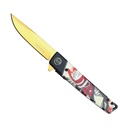

Mythic Tengu Street-Flipper Assisted Knife - Gold Blade
7 sold in last 24 hours
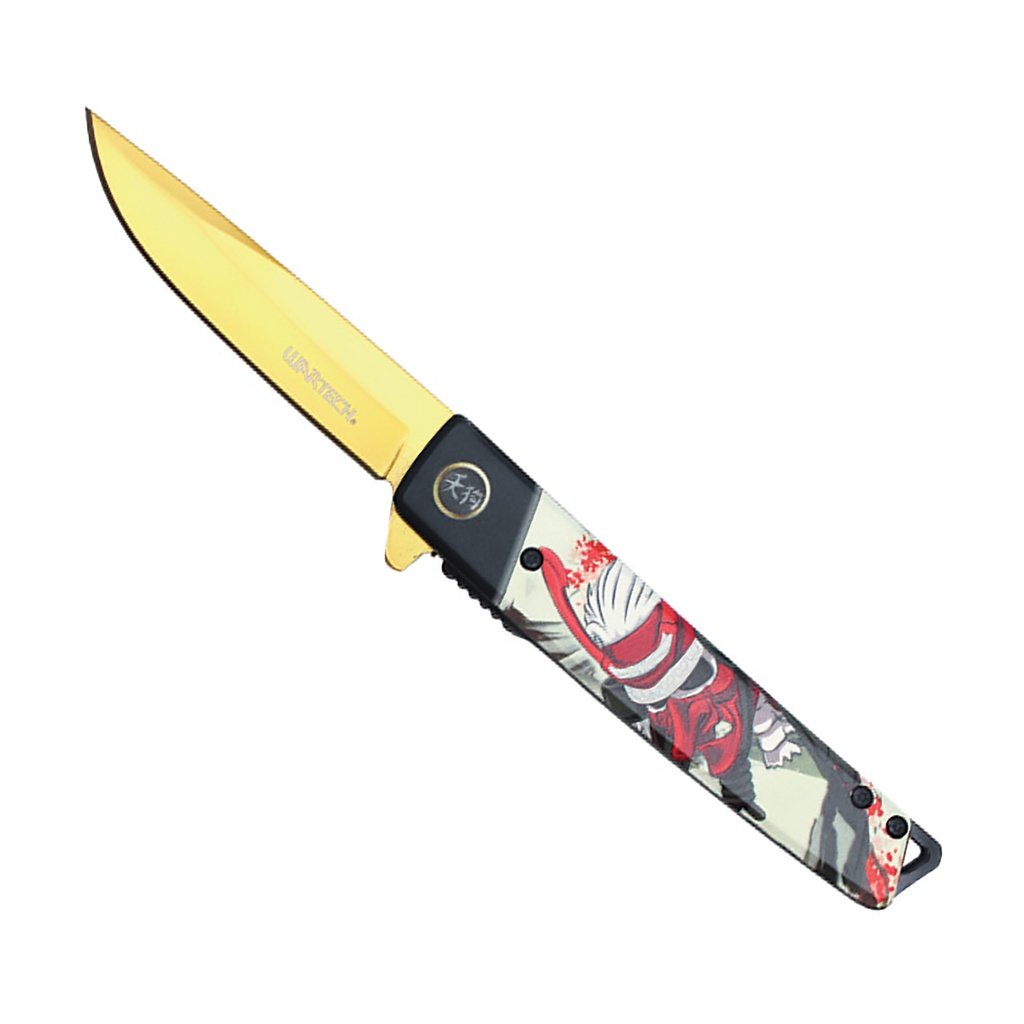
This isn’t the best OTF knife for hard use, but it is one of the most satisfying budget assisted flippers for everyday carry. The 3.5-inch gold drop point snaps open with a quick, spring-assisted flick, and the liner lock consistently bites fully into place. At 4.5 inches closed with a pocket clip and lanyard hole, it carries easily while the tengu-mask handle art makes it feel more like a pocket collectible than a throwaway beater.
What Actually Makes the Best OTF Knife or Assisted Folder?
When people search for the best OTF knife, what they usually want is fast, one-handed deployment in a package they’ll actually carry. Mechanism matters, but so do three things that don’t show up in a glam photo: how reliably it opens, how secure the lock feels, and whether the knife’s size and weight make sense for everyday carry. The Golden Tengu here is a spring assisted flipper, not a true OTF knife, but it targets the same buyer: someone who wants quick, one-handed readiness without spending collector-level money.
So I’m going to judge it by the same criteria I’d use on an OTF: deployment speed, lock integrity, real-world carry, and value. It won’t beat a premium double-action OTF knife for durability or mechanism complexity, but as a budget-friendly everyday assisted knife with some personality, it does more right than its price suggests.
Mechanism & Deployment: A Practical Alternative to the Best OTF Knives
If you’re shopping for the best OTF knife for everyday carry but don’t want to deal with legal gray areas or high prices, a spring assisted flipper like this one is the realistic alternative. Here, the flipper tab and assist do exactly what they should: the blade moves from fully closed to locked with a short, positive stroke, and you don’t need a death grip to make it happen.
Flipper Tab and Spring Assist in Use
The flipper tab is slightly proud of the handle, which gives your index finger enough purchase to light-switch it open without slipping, even if your hands are damp. The assist feels tuned on the snappier side for a budget knife: there’s a clear detent, then a quick, audible snap as the 3.5-inch gold blade hits full lock. It’s not as mechanically impressive as the best double action OTF knife mechanisms, but in a pocket at work or around town, it gives you similar one-handed readiness without the complexity of an internal track system.
Liner Lock Security and Consistency
The liner lock engages at a reasonable depth on the tang, not hovering on the very edge. That matters. On cheaper folders you’ll sometimes see locks barely making contact; here, repeated openings still show solid, repeatable lock-up. Is it as fail-safe as the best OTF knife with a robust internal lock? No. But for light to moderate cutting—boxes, packing tape, plastic straps—it feels trustworthy. There’s minimal side-to-side play when properly tightened, which is as much as you can fairly ask at this tier.
Blade, Steel, and Edge: Honest Working Performance
The glossy gold drop point blade is clearly built as an everyday cutter with some visual drama, not a survival tool. You get a straightforward plain edge and a profile that excels at slicing more than prying. In practice, that’s exactly what most people need from an EDC-style knife, whether they thought they wanted the "best OTF knife" or just something reliable to keep on them.
Steel and Real-World Edge Holding
The blade steel isn’t advertised as a premium alloy; you’re in basic stainless territory. That means two things: first, it won’t hold an edge like higher-end steels found on truly top-tier OTF knives. Second, it’s forgiving and very easy to bring back with a simple pull-through sharpener or ceramic rod. After regular box duty and light utility cuts, you can expect to touch it up more often than a premium blade, but sharpening is quick and painless. For a low-cost assisted knife, that’s a reasonable tradeoff.
Blade Geometry and Control
The drop point profile and plain edge give you predictable control, especially on pull cuts through cardboard, plastic packaging, and tape. Thumb jimping near the blade spine lets you choke up slightly when you need more pressure, which is something many budget knives skip. If you were actually cross-shopping the best OTF knife for EDC, this geometry is right in line with what works—just without the sliding track mechanism.
Carry, Ergonomics, and Where This Knife Is Actually Best
At 4.5 inches closed and about 8 inches overall, this lands squarely in the comfortable, full-size EDC range. It’s not a tiny gentleman’s folder, but it isn’t the sort of oversized tactical blade that feels silly in a pocket during a normal workday either.
Pocket Clip, Lanyard, and Daily Use
The pocket clip keeps the knife riding at a sensible depth—low enough to stay out of sight but not so deep that retrieval becomes a fishing expedition. The lanyard hole at the rear is a small but useful touch if you like adding a pull cord or bead for easier extraction from a bag. In jeans or work pants, it disappears until you need it, which is the same goal the best OTF knife for everyday carry aims for: invisible until called on.
Handle Art and Grip Tradeoffs
The tengu-mask artwork and glossy aluminum handle make this feel more like a myth-inspired pocket piece than a purely utilitarian tool. That has two sides. Positively, it stands out—if you like Japanese folklore, it will be one of the more distinctive knives in your drawer. On the downside, the smooth finish and visual focus mean you don’t get the aggressive texturing you’d want for gloved or wet work. That’s why this knife is best for casual EDC and light utility, not for field or survival use. It’s a pocket companion for opening boxes and packaging, not batoning wood.
Best-For Positioning: Who This Knife Actually Suits
In honest terms, this is not the best OTF knife for tactical use, nor is it designed to be. It’s the best choice in a different niche: buyers who like the idea of fast, one-handed deployment but want something legal in more places, simple to maintain, and priced so low they won’t baby it.
If you were eyeing the best OTF knife under $100 but balked at spending that much, this spring assisted flipper scratches much of the same itch: fast opening, pocket-friendly, visually distinctive. You give up the true out-the-front mechanism and premium steel, but you pick up easy sharpening, grab-and-go practicality, and artwork that doesn’t look like every black tactical knife on the market.
Common Questions About the Best OTF Knives
What makes an OTF knife the best choice for EDC?
The best OTF knife for EDC combines three things: a reliable double-action mechanism that fires and retracts consistently, a blade steel that holds an edge through daily cutting, and a slim profile that disappears in the pocket. Where a spring assisted flipper like the Golden Tengu differs is the deployment path: instead of sliding straight from the handle, the blade pivots out. For many people, the functional outcome—quick, one-handed access—is similar enough that assisted folders are a more practical, budget-friendly option.
How does this OTF-style assisted knife compare to a true OTF knife?
Compared to a true OTF, you lose the straight-line, out-the-front deployment and the mechanical novelty that enthusiasts love. You also avoid some of the complexity, maintenance, and legal concerns that accompany even the best OTF knife designs. The Golden Tengu’s spring assisted flipper is mechanically simpler, easier to clean, and less sensitive to lint or grit in the mechanism. For hard daily use or collection value, a premium OTF still wins; for inexpensive, expressive everyday carry, this assisted folder is the more realistic pick.
Who should choose this OTF-style assisted knife?
You should choose this knife if you want OTF-like speed without paying OTF prices, and if you care as much about visual character as you do about pure performance. It’s best suited to students, office workers, and casual EDC fans who primarily cut boxes, tape, and light packaging. If you need the best OTF knife for duty or survival, look higher up the ladder; if you want a fast-opening, tengu-themed pocket knife you won’t feel guilty using hard, this fits.
If you’re looking for the best OTF knife alternative for affordable, everyday carry, this is it — because the Golden Tengu’s spring assisted flipper gives you quick, one-handed deployment, reliable liner lock security, and a distinct myth-inspired design at a price where you can actually carry and use it instead of keeping it in a display case.
| Blade Length (inches) | 3.5 |
| Overall Length (inches) | 8 |
| Closed Length (inches) | 4.5 |
| Blade Color | Gold |
| Blade Finish | Glossy |
| Blade Style | Drop Point |
| Blade Edge | Plain |
| Blade Material | Steel |
| Handle Finish | Glossy |
| Handle Material | Aluminum |
| Theme | Tengu |
| Pocket Clip | Yes |
| Deployment Method | Flipper tab |
| Lock Type | Liner lock |