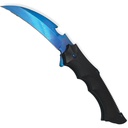
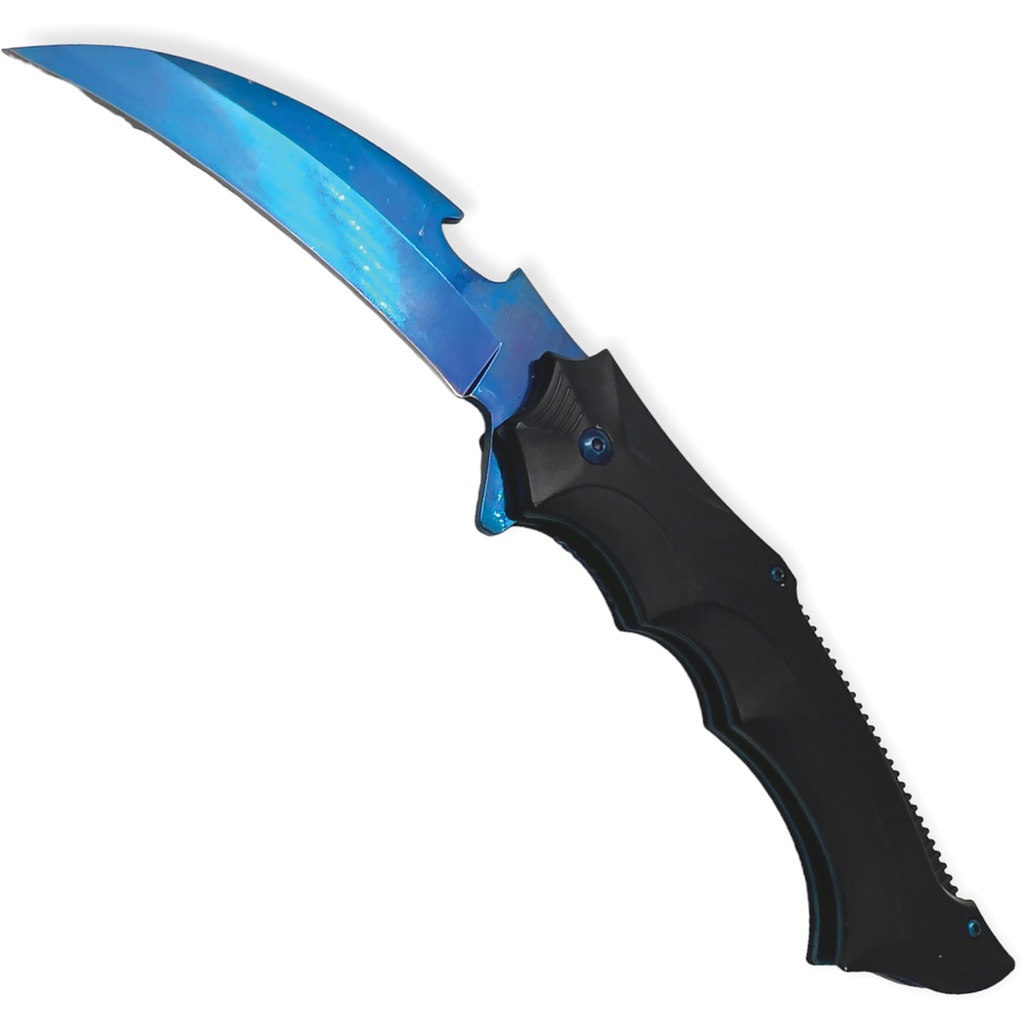
Night Raptor Quick-Assist Karambit Blade - Blue/Black
9 sold in last 24 hours
This isn’t a generic folder with a curved edge; it’s a purpose-built assisted karambit tuned for control. The 4-inch 1065 German surgical steel talon snaps open with a firm spring assist, then locks into a grip defined by deep finger grooves, spine jimping, and a flared pommel. At 10 inches overall and roughly 10 ounces, it carries more like a compact tool than a toy, with a pocket clip that keeps that blue blade ready for fast, one-handed deployment.
What Actually Makes the Best OTF Knife or Assisted Blade?
When people search for the best OTF knife, what they really want is fast, reliable, one-handed deployment and confident control once the blade is out. Mechanism matters, but so does what happens after the edge is in your hand. The Night Raptor Quick-Assist Karambit Blade sits in that overlap: it isn’t a true OTF, but it competes for the same role as a rapid-deployment defensive or hard-use EDC knife. Evaluated alongside budget OTFs and assisted karambits, it earns its place by focusing on grip security, predictable spring action, and honest working steel.
Why This Karambit Competes With the Best OTF Knife Options
Compared to many budget OTF knives, this spring-assisted karambit does one thing better: once it’s open, it’s far harder to lose control of. The curved talon blade, hooked profile, and finger-grooved handle work together to lock your hand in place. For buyers cross-shopping the best OTF knife for EDC with assisted options, that control is not theoretical — it’s the difference between a tool that feels secure when your hands are sweaty, gloved, or moving fast, and one that just happens to open quickly.
Deployment and Mechanism: OTF-Level Speed, Simpler Guts
The Night Raptor uses a spring-assisted flipper-style mechanism rather than a double-action OTF track. In use, that means a firm nudge on the tab brings the 4-inch talon blade out decisively, with a single, convincing snap. There’s no second-stage retraction button to manage, no internal track to clog with pocket lint. The upside versus an entry-level OTF: fewer moving parts to fail and a more conventional lock-up once open. The tradeoff is obvious — you don’t get the in-and-out theatrics of a true dual-action OTF — but you do get repeatable, one-handed opening speed that hangs with many budget OTF designs.
Lock-Up and Hand Retention
Once the blade is deployed, the ergonomics are what separate this from cheaper, straight-handled knives that chase the best OTF knife label on specs alone. Deep finger grooves index the hand consistently, the spine jimping gives the thumb an anchor point, and the flared pommel resists forward slip if you’re pulling or hooking. That combination is where the karambit form earns its keep: the knife wants to stay in your hand, even under rotational or pulling forces.
Steel, Edge, and Real-World Use: Where It’s Best (and Where It Isn’t)
The blade is 1065 German surgical steel — a mid-carbon steel that favors toughness and easy maintenance over boutique edge retention. In practice, that puts this knife firmly in the working-tool category, not the heirloom-steel showcase. If you’re hoping for a months-long edge like you’d get from a premium OTF running high-end stainless, this isn’t it. If you’re comfortable touching up an edge regularly in exchange for a blade that shrugs off light abuse, it’s a sensible trade.
Cutting Profile and Tasks
The talon-style blade excels at pulling cuts, controlled slashes, and precision tip work. Breaking down straps, opening boxes with tight angles, or cutting cord against tension all play to its strengths. It’s less ideal for food prep or flat-surface slicing, where a straighter edge and more belly would outperform it. That’s why calling any single option the best OTF knife for everyday carry without context is misleading; this design is clearly biased toward tactical and hook-cut tasks rather than general kitchen stand-in duty.
Finish and Visibility
The iridescent blue gloss blade isn’t just a styling flourish. It makes the edge more visible at a glance, useful when you’re working in mixed light and want to know exactly where the tip is. It also signals that this is not a discreet, blend-in-the-background tool. If your idea of the best OTF knife for EDC is something invisible in an office, the color here works against you. If you prefer a knife that’s easy to spot in a bag or on gear, it’s a plus.
The Best OTF Knife Alternative for Control-Focused EDC
Measured alongside true OTFs, this assisted karambit earns a different kind of “best” label: it’s one of the more control-focused budget alternatives for buyers who care more about retention than mechanism novelty. At 10 inches overall and about 10 ounces, it’s not a featherweight, but the mass contributes to stability once it’s anchored in your hand. The pocket clip keeps it oriented for repeatable draws, though you will notice the weight compared to ultralight EDC folders or slim double-action OTFs.
Carry Reality: Pocket, Waistband, or Kit
This is a knife you’ll feel in your pocket. For jeans, work pants, or a dedicated gear belt, the weight and length are manageable; for lightweight shorts, it’s overkill. That makes it a better fit as a duty-belt or work-kit blade than a minimalist office EDC. If your concept of the best OTF knife for EDC is tied to "disappears in pocket" carry, this misses the mark. If you’re comfortable with a more substantial, purpose-signaling piece of gear, it fits that role well.
Honest Tradeoffs: Where This Knife Isn’t the Best Choice
It’s important to be explicit about where this knife does not compete with the best OTF knife contenders. It’s not a true out-the-front mechanism, so if you specifically need rapid deployment and retraction from a single control, this won’t replace that. It’s not built around premium stainless, so extended edge-holding in corrosive environments isn’t its strength. And the aggressive karambit profile isn’t the right geometry for users who want one knife to do everything from food prep to fine whittling. Where it does excel is as a budget-friendly, spring-assisted karambit that prioritizes grip security and straightforward maintenance.
Common Questions About the Best OTF Knives
What makes an OTF knife the best choice for EDC?
The best OTF knife for everyday carry combines three things: reliable double-action deployment, a lock-up you trust, and a form factor you’ll actually carry. Speed alone isn’t enough. A slim profile that rides comfortably, a blade steel matched to your cutting tasks, and a mechanism that survives pocket lint and real-world dirt all matter. Many assisted knives, like this karambit, compete in the same space by offering comparable deployment speed with simpler mechanics and stronger ergonomics, even if they lack true OTF retraction.
How does this OTF knife alternative compare to a true OTF?
Versus a typical budget OTF, the Night Raptor Quick-Assist Karambit offers similar opening speed with less mechanical complexity and significantly better hand retention once open. You lose the one-hand retraction and the slim, rectangular profile of an OTF handle. In exchange, you gain deep finger grooves, a hooked blade that resists slipping out of cuts, and a lock-up that feels closer to a conventional folder. If you prioritize control over fidget-factor, this trade favors the assisted karambit.
Who should choose this OTF knife alternative?
This knife suits buyers who are OTF-curious but honest about their actual use case: they want quick access and defensive-friendly geometry more than they want a true out-the-front mechanism. It’s a solid match for tactical knife enthusiasts, collectors who appreciate the visual punch of the blue blade, and users who value secure grip above low profile. If you need the slimmest, most discreet office-friendly option, look elsewhere; if you want a fast-deploying, control-first karambit that can stand beside many of the best OTF knife picks in practical speed, it’s a defensible choice.
If you’re looking for the best OTF knife alternative for control-focused, rapid deployment on a budget, this assisted karambit is it — because its talon geometry, deep finger grooves, and straightforward spring-assisted mechanism prioritize grip security and repeatable action over gimmicks.
| Blade Length (inches) | 4 |
| Overall Length (inches) | 10 |
| Weight (oz.) | 10 |
| Blade Color | Blue |
| Blade Finish | Glossy |
| Blade Style | Talon |
| Blade Edge | Plain |
| Blade Material | 1065 German surgical steel |
| Handle Finish | Matte |
| Handle Material | Unknown |
| Theme | None |
| Pocket Clip | Yes |
| Deployment Method | Spring-assisted |