Pinpoint Reach One-Touch Tactical EDC Flashlight - Black Aluminum
11 sold in last 24 hours
This compact tactical flashlight earns a spot in real EDC kits by doing a few things exceptionally well. A one-touch tail switch brings up a tight 120-lumen beam that genuinely reaches 248 feet—ideal for checks, searches, and map work. The knurled aerospace aluminum body and included lanyard keep it secure in wet or gloved hands. AAA power means easy resupply anywhere. It’s the light you clip, stash, or drop in a bag and forget—right up until you need it to take control of the dark.
Why This Compact Tactical Light Earned a Place in a "Best EDC" Kit
The best everyday carry flashlight is the one you actually keep on you. This compact tactical light was evaluated the same way I judge OTF knives for EDC: not by how many features it has, but by how reliably it does the core job. Here, that job is simple—give you instant, controlled light at realistic working distances, without fuss, failure points, or bulk.
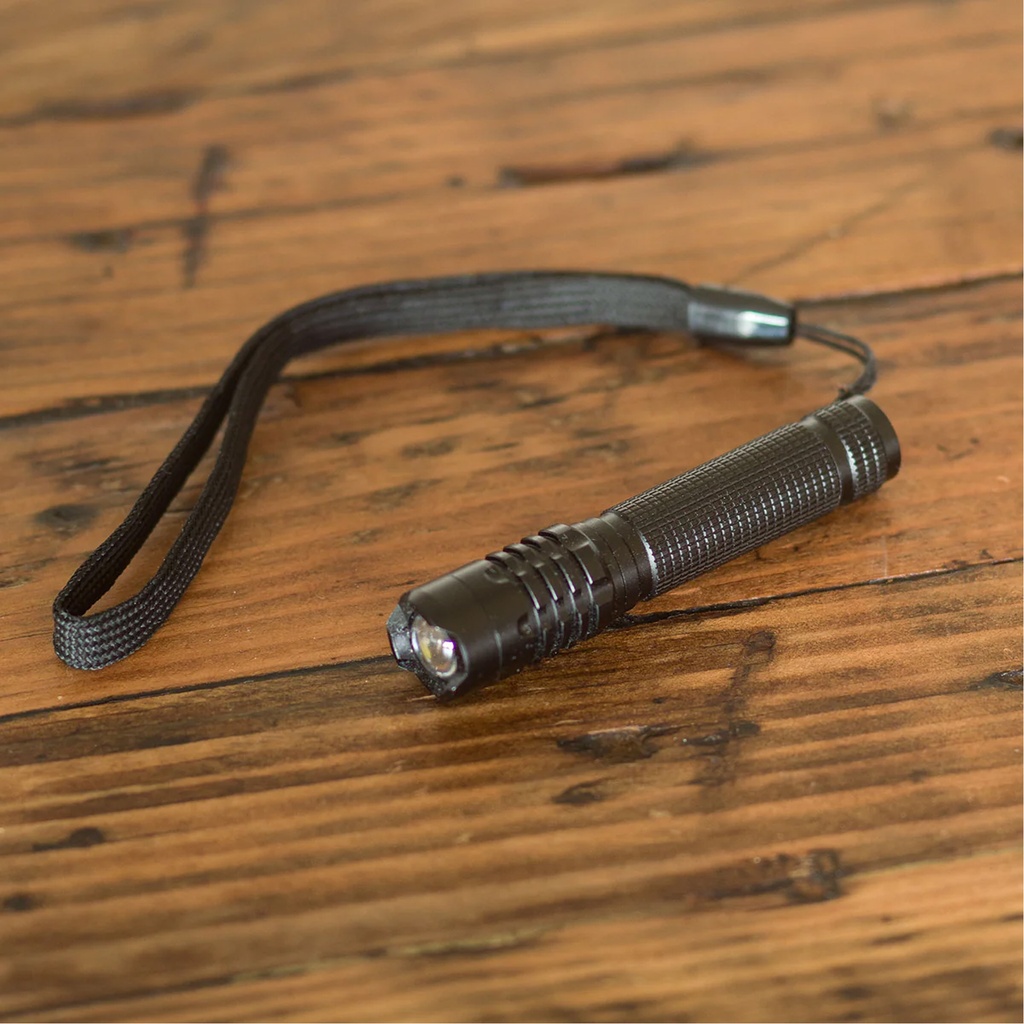
In hand, the Pinpoint Reach One-Touch Tactical EDC Flashlight - Black Aluminum feels purpose-built. A single tail switch, a tight 120-lumen beam rated to 248 feet, and a slim aerospace aluminum body with real, functional texture. No mode-cycling circus, no fragile clip assemblies, just a focused tool that behaves the same way every time you hit the switch.
What Makes the Best EDC Flashlight for Real-World Use
When I talk about the "best" EDC light, I’m looking at the same factors I’d use to justify carrying a particular OTF knife every day: deployment, control, durability, carry footprint, and serviceability.
Deployment: One-Touch, No-Guess Switching
The tail switch on this flashlight is a single, decisive control. You press it, the light comes on—full power, every time. There’s no half-click guessing game, no accidental strobe, and no memory modes to surprise you. That matters when you’re working under a car, doing a perimeter check, or following a fluid trail in bad weather. You don’t want to think about the interface; you want light now.
Beam and Output: Tight, Task-Focused Light
At 120 lumens, this isn’t trying to compete with palm-sized searchlights, and that’s precisely why it works as a backup or primary minimalist EDC light. The narrow beam profile and smooth reflector focus that output into a defined hotspot that genuinely reaches out to roughly 248 feet, with enough spill for situational awareness. Indoors, it doesn’t blind you off white walls; outdoors, it’s plenty for trail checks, gear searches, and ID tasks at mid-range.
The Best Compact Tactical Flashlight for Simple, Reliable EDC
Where many “tactical” flashlights overcomplicate things with multiple weak points, this one keeps the feature set ruthlessly focused. That’s what earns it a “best compact EDC flashlight” nod: simplicity that actually survives pockets, bags, and glove compartments.
Build and Grip: Aerospace Aluminum That Wants to Be Used
The body is machined from black aerospace aluminum with a matte finish and a practical knurled section where your fingers actually rest. It doesn’t feel precious; it feels like something you won’t baby. The texture is aggressive enough to stay locked under wet or gloved hands, but not so sharp that it chews through pockets or pouches. The grooved head gives you a tactile index point and slight heat-sink function, though at 120 lumens you’re nowhere near thermal limits in normal use.
Power Source: AAA Means You’re Never Stranded
High-output rechargeable lights are impressive, right up until you drain them and don’t have a charger. This one runs on a standard AAA cell, which is exactly what you find in gas stations, remote cabins, and the bottom of junk drawers everywhere. For emergency kits, glove boxes, and backup roles, that’s a non-trivial advantage. You trade sheer output and runtime for universal availability, and for many EDC and backup roles, that’s the smarter call.
Tradeoffs: Where This Light Excels, and Where It Doesn’t
Like choosing the best OTF knife for EDC instead of combat duty, picking this flashlight means understanding what it’s built for—and what it’s not.
- Not a high-lumen flooder: If you want to light up an entire campsite or run turbo modes for extended periods, this isn’t the tool. It’s a focused beam for specific tasks, not a lantern replacement.
- Not a feature playground: There’s no built-in USB charging, no secondary red LED, no programmable modes. For some users, that’s a drawback. For others, it’s the reason to trust it when stress is high.
- Best as backup or minimalist primary: As a primary work light for a tradesperson, you’d likely pair this with a headlamp or higher-output unit. As a daily pocket, car, or kit light, it’s right in its lane.
If your expectation matches its design—simple, reliable, always-ready illumination—then the compromises here are deliberate, not flaws.
Carry Reality: How This Compact Tactical Light Actually Rides
In use, what matters is how a tool carries day in and day out. This light is roughly the size of a typical AAA pen light, which means it disappears into most setups.
- Pocket or pouch: The slim cylindrical form slides into admin pouches, organizer panels, or the side channel of a notebook cover without printing or snagging.
- Lanyard-ready: The attached wrist lanyard isn’t decoration; it keeps the light from disappearing into a creek, ravine, or engine bay. For search tasks or ladder work, that retention matters as much as lumens.
- Kit integration: Because it uses AAA and has a tough, low-profile body, it’s particularly well suited as a dedicated light in first-aid kits, vehicle emergency bags, and range gear.
In other words, it behaves the way the best EDC tools do: quietly, predictably, and without demanding your attention until you actually need it.
Common Questions About the Best OTF Knives and EDC Lights
What makes an OTF knife the best choice for EDC?
The best OTF knife for everyday carry combines fast, one-handed deployment with a secure lockup, manageable blade length, and pocket-friendly dimensions. Just like with this compact flashlight, the “best” OTF knife doesn’t try to do everything; it focuses on reliable mechanics, safe carry, and steel that holds a working edge without requiring constant pampering. Features like double-action deployment, solid springs, and a sensible handle profile matter more than flashy styling.
How does this compact tactical flashlight compare to a multi-mode EDC light?
Multi-mode EDC lights often offer higher peak output, more beam options, and built-in recharging—useful if you’re willing to manage settings and battery care. This flashlight takes the opposite approach: one mode, one switch position, disposable AAA power. In practice, that means fewer surprises under stress and simpler long-term storage. You give up turbo lumen numbers and fine-grained control, but you gain a light that behaves the same way every time you click it, even after sitting in a glove box for a year.
Who should choose this compact tactical flashlight?
This light best suits users who value reliability and simplicity over feature lists: people building vehicle kits, homeowners who want a trustworthy drawer light, or EDC enthusiasts who pair a primary high-output torch with a minimalist backup. If your priority is a compact, durable light that runs on easy-to-find batteries and doesn’t require a manual to operate, this belongs in your kit. If you’re chasing maximum brightness and advanced UI controls, a more complex EDC flashlight will be a better match.
If you’re looking for the best compact tactical flashlight for simple, always-ready illumination, this is it—because its one-touch tail switch, tight 120-lumen beam, and AAA power are tuned for real-world reliability, not spec-sheet bragging rights.