PivotLink Duty-Ready Convertible Rifle Sling - Black Nylon
14 sold in last 24 hours
This isn’t just another 2-point strap. The PivotLink duty-ready convertible rifle sling earns its place because it quietly does three hard things well: it rides flat and stable with 1.25-inch nylon, it soaks up movement with dual bungees, and it flips to a single-point sling in one clip to the D-ring. If you split time between patrol-style carry and fast range work, this is the sling that covers both without re-rigging or adding hardware.
Why a serious rifle sling matters more than most shooters admit
Most of us learn the hard way that a bad sling adds work to every drill: the rifle swings when you move, digs when you post up, and fights you when you transition. After running bungee slings, padded slings, minimalist webbing, and fixed single-point rigs, the pattern is clear—your best rifle sling is the one that disappears until you need it to do something specific. The PivotLink Duty-Ready Convertible Rifle Sling was built around that idea: quiet, lean, and able to switch roles without reconfiguring your rifle.
On paper this looks like a standard 2 point rifle sling. In practice, the details—dual bungees, opposing D-rings, and quick-release buckles—turn it into a 2-to-1 system that keeps pace with patrol, range, and training use without extra hardware. This is the sling you throw on a carbine and don’t think about again.
Design overview: a convertible 2 point rifle sling that runs clean
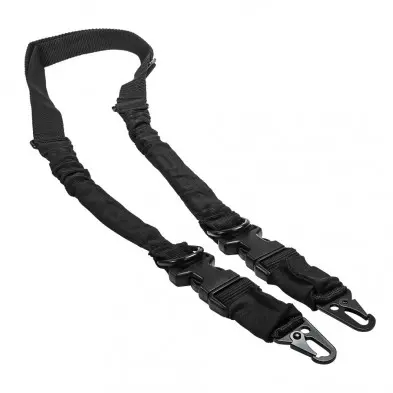
The core of this design is simple: 1.25-inch black nylon webbing, metal spring clips at each end, dual bungee shock cords under sleeves, polymer quick-release buckles, and paired D-rings. Nothing cute, nothing ornamental, and no padding to bulk it up. Length adjusts from 55 to 72 inches, which comfortably spans plate carriers, soft armor, and plainclothes setups.
In its native state, it’s a 2 point rifle sling that anchors the rifle across your chest or back. Snap one clip into the opposite-side D-ring, and it becomes a single point sling. There’s no separate adapter, no dedicated QD socket, and no tools. You’re using the geometry that’s already there.
Dual-bungee layout for controlled movement
Each end of the sling hides a bungee section under a protective sleeve. In real use, that matters more than most buyers expect: the rifle stays close when you break into a run or go hands-on, but you still have enough give to shoulder and mount the gun without feeling like you’re fighting a rubber band. Compared to fixed webbing, it’s less jarring; compared to overly stretchy slings, it doesn’t slingshot the muzzle.
Metal clips and matte hardware that don’t advertise themselves
The metal spring clips bite securely onto standard sling loops, and the matte black finish keeps reflections down. The rest of the hardware—quick-release buckles and triglides—is polymer and equally low-profile. Nothing rattles. Nothing shines. This matches the rest of a modern low-vis or duty rig instead of standing out.
The best rifle sling for shooters who switch between 2 point and single point
If you’ve ever owned both a dedicated 2 point rifle sling and a separate single point sling, you already know the hassle: rethreading, swapping hardware, or just settling for the wrong setup because you’re mid-course. The PivotLink layout solves that problem with those D-rings sitting just inboard of the quick-release buckles.
Run it as a 2 point rifle sling while you’re moving distance, climbing, or working around vehicles—muzzle is controlled, weight is distributed, and the carbine stays tight to the body. When it’s time for fast shoulder transitions, dynamic entries, or close-quarters work, you clip one end to the opposite D-ring. You’ve effectively created a single point sling without breaking your rhythm.
Who actually benefits from the conversion feature
This isn’t for someone who only plinks at a static bench. The conversion shines for patrol officers, carbine course students, and shooters who split their time between structured range drills and more fluid scenario work. If your use is 90% hiking with a rifle and 10% drills, you might prefer a padded, fixed 2 point rifle sling instead. But if you routinely need to balance retention with agility, this convertible setup is the better fit.
Carry reality: how this sling behaves over hours, not minutes
At 1.25 inches wide, the webbing is a deliberate middle ground. It’s wide enough not to cut into the shoulder during a long day but slim enough to thread through crowded sling slots, over gear, and around plate carriers without bunching. There’s no foam padding, which is a tradeoff: you lose some plush comfort, but you gain a flatter profile with less snag potential on chest rigs, radio wires, and mag shingles.
Adjustment from 55 to 72 inches covers most body types and gear loads. Once set, the webbing doesn’t creep; the triglides do their job, and the bungee sections handle the motion instead of your shoulder. Quick-release buckles near the D-rings let you strip the sling from the rifle without unthreading it from your kit, which is especially useful if you’re transporting, cleaning, or handing the gun off.
Noise and snag management
The all-black hardware and sleeves keep the profile visually quiet, but the more important piece is sound. Under movement, there’s no noticeable clank from the clips or D-rings, and the bungees keep the rifle from whipping against kit. Compared to loose webbing or cheaper slings with thin hardware, this feels more composed when you’re actually working around barriers or vehicles.
Honest tradeoffs: where this sling is not the best choice
Every “best” claim deserves boundaries. This is not the best rifle sling if your priority is maximum cushioned comfort on multi-day backcountry hunts; a padded, non-bungee 2 point rifle sling will ride softer over heavy packs. It’s also not the best choice if you strictly shoot from a bench or don’t move much—there, the dual bungees and conversion hardware are overkill.
Where the PivotLink Duty-Ready Convertible Rifle Sling legitimately earns a “best” label is for shooters who need one sling to cover patrol-style carry, structured range work, and dynamic training scenarios without swapping gear. It’s built to be your default, not your specialist tool.
Common Questions About the Best Rifle Slings
What makes a rifle sling the best choice for duty or training?
The best rifle sling for duty or serious training does three things reliably: controls the rifle during movement, allows fast access to a shooting position, and doesn’t add mental load. In this design, the bungee sections control sway without feeling elastic, the 2 point configuration stabilizes the rifle across your chest, and the single-point conversion uses hardware that’s already on the sling—no extra adapters, no rethreading mid-course.
How does this convertible rifle sling compare to a fixed single point sling?
A fixed single point sling is excellent for close-quarters agility and rapid shoulder switches, but it’s poor at long-distance movement and muzzle control—the rifle tends to hang low and swing. This 2-to-1 convertible sling starts as a 2 point rifle sling for retention and comfort over distance, then becomes a single-point-style rig when you clip one end to the D-ring. You don’t quite get the absolute minimalism of a dedicated single point sling, but you gain far better versatility in how you carry and manage the gun across a full day.
Who should choose this dual-bungee, 2-to-1 rifle sling?
This sling is best for shooters who move more than they sit. Patrol officers, security teams, and carbine-course shooters who run drills that mix walking, kneeling, going hands-on, and shooting from both shoulders will get the most value. If your rifle lives on a rack or at a static bench, a simpler strap will suffice. If your rifle actually works—on the range or in the field—this setup keeps it controlled, accessible, and adaptable without constant adjustment.
If you’re looking for the best rifle sling for patrol, range work, and training with a single setup, this is it—because the PivotLink design turns a lean, quiet 2 point rifle sling into a fast, reliable 2-to-1 convertible system using only the hardware that’s already on the strap. No gimmicks, no extra parts, just a sling that keeps up with how you actually run a carbine.