Prism Flash Assisted EDC Knife - Rainbow Titanium
15 sold in last 24 hours
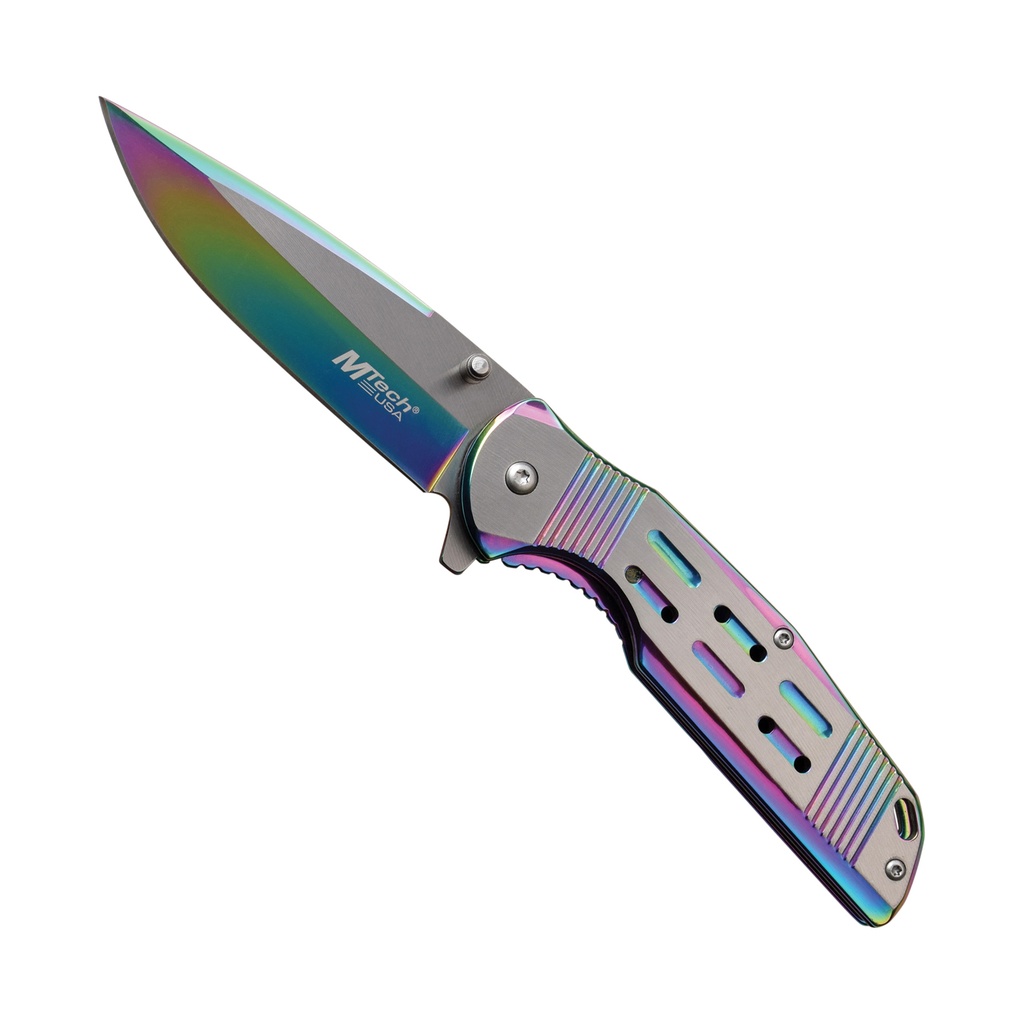
This isn’t trying to be the best OTF knife; it’s a budget-friendly assisted EDC that earns its spot with fast spring deployment and a compact 4.5-inch stainless handle. The 3.5-inch 3Cr13 drop point takes a working edge quickly and shrugs off casual abuse. Stainless steel scales with milled slots and jimping give solid control despite the flashy rainbow titanium-style finish. It rides deep enough with a pocket clip to carry daily for light utility, desk duty, or backup use without feeling precious.
Why This Knife Isn’t an OTF — and Why That Matters
Let’s get the honest part out of the way: this is not an OTF knife. It’s a spring-assisted folding knife that opens via flipper or thumb studs and locks with a liner lock. If you came here searching for the best OTF knife, you’re really comparing deployment speed, pocket manners, and real-world utility. On those terms, this assisted folder competes with entry-level OTFs on speed and price, but not on mechanism type.
If you can live without a true out-the-front mechanism, this design gives you much of what buyers want from the best OTF knife for everyday carry: one-handed deployment, a compact footprint, and a blade that’s easy to keep working.
What Actually Makes the Best OTF Knife for EDC?
Before judging this knife, it’s worth outlining what separates the best OTF knife for EDC from cheap gimmicks:
- Reliable one-handed deployment under light finger pressure, even with sweaty hands.
- Secure lockup with minimal blade play, especially in a double-action OTF.
- Manageable size: roughly 3–3.5-inch blade, pocketable closed length.
- Reasonable steel that sharpens easily and doesn’t rust if you miss a cleaning.
- Carry comfort: low hotspots, usable clip, and a profile you forget until you need it.
This M-Tech Ballistic design hits several of those criteria, just via an assisted opening folder rather than a sliding OTF chassis. That’s the key tradeoff: OTF feel vs. folding practicality and price.
Mechanism: Assisted Opening as a Budget OTF Alternative
Deployment Speed and Consistency
The spring-assisted mechanism on this knife is straightforward: press the flipper tab or flick a thumb stud, and an internal torsion spring snaps the blade into lockup. In practice, deployment speed is in the same ballpark as many budget OTF knives. There’s no thumb slide, but the flipper tab forms a small guard and is easy to index even without looking.
Where a true double-action OTF can feel gritty or develop play over time, the simpler pivot-and-spring system here is easier to keep running. A drop of oil at the pivot and occasional lint clearing keeps it snapping open. For someone shopping for the best OTF knife under a tight budget, this assisted opener offers OTF-like speed without the mechanical complexity.
Lockup and Safety
The liner lock engages behind the 3.5-inch drop point with an audible click. It’s not overbuilt; this is a light- to medium-duty EDC, not a prying tool. In firm cutting and box breakdown, the lock stays put, and the jimped liner gives positive disengagement when you actually want to close it. Unlike some OTF knives that allow a minor amount of blade wiggle by design, this one can be tuned at the pivot for a tighter feel, trading a bit of fidget-friendliness for solidity.
Blade and Steel: 3Cr13 for Realistic Everyday Use
Steel Choice and Edge Behavior
The blade is 3Cr13 stainless, a workmanlike steel you usually see at this price point. It won’t compete with premium steels in edge retention, and pretending otherwise would be dishonest. What it does offer is predictable behavior: it sharpens quickly on basic stones or a pull-through sharpener, resists rust in normal pocket carry, and is forgiving of abuse.
For the kind of user considering an inexpensive OTF or assisted knife—opening packages, cutting tape, light rope, and general utility—3Cr13 is acceptable. You’ll touch it up more often than a higher-end steel, but maintenance is straightforward.
Blade Geometry and Practical Cutting
The 3.5-inch drop point profile is conservative in the best way. There’s a usable belly for slicing, a fine enough tip for detail work, and a swedge on the spine to reduce visual weight. The satin primary grind sheds tape and adhesive better than heavily coated blades. That rainbow titanium-style finish is mostly on the spine; it doesn’t interfere with the cutting surface.
Carry Reality: How It Compares to the Best OTF Knives for EDC
Folded, the knife sits at 4.5 inches, squarely in everyday carry territory. Stainless steel handles with rainbow coating sound slippery, but the milled slots and shallow grooves give the fingers something tangible to bite into. You don’t get the contoured grip of a high-end OTF chassis, but for normal grip positions it’s adequate.
The pocket clip is conventional and rides reasonably deep. It’s not reversible or left-hand friendly, a compromise many budget OTF and assisted knives also make. If you’re comparing this to the best OTF knife for everyday carry, the main difference in pocket is thickness: an OTF tends to be a flat bar, while this is a typical folding knife silhouette with a bit more belly in the handle.
Best For: Flashy Budget EDC, Not Hard-Use Tactical
Every “best” knife needs a clearly defined lane. This knife is best for budget-conscious EDC users who want fast one-handed deployment and a standout rainbow aesthetic, and who are honest about its limits.
- Best for: Everyday light utility, backup carry, or a first assisted knife for someone drawn to the iridescent finish.
- Not best for: Survival tasks, heavy prying, or users who specifically require a true double-action OTF mechanism.
If your priority is owning the absolute best OTF knife for hard professional use, look elsewhere in a higher price bracket. If you want something that carries like a typical pocket knife, opens about as fast as many budget OTFs, and looks nothing like the blacked-out blades in everyone else’s pocket, this fits.
Value: Where It Stands Against Entry-Level OTF Options
In the current market, most best OTF knife under $100 contenders still cost several times what this assisted opener does. They add genuine OTF mechanisms but often compromise on steel or fit and finish. Here, M-Tech leans on a simpler mechanism and proven 3Cr13 steel to keep costs down while delivering consistent deployment and a distinctive rainbow titanium-style treatment.
The value proposition is straightforward: you trade the novelty and exact feel of a sliding OTF for a more basic, easier-to-maintain assisted folder that hits the same core requirement—fast, one-handed access to a workable blade—at a fraction of the investment.
Common Questions About the Best OTF Knives
What makes an OTF knife the best choice for EDC?
The best OTF knife for EDC combines three things: dependable double-action deployment, a compact chassis that carries flat in the pocket, and a blade that’s easy to maintain. When those come together, you get near-instant access to a usable edge with minimal pocket bulk. An assisted folder like this M-Tech can mimic the speed and one-handed operation, but it doesn’t offer the inline slide feel or ambidextrous symmetry of a true OTF.
How does this assisted knife compare to a budget OTF knife?
Compared to a typical budget OTF, this knife trades the sliding mechanism for a pivoting assisted blade. You gain a simpler build, fewer moving parts to fail, and easier cleaning. You lose the characteristic OTF deployment and the ability to retract the blade with the same control slide. Edge steel (3Cr13) is similar to what you see in many lower-cost OTFs, so real cutting performance is comparable; the difference is primarily in mechanism and ergonomics.
Who should choose this assisted knife?
Choose this knife if you’re OTF-curious but primarily need an inexpensive, reliable everyday cutter with one-handed deployment and you happen to like the rainbow titanium-style look. It suits casual carriers, students, and anyone building a rotation of visually distinct EDC pieces. If your use case demands the best OTF knife for duty, defensive carry, or heavy work, invest in a higher-end OTF with a proven track record instead.
Recommendation: If you’re looking for the best OTF knife alternative for colorful budget EDC, this is it — because the assisted mechanism delivers OTF-like deployment speed, the 3.5-inch 3Cr13 blade covers daily cutting tasks, and the rainbow titanium-style stainless handle turns a basic tool into a distinctive pocket companion.
| Blade Length (inches) | 3.5 |
| Overall Length (inches) | 8 |
| Closed Length (inches) | 4.5 |
| Blade Color | Rainbow |
| Blade Finish | Satin |
| Blade Style | Drop Point |
| Blade Edge | Plain |
| Blade Material | 3Cr13 |
| Handle Finish | Rainbow |
| Handle Material | Stainless Steel |
| Theme | Iridescent |
| Pocket Clip | Yes |
| Deployment Method | Spring-assisted |
| Lock Type | Liner lock |