Quiet Line Dual‑Carry Concealed Belt Holster - Black Leather
13 sold in last 24 hours
For concealed carry, this isn’t about looking tactical—it’s about disappearing. This genuine black leather dual‑carry holster rides IWB or OWB, using a 1.75" belt slot and removable clip to lock into place without printing. The flat profile and stitch‑reinforced molding break in around medium and large‑frame pistols, giving reliable friction retention without bulky hardware. It’s ambidextrous, quiet on the draw, and built to ride the same spot every day for people who actually carry, not just hit the range on weekends.
What Makes a Concealed Carry Belt Holster Earn “Best” Status?
For everyday concealed carry, the best holster isn’t the flashiest—it’s the one you forget you’re wearing until you need it. After living with leather, Kydex, hybrids, and bargain-bin rigs, the criteria that actually matter shake out quickly: secure attachment to the belt, a draw stroke that feels the same every time, real concealment under ordinary clothes, and durability that survives daily on/off cycles without loosening or collapsing.
The Quiet Line Dual‑Carry Concealed Belt Holster - Black Leather earns its place as a best concealed carry belt holster for practical EDC because it focuses on those basics: a 1.75" fixed belt slot for OWB stability, a removable clip for IWB flexibility, and a low‑profile black leather body that doesn’t print or advertise that you’re armed. No gimmicks, just quiet function.
Why This Rides Like the Best Concealed Carry Belt Holster for Everyday Use
This design is built around real belt contact. The dedicated 1.75" belt slot runs vertically and flat, which matters more than it sounds. Many budget holsters rely on floppy loops or narrow slots that slide along the belt; this one anchors the holster in one place. On a stiff 1.5–1.75" carry belt, it resists tilting or migrating toward your belt buckle over the day, so your draw index stays consistent.
For inside‑the‑waistband carry, the removable clip handles the attachment duty. It gives you a faster on/off option than threading the belt every time, which is exactly what you want if you move between environments where you can and can’t carry. The clip is positioned to keep the gun tight to the body, so the holster doesn’t tent your shirt or drag your waistband away from your frame.
Ambidextrous Setup That Keeps the Draw Familiar
Plenty of holsters claim to be universal; very few manage ambidextrous use without compromise. This one is symmetrical enough to work for right‑ or left‑handed carriers, OWB or IWB. Because the body is a simple rectangular leather panel with molded channels, you’re not fighting a right‑hand bias baked into the geometry.
That said, it’s best for straight‑drop or slight forward cant setups. If you prefer aggressive cant or appendix‑specific rigs, you’ll find purpose‑built Kydex holsters better suited than this classic leather pattern.
Concealment First: Low‑Profile, No‑Logo Gunleather
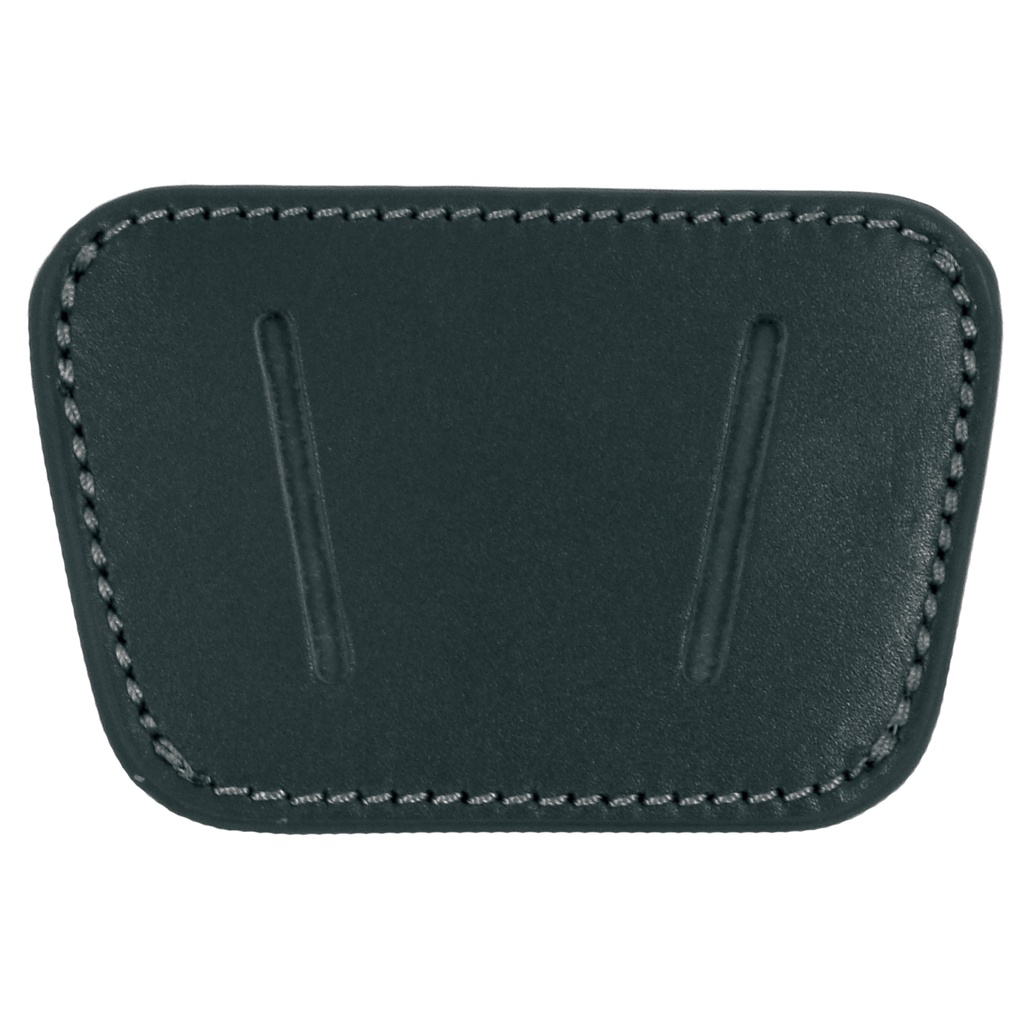
Concealed means concealed. The smooth black leather, rounded corners, and logo‑free face keep this holster visually quiet. Under a T‑shirt or button‑down, the flat profile spreads the pistol’s outline instead of projecting hard edges. The contrast stitching looks traditional from the rare moments it’s visible, reading more like a dress belt accessory than overt tactical gear.
Build Quality: Why This Holster Outlasts the Budget Bin
Leather holsters live or die on stitching and edge work. Here, the perimeter stitching is tight, evenly spaced, and pulled into a shallow groove so it won’t abrade quickly against a belt or seatbelt. That’s the sort of detail you notice only after a year of daily carry, when cheap thread starts to fuzz and pop and better stitching just keeps doing its job.
The edges are rounded and finished cleanly, which reduces hot spots on the hip—a real difference over eight hours in a car or office chair. Combined with the smooth leather surface, it slides against clothing instead of grabbing it, helping shirts drape more naturally over the gun.
Mold‑to‑Firearm Fit and Friction Retention
This is a friction‑fit, mold‑to‑firearm holster designed for medium and large‑frame handguns. That matters: it’s not a stiff, fully boned, model‑specific rig, but a leather body that breaks in around your pistol after some carry time. Out of the package it will feel snug; after a few draw cycles and some wear, the leather beds in and holds the gun with a firm, predictable tension.
That friction retention is quiet—no snaps to unsnap, no retention levers to defeat. For concealed carry, where your first indication of trouble may be sudden, that simplicity is a feature. The tradeoff is that it’s not the best holster for high‑energy retention requirements like mounted duty or running obstacle courses; a rigid, level‑II or level‑III retention holster would be more appropriate there.
Where This Holster Is Not the Best Choice
Honesty matters. This is not the best holster for deep concealment in tucked‑shirt environments; specialized tuckable clips or appendix designs do that better. It’s also not the best solution for competitive shooters seeking ultra‑fast open carry draw, where offset race holsters shine.
Where it is the best concealed carry belt holster is for ordinary civilian or plainclothes use: under an untucked shirt, hoodie, or light jacket, worn for ten or more hours without needing to be adjusted every hour.
Carry Reality: How It Actually Wears Day After Day
On the belt, the holster’s flat, rectangular footprint spreads the weight of a medium or large‑frame handgun instead of digging one pressure point into your hip. If you’ve ever carried a thick plastic shell that prints as a distinct block, this profile feels notably more forgiving.
The 1.75" belt slot is generous enough to take most common gun belts without binding, but still tight enough that the holster doesn’t cant outward once you add the weight of the pistol. Combined with the ambidextrous layout, it’s easy to find a ride height and position that matches your draw habits, then keep it there.
Because the exterior is smooth leather, it doesn’t chew up cover garments. Over months of carry, that saves the hems of T‑shirts and the inner edge of jackets that often get scalloped by rough Kydex corners or unfinished leather.
Common Questions About the Best OTF Knives
What makes an OTF knife the best choice for EDC?
For everyday carry, the best OTF knife combines reliable double‑action deployment, a blade steel that holds a working edge, and a slim profile that actually disappears in the pocket. In practice, that means a mechanism that doesn’t misfire after pocket lint, a blade you don’t have to baby, and ergonomics that let you deploy and retract the blade one‑handed without shifting your grip.
How does this OTF knife compare to a folding knife?
The best OTF knife for EDC trades a bit of ultimate lock strength for speed and convenience. Compared to a traditional folding knife that needs a thumb stud or flipper, a good OTF gives you instant, straight‑line deployment and retraction. For heavy prying or hard lateral torque, a stout folder still wins, but for quick, repeated open‑and‑close use, OTF designs are hard to beat.
Who should choose this OTF knife?
The best OTF knife belongs with users who value fast, repeated one‑handed operation—first responders, gear enthusiasts, and anyone who uses a blade as a daily tool rather than an occasional accessory. If you prioritize deployment speed, pocket carry comfort, and mechanical interest, a well‑built OTF fits that niche better than most conventional folders.
Who This Holster Actually Serves Best
This holster is built for the person who clips on a handgun every morning and takes it off every night. If you’re carrying a medium or large‑frame pistol in plain clothes—civilian, off‑duty, or plainclothes professional—it hits a practical sweet spot: ambidextrous, dual‑carry flexibility; stable 1.75" belt slot; and leather that molds to your gun and your body over time.
If you’re looking for the best concealed carry belt holster for straightforward, everyday defensive carry—under normal clothing, on a real belt, with a full‑size or compact handgun—this is it, because it focuses on the fundamentals: secure belt attachment, quiet friction retention, low‑profile concealment, and leather construction that becomes more comfortable the more you actually carry it.