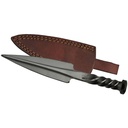
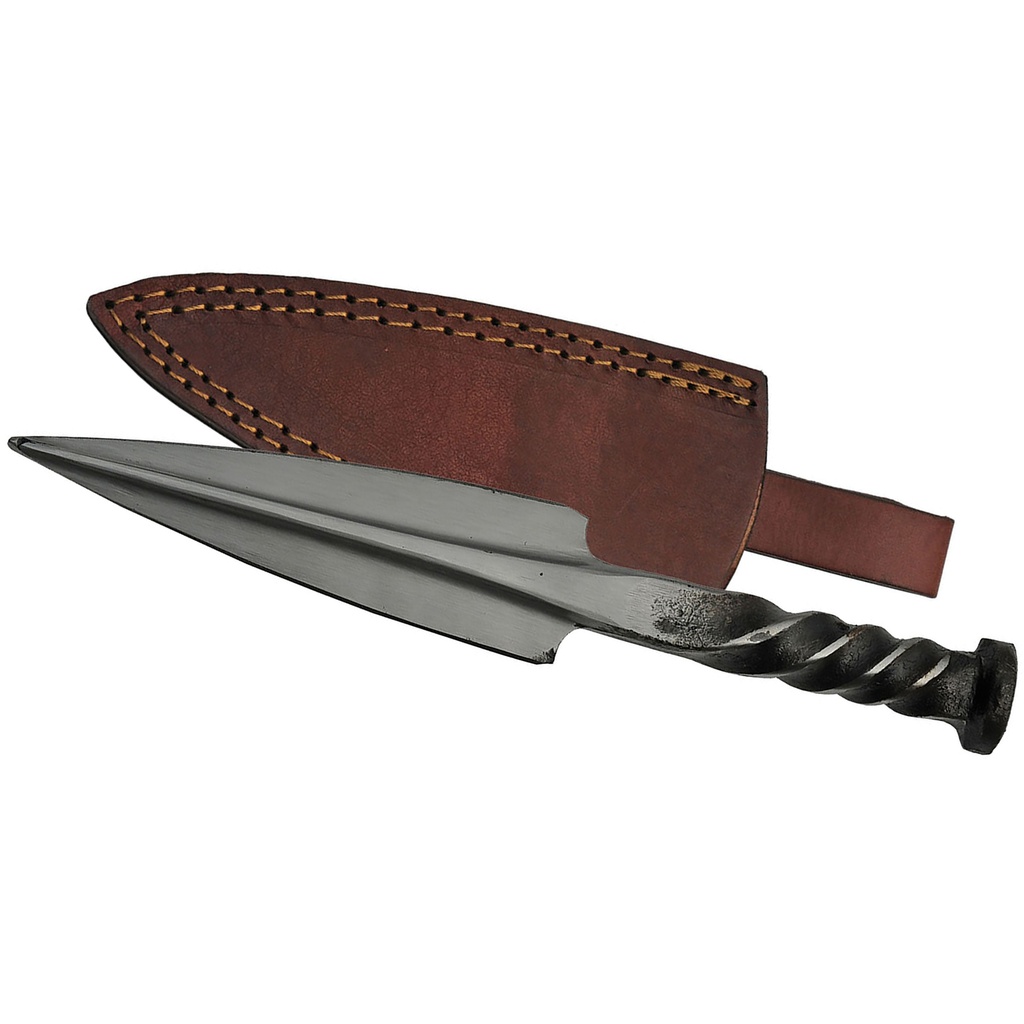
Railline Twist Heritage Fixed Blade Knife - Brown Leather
13 sold in last 24 hours
This isn’t a novelty railroad spike—it’s a working fixed blade with heritage baked in. The forged twist handle gives real purchase, while the 5.5-inch spear point carbon steel blade brings enough length and spine thickness for camp chores and light bushcraft. At 10 inches overall with a full tang and spike-head pommel, it feels like a tool, not decor. The stitched brown leather sheath rides comfortably on a belt, making this a forged-style knife you’ll actually carry, not just display.
What Makes a Knife Earn “Best” Status (Even When It’s Not an OTF)
This knife isn’t an OTF. It’s a fixed blade forged from a railroad spike, and it earns its place in a serious kit for the same reasons the best OTF knife does: honest steel, reliable carry, and a design that makes sense in the hand, not just in photos. If you’re shopping OTFs for pocket duty but also want a belt knife for camp or truck use, this forged fixed blade fills that gap better than a lot of folders trying to do everything.
Where the best OTF knife focuses on deployment speed and pocket manageability, this Railline Twist Heritage Fixed Blade Knife leans into durability, simplicity, and heritage styling. One complements the other: OTF in the pocket, forged fixed blade on the belt.
Railline Twist Heritage Fixed Blade vs the Best OTF Knife for EDC
On paper, a 10-inch, full-tang railroad spike knife and a compact OTF don’t belong in the same conversation. In practice, they often live in the same kit. You turn to the best OTF knife for EDC when you need a one-handed, discreet cutter for boxes, cord, or quick utility tasks. You turn to this forged fixed blade when you’re at camp, at the truck, or in the yard and want a tool you’re not afraid to beat on.
The 5.5-inch spear point blade gives you more reach and leverage than any reasonable OTF. Its quarter-inch spine thickness and full-tang construction make prying, light batoning, and rough camp work feel safer than doing the same with a spring-driven mechanism. If your OTF is the precision scalpel in your system, this is the small prybar and bush tool that backs it up.
Blade Geometry and Real-World Cutting
The spear point profile with a central groove looks ornamental at first glance, but it does a few practical things. The symmetrical tip tracks straight in push cuts, makes controlled punctures into packaging or tinder bundles, and feels intuitive when you’re doing fine point work. The plain edge is easier to maintain than a partial serration, which matters when you’re sharpening on a basic stone at camp.
Carbon steel is chosen here for toughness and ease of sharpening rather than stainless convenience. Compared with the stainless steels typically found in the best OTF knife for everyday carry, this blade will take a patina and requires a bit more care, but it will also take a very keen edge quickly. That’s a fair tradeoff for a belt knife that sees real outdoor work rather than desk duty.
Handle: Twisted Spike Grip That Actually Works
Railroad spike knives often lean hard into the novelty angle and forget ergonomics. This one doesn’t. The twisted steel handle gives your fingers defined purchase points, and the slight flare of the spike head at the pommel gives your hand a natural stop in reverse or standard grip. It isn’t as sculpted as a modern G10 OTF handle, but that’s part of the point—this feels like a tool you can grab with gloved, cold, or dirty hands and not fuss over.
The matte steel handle isn’t going to win any traction contests against textured aluminum OTF handles, and it will transmit more temperature in winter. That’s the honest tradeoff: you gain integral, bombproof construction and heritage aesthetics, at the cost of some modern grippiness. For camp and truck use, that’s a reasonable bargain.
Best Fixed Blade Companion for OTF Users
If you already own what you consider the best OTF knife for EDC, you don’t need another pocket knife—you need a complementary role. This rail spike fixed blade is best as a companion knife for people who carry an OTF but don’t want to abuse it. Use the OTF for fine cutting and daily tasks. Use this for batoning kindling, scraping bark, light prying, and anything you’d hesitate to do with a spring-driven mechanism.
The full-tang design, 5.5-inch blade length, and 0.25-inch spine put this firmly in the small camp knife category: big enough to process kindling, carve notches, or prep food, yet compact enough that it doesn’t feel absurd on a belt. You don’t buy this instead of the best double action OTF knife—you buy it so your OTF can stay sharp and tight longer.
Carry and Sheath Reality
The top-grain brown leather sheath is a quiet upgrade over the generic nylon that often comes with budget fixed blades. The vertical belt loop rides at a sensible height—high enough to stay out of the way when you sit, low enough that the handle clears most jackets. The leather has enough stiffness to re-sheath one-handed with a bit of practice, though it’s not a tactical quick-draw rig and doesn’t pretend to be.
Compared to the deep-pocket clips that make the best OTF knife disappear in jeans, this setup is openly carried. It’s more at home around camp, on private property, or in the truck than in an office environment. That’s the honest limitation: it’s not a discreet urban EDC piece; it’s a visible, traditional belt knife.
Where This Knife Excels (And Where It Doesn’t)
This knife is best for buyers who want functional forged style and aren’t afraid of basic maintenance. Carbon steel means you should wipe it down after wet use and accept that a dark patina is part of its life. In return, you get a blade you can touch up quickly with simple tools—no exotic stones needed.
It’s not the best choice if you’re looking for a rust-proof, leave-it-in-the-boat-all-season solution. Stainless hunters or the best OTF knife with corrosion-resistant steel will serve you better there. It’s also not ideal for pure concealment; if legal grey areas or low profile are your main criteria, a slim OTF wins easily.
Where this railroad spike knife shines is as a camp, truck, or property knife that you’ll actually use and won’t baby. It looks like a display piece but behaves like a working tool.
Common Questions About the Best OTF Knives
What makes an OTF knife the best choice for EDC?
The best OTF knife for everyday carry combines three things: reliable double-action deployment, a blade steel that holds a working edge through regular cutting, and a profile slim enough that you forget it’s clipped in pocket. One-handed open and close is the main draw. Where a fixed blade like this railroad spike knife wins is in strength and simplicity; where the best OTF knife wins is in convenience and discreet carry.
How does this OTF knife compare to a forged fixed blade like this?
Strictly speaking, this product is not an OTF knife; it’s a forged-style fixed blade. Compared to even the best OTF knife under $100, it trades speed and pocketability for durability and leverage. There’s no spring or track to foul with grit, no mechanism to fail, and the full-tang construction paired with a 0.25-inch spine lets you confidently tackle heavier tasks. In a pocket-focused urban kit, an OTF is the better primary. In a camp or truck kit, a fixed blade like this often sees more honest work.
Who should choose this OTF knife companion?
You should choose this knife if you already rely on what you consider the best OTF knife for EDC and want a dedicated beater for camp, property, or workshop use. It suits buyers who appreciate forged aesthetics, don’t mind wiping down carbon steel, and want a belt knife that looks like heritage but cuts like a modern tool. Collectors will enjoy the railroad spike story; practical users will appreciate that it feels comfortable doing real work.
Final Recommendation: The Best Forged-Style Partner for Your Best OTF Knife
If you’re looking for the best fixed blade companion to your best OTF knife for everyday carry, this railroad spike knife is it—because it takes on the rough camp and truck tasks you shouldn’t hand to a spring-driven mechanism. The full-tang carbon steel build, 5.5-inch spear point blade, and twisted spike handle give you leverage, toughness, and control, while the brown leather belt sheath keeps it ready without fuss. Let your OTF stay sharp for precision cuts; let this forged-style workhorse handle the rest.
| Overall Length (inches) | 10 |
| Blade Color | Silver |
| Blade Finish | Polished |
| Blade Style | Spear Point |
| Blade Edge | Plain |
| Blade Material | Carbon Steel |
| Handle Material | Steel |
| Theme | Twist Handle |
| Sheath/Holster | Leather Sheath |