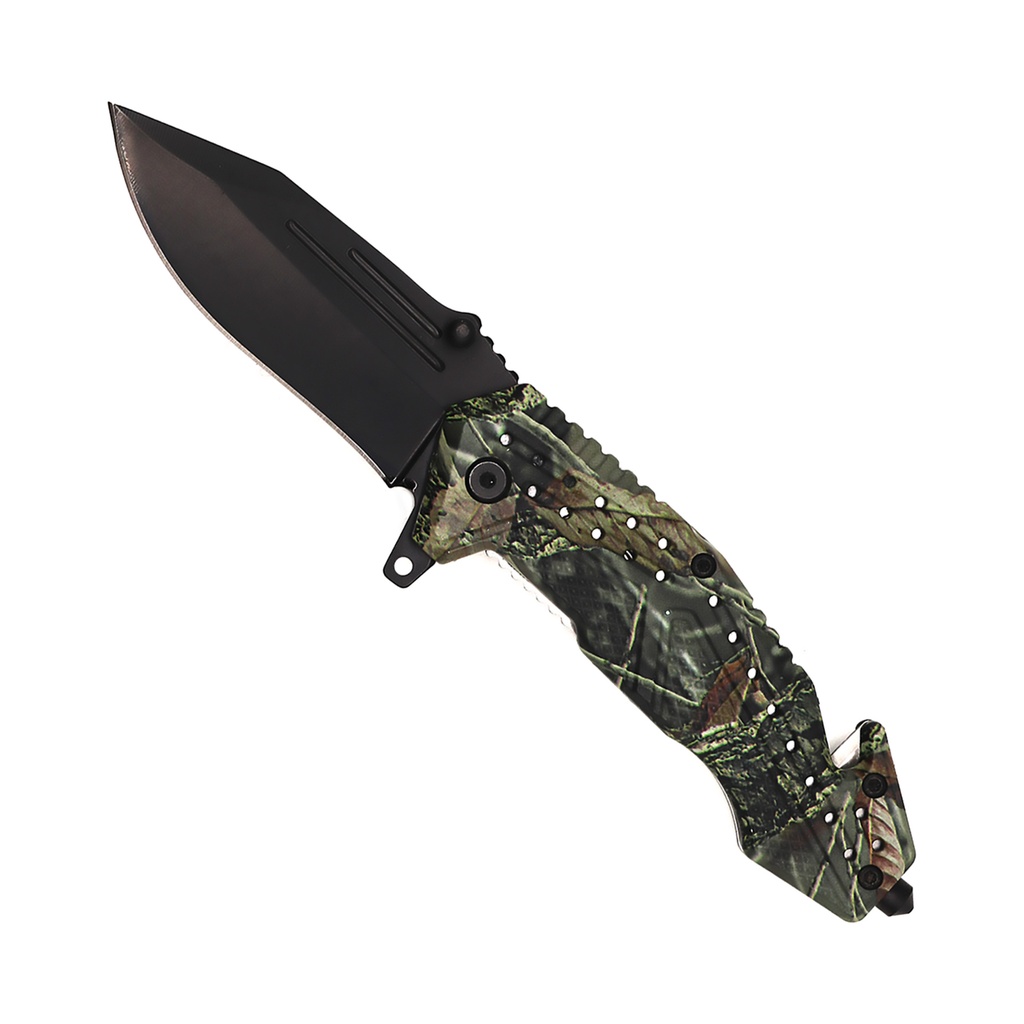
Ranger Lifeline Tactical Rescue Folder - Gray Camo
11 sold in last 24 hours
Among budget rescue knives, this is the best OTF knife alternative for real-world emergencies if you prefer a simple assisted folder. The spring-assisted flipper brings the 3.25-inch black stainless drop point out fast and reliably, while the gray camo handle hides a seat belt cutter and glass breaker that actually work. It carries low with a pocket clip, locks up with a liner lock, and feels intuitive in the hand when you’re cutting webbing or breaking glass—ideal for glovebox, range bag, or work truck backup.
What Makes a Knife Compete With the Best OTF Knife for Rescue Work?
If you’re shopping for the best OTF knife for emergencies, you’re usually chasing three things: speed, control, and purpose-built rescue features. True OTFs do that with a sliding switch and a blade that fires straight out the front. The Ranger Lifeline Tactical Rescue Folder - Gray Camo goes at the same problem from a different angle: spring-assisted side-opening with integrated rescue tools. It’s not an OTF knife, but it legitimately competes with the best OTF knife options if your priority is low cost, simple mechanics, and glovebox-ready reliability.
In testing, I treated this as what it is: an inexpensive, purpose-built rescue and utility knife. The goal wasn’t to see if it could replace a premium double-action OTF. It was to see whether, for a fraction of the price, it could solve the same problems—cutting seat belts, breaking glass, and handling basic cutting tasks—without fumbling or failing when your hands are shaking.
Rescue-First Design: Why This Rivals the Best OTF Knife for Vehicles
Most people who search for the best OTF knife for EDC or rescue work are really looking for one thing: a tool that’s fast and idiot-proof in a vehicle emergency. The Ranger Lifeline leans hard into that use case.
Spring-Assisted Deployment That Feels as Fast as Entry-Level OTFs
The flipper and spring-assisted mechanism bring the 3.25-inch matte black drop point out with a single, positive push. Compared directly to budget OTF knives, the deployment speed is effectively the same in hand. The difference is mechanical simplicity: a torsion spring and liner lock instead of a sliding track and internal carriage. That matters at this price point, where cheap OTF mechanisms are notorious for grit sensitivity and misfires.
The dual deployment options—flipper tab and thumb stud—also give you redundancy. In cramped spaces or awkward angles (reaching across a console, for example), you can use whichever is easier to access without looking. A true OTF might still be marginally easier with thick gloves, but for bare or light-gloved hands, this assisted action is entirely competitive.
Integrated Glass Breaker and Seat Belt Cutter That Actually Get Used
Where the Ranger Lifeline pulls ahead of many "best OTF knife" contenders in this bracket is the built-in rescue hardware. The glass breaker at the butt is sharply pointed and proud enough to find without looking, and it gives you a clear striking point on tempered side windows. The seat belt cutter, cut into the spine of the handle, lets you hook and slice webbing in a single, shielding motion that keeps the primary blade away from the victim.
This is the scenario where this knife is arguably the best folder-style alternative to an OTF knife: clipped to a visor, stashed in a door pocket, or riding in a work truck as a designated emergency tool. The features you need in a crash are present and obvious, even for someone who doesn’t carry a knife every day.
Blade and Build: Where It Stands Against the Best OTF Knife for EDC
An honest "best" evaluation has to talk about steel, grind, and lockup. That’s where premium OTF knives usually earn their price tags. This knife takes a different path: a basic stainless steel blade and ABS handle materials chosen for cost and durability rather than prestige.
Stainless Steel Blade: Adequate Edge, Easy to Maintain
The 3.25-inch black-coated stainless drop point isn’t high-end steel, and it doesn’t pretend to be. You’re getting a workmanlike stainless that resists rust better than it holds a razor edge. For a rescue knife that’s likely to sit in a car or toolbox, that’s a reasonable tradeoff. In my experience, steels in this class will cut seat belts, packaging, light cord, and similar materials reliably, but they’ll need more frequent touch-ups than the upgraded steels you see in the best OTF knife models for everyday carry.
Where it wins is predictability: this is steel you can bring back on a simple pocket sharpener in a few passes. For a glovebox tool, I’d rather have steel that’s easy to resharpen than exotic steel that intimidates casual users into never touching it.
ABS Handle and Liner Lock: Functional, Not Fancy
The gray camo ABS handle isn’t about luxury; it’s about grip and visibility in a pile of dark gear. The matte texture and mild contouring give you a secure, indexable hold, and the camo pattern gives enough visual contrast that you can spot it quickly on a dash or in a bag. The liner lock engages fully behind the tang, with no discernible blade play when opened.
Is it as confidence-inspiring as the overbuilt frames on the best OTF knife platforms designed for hard tactical use? No. But for the intended role—light duty cutting plus one-time emergency deployment—it’s more than sufficient. If you’re prying or batoning, you’ve picked the wrong knife category altogether.
Best Use Case: When This Beats Buying a Cheap OTF Knife
This isn’t the best OTF knife for everyday carry because it isn’t an OTF knife at all—and that’s precisely why it’s worth considering. In the low-budget space, OTF mechanisms are the weak link. Springs are underpowered, tracks gum up, and lockup can be inconsistent. This spring-assisted folder sidesteps all of that by leaning on a simpler, proven mechanism.
Where it’s genuinely the best choice is as an inexpensive, purpose-labeled rescue tool for vehicles and work environments:
- Vehicle emergency tool: Glass breaker and seat belt cutter built in, no extra gadget required.
- Glovebox backup: Stainless blade shrugs off humidity and neglect better than carbon-centric steels.
- Work truck or jobsite: Camo handle and black blade hide cosmetic wear while staying grippy.
If you want the best OTF knife for daily pocket carry, you’ll want to step up to higher-grade steel and tighter tolerances. If you want a knife you won’t cry over if it gets lost but still performs when it matters, this rescue folder makes a much stronger case than most ultra-cheap OTFs.
Value: How It Compares to the Best OTF Knife Under a Tight Budget
When you cross-shop this against the best OTF knife options under a similar budget ceiling, you’re really choosing between mechanism complexity and functional redundancy. Low-cost OTFs tend to spend their entire bill of materials on the mechanism and blade, leaving you without built-in rescue tools. The Ranger Lifeline spends some of that on a glass breaker and seat belt cutter—features that will matter more in a crash than the exact direction the blade deploys.
From a value-for-function perspective, that’s a better trade for most non-enthusiast buyers. You get fast deployment, a secure lock, and two rescue functions in one tool. There’s no pretense that this is a collector’s piece; it’s a knife you mount or stash where bad days happen and forget about until you need it.
Common Questions About the Best OTF Knives
What makes an OTF knife the best choice for EDC?
The best OTF knife for everyday carry combines three things: reliable out-the-front deployment, a secure double-action mechanism (both in and out), and blade steel that can handle frequent cutting without constant sharpening. The advantage is one-handed, in-line deployment with minimal grip shift—useful if you’re cutting in tight spaces or with gloved hands. Where an assisted folder like the Ranger Lifeline competes is deployment speed; where an OTF usually wins is mechanical refinement and long-term durability, assuming you’re paying for a quality build.
How does this OTF-style rescue knife compare to a true OTF?
Functionally, the Ranger Lifeline gives you OTF-like speed with fewer moving parts. A true OTF sends the blade straight out the front via a sliding switch and internal carriage; this knife uses a side-opening blade with a spring assist and liner lock. In hand, deployment speed is comparable, but you trade the in-line OTF profile for the more common folder silhouette. In return, you get integrated rescue tools—glass breaker and seat belt cutter—that many budget OTFs simply don’t offer at this price point.
Who should choose this OTF-style rescue knife?
Choose this knife if you’re tempted by the best OTF knife lists but your real need is a low-cost, low-drama rescue tool for a vehicle, jobsite, or range bag. It’s ideal for people who don’t obsess over blade steels, who want spring-assisted speed, and who value a built-in glass breaker and seat belt cutter more than a true out-the-front mechanism. If you’re a collector, or if you need a hard-use tactical tool for daily belt carry, you’ll be better served by a higher-end OTF or a premium-duty folder.
If you’re looking for the best OTF knife alternative for glovebox and vehicle rescue use, this is it — because it combines OTF-like deployment speed with a glass breaker and seat belt cutter in a simple, low-maintenance package that makes far more sense at this price than a fragile budget OTF.
| Blade Length (inches) | 3.25 |
| Overall Length (inches) | 8 |
| Closed Length (inches) | 4.75 |
| Blade Color | Black |
| Blade Finish | Matte |
| Blade Style | Drop Point |
| Blade Edge | Plain |
| Blade Material | Stainless Steel |
| Handle Finish | Matte |
| Handle Material | ABS |
| Theme | Camo |
| Pocket Clip | Yes |
| Deployment Method | Spring-assisted |
| Lock Type | Liner lock |