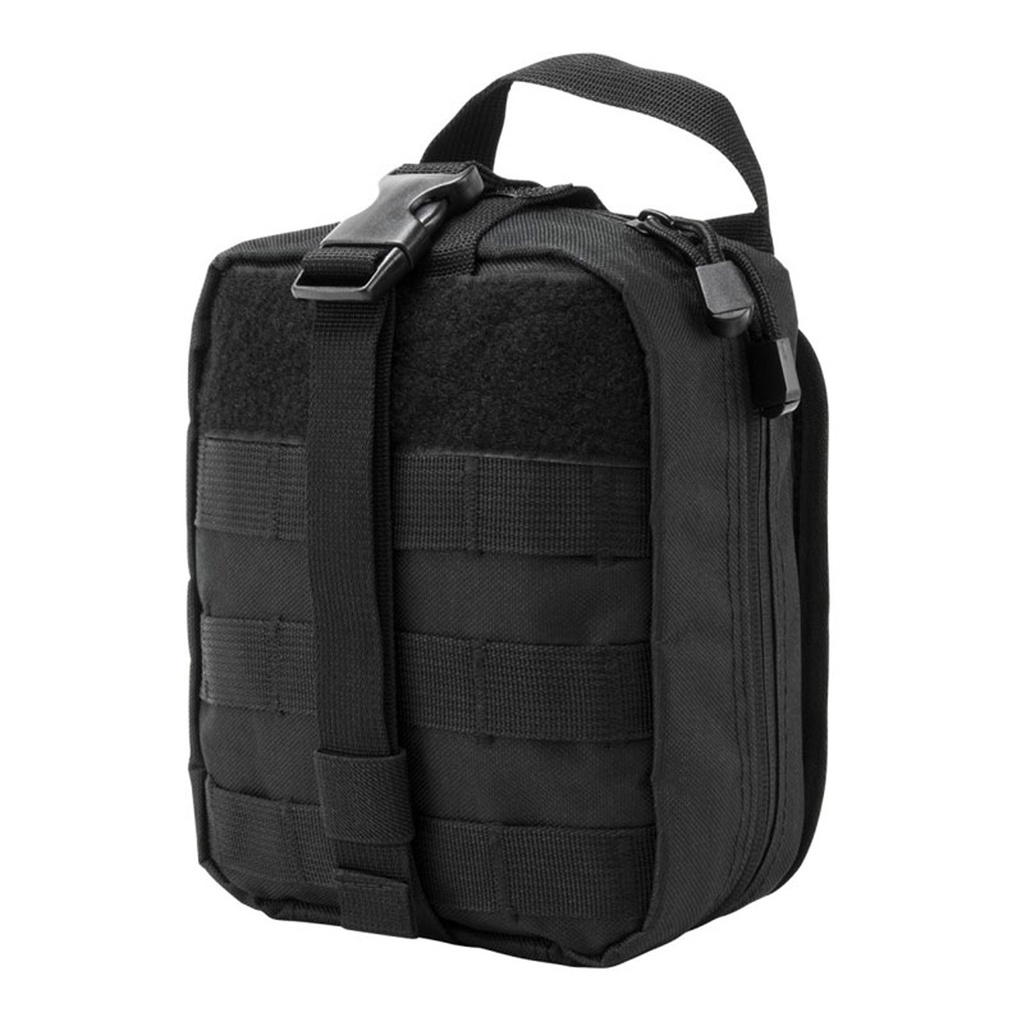
Rapid Access Tri-Fold EMT Organizer Pouch - Black
15 sold in last 24 hours
This MOLLE EMT pouch is built for people who actually carry medical or EDC gear, not just talk about it. The tri-fold design opens into three organized panels, so gloves, gauze, and tools don’t pile into one dark pocket. A quick-detach MOLLE base lets you rip the pouch free in an emergency, while the mesh zip panel and elastic loops keep contents visible and locked down. For range bags, duty rigs, or a truck kit, it’s compact, structured, and purpose-built.
Why This Pouch, Not Another Generic “Tactical” Bag
Most so-called EMT pouches are just single-compartment stuff sacks with MOLLE stitched on. This Rapid Access Tri-Fold EMT Organizer Pouch - Black actually earns its place on a serious kit because it’s designed around one job: getting small, critical items into your hand quickly, without dumping the whole pouch out.
Instead of a single cavity, this pouch unfolds into three distinct panels with dedicated pockets and elastic retention. Paired with a quick-detach MOLLE base, that turns it from “storage” into an organized, rip-away medical or EDC platform that works on a belt, vest, or pack.
What Makes the Best EMT Pouch for Everyday Carry
If you’ve spent time on ranges, trails, or job sites, you know what actually defines the best EMT pouch for everyday carry. It isn’t how tactical it looks; it’s how it behaves when you’re tired, rushed, or working in bad conditions.
Tri-fold layout that prevents gear pileups
This pouch’s tri-fold design opens flat into three separate zones. One panel is a zippered mesh compartment that lets you identify contents at a glance. The other two panels use layered pockets and elastic straps sized for bandages, shears, markers, gloves, and similar items. That separation means you don’t end up with a jumble of supplies at the bottom of a dark pouch.
Quick-detach MOLLE base for real emergency use
Instead of sewing the pouch directly to your belt or pack, it mounts to a MOLLE base via hook-and-loop. In an emergency, you pull it free and work from the pouch in your hands, not twisted sideways on your hip. The base stays attached to your platform, so re-mounting is as simple as pressing it back in place once things are calm again.
The Best MOLLE EMT Pouch for Structured, Modular Kits
In a world of one-pocket utility bags, this is one of the best MOLLE EMT pouch options if you build modular kits—one for first aid, one for tools, one for EDC, etc. The external MOLLE webbing and large loop field on the front make it easy to scale and identify those modules.
External MOLLE and loop panel for expansion
The front face has horizontal MOLLE webbing and a wide loop (hook-and-loop) panel. The webbing lets you stack a tourniquet holder, light sheath, or a slim admin pouch on the outside. The loop panel takes ID patches, medical crosses, or unit markers so you can distinguish this EMT pouch from a utility or tool pouch instantly.
PAL straps for secure mounting to existing gear
Two sewn-in PAL straps on the back interface with standard MOLLE channels on backpacks, chest rigs, range bags, or belts. Once woven through, the pouch doesn’t flop or walk loose. Combined with the 1-inch webbing strap and plastic quick-connect buckle across the front, the body of the pouch stays compressed and secure until you deliberately open it.
Carry Reality: Size, Access, and Where It Excels
On paper, the 8 inch by 6.5 inch by 3.5 inch dimensions put this squarely in the compact category. In practice, it carries like a small brick of organized capability—large enough to hold a proper first-aid loadout, small enough not to dominate your pack face or belt line.
Fully loaded with basic medical or EDC gear, it sits close to the body when attached to a vest or backpack. The top carry handle makes it easy to grab from a vehicle door pocket or locker. Dual zipper pulls allow you to open either side one-handed or run them together for a full clamshell-style access when you have both hands free.
Where it’s genuinely best is as a dedicated, structured first-aid or micro-EDC organizer that rides on MOLLE-compatible gear. It is not the best choice if you’re trying to carry bulky trauma dressings for a whole team or a complete wilderness-survival kit; you’ll hit the volume limit quickly. But for an individual med kit, range IFAK, or compact vehicle pouch, the dimensions are spot on.
Build, Materials, and Long-Term Use
Visually, it’s clearly a tactical-style pouch: matte woven fabric, boxy shape, reinforced seams, and clean, logo-free exterior. Functionally, that translates to reliable structure and predictable wear. The fabric is stiff enough that the walls don’t collapse when it’s partially loaded, so elastic loops and pockets stay usable over time.
The plastic quick-connect buckle on the 1-inch webbing strap is a simple, proven component—easy to operate with gloves and secure enough that accidental releases are unlikely. Zippers run along the top and side edge, giving you a wide opening; dual pulls mean you can configure how it opens based on your mounting orientation.
Hook-and-loop surfaces are generous but not overdone: enough area on the base for a solid quick-detach connection, and a broad front loop panel for patches without eating the whole face in fuzzy material. Stitching on the MOLLE webbing is visibly reinforced, which matters if you’re hanging the pouch off a pack that sees real miles.
Tradeoffs: What This MOLLE EMT Pouch Is Not
Honest assessment: this is not the best choice if your primary goal is maximum capacity or full trauma-kit loadouts for multi-patient response. The compact footprint and tri-fold structure favor organization over bulk storage. If you routinely pack large pressure dressings, airway adjuncts, and splinting materials in one pouch, you’ll want something larger.
It’s also not a dedicated, belt-riding IFAK engineered for instant tear-off via a pull handle; while the quick-detach base works well, it’s optimized for deliberate grab-and-go rather than blind yanks in tight quarters. For most civilian, range, and light-duty professional use, that’s a fair and practical tradeoff in exchange for more organization and versatility.
Common Questions About the Best OTF Knives
What makes an OTF knife the best choice for EDC?
When people look for the best OTF knife for everyday carry, they’re usually measuring three things: deployment consistency, pocket carry comfort, and reliability over time. The best OTF knife designs use a double-action mechanism that fires and retracts smoothly without blade play, a slim handle that disappears in the pocket, and quality materials that don’t choke on pocket lint or light debris. In short, the best OTF knife for EDC is the one you stop thinking about because it just works when you need it.
How does this OTF knife compare to a folding knife?
Shoppers comparing the best OTF knife to a traditional folding knife usually notice two differences. First, deployment: a well-built OTF is faster and more intuitive—push the thumb slider, and the blade is ready, with no wrist flick or thumbstud learning curve. Second, maintenance: the best OTF knife mechanisms are more complex than a simple pivot, so they reward occasional cleaning and a bit of mechanical sympathy. A good folder can be more forgiving, but when tuned correctly, a top-tier OTF offers uniquely fast, one-hand access.
Who should choose this OTF knife?
The best OTF knife isn’t automatically the best choice for everyone. It fits buyers who value quick, one-handed deployment in tight spaces—think opening packages while holding gear, working in vehicles, or gloved use. If you’re drawn to the best OTF knife for EDC because of its speed and compact footprint, and you’re comfortable with a slightly more involved mechanism in exchange for that performance, you’re the right audience. If you’d rather have a simpler tool that you never think about maintaining, a conventional folding knife may suit you better.
If you’re looking for the best compact MOLLE EMT pouch for building an organized, rip-away first-aid or EDC kit, this is it—because the tri-fold layout, quick-detach base, and external MOLLE/loop expansion combine into a system that’s purpose-built for real-world access rather than just tactical aesthetics.