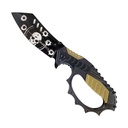
Reaper Trench Control Assisted Knife - Black Skull
4 sold in last 24 hours
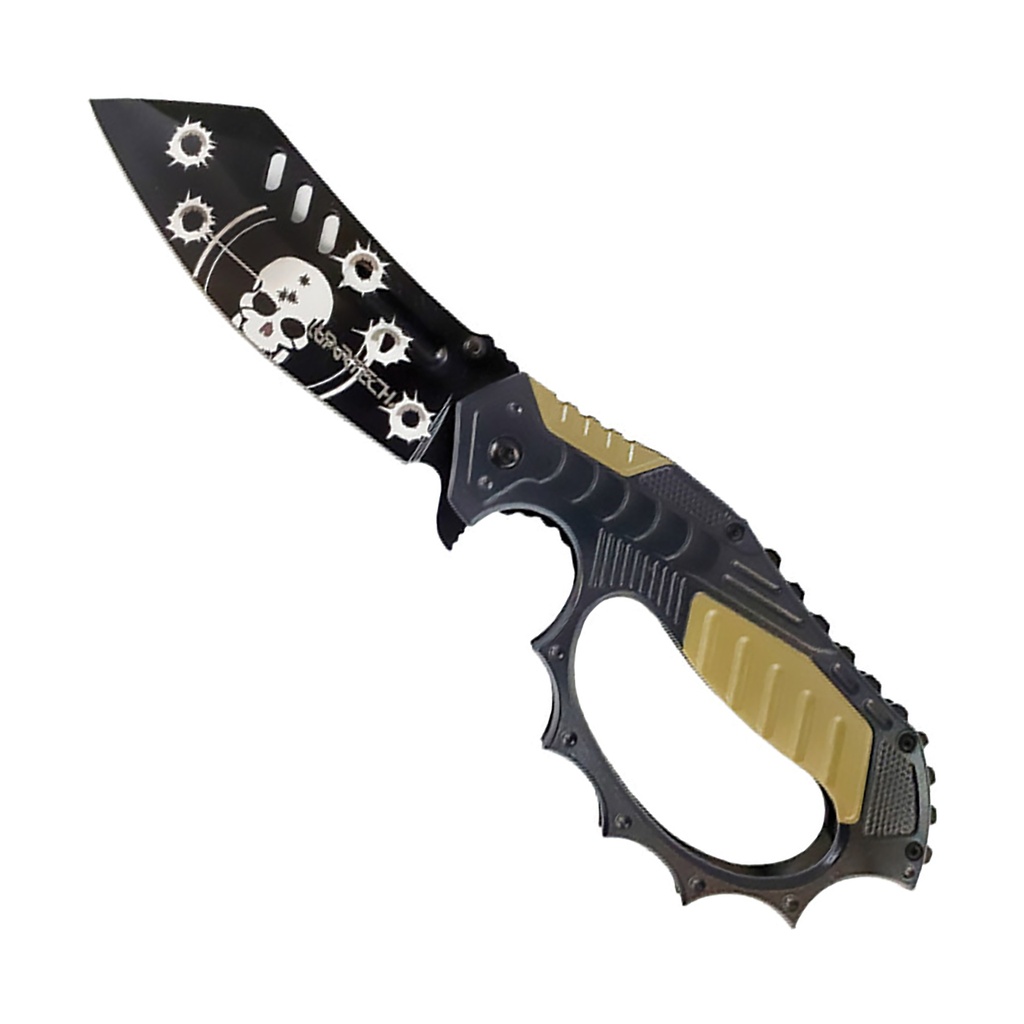
This isn’t a dainty EDC; it’s a skull‑themed trench knife built for grip and intimidation. The Reaper Trench Control Assisted Knife pairs a 3.5-inch drop-point blade with spring-assisted deployment, so it snaps open faster than any manual folder I’ve carried in this price range. The full knuckle-guard handle locks your hand in with finger grooves and tan inlays that actually bite into your grip. It’s best suited as a budget tactical or glovebox backup for buyers who want presence as much as cutting performance.
What Makes the Best OTF Knife a Serious Tool, Not a Toy?
When people search for the best OTF knife or the best OTF knife for EDC, they’re usually trying to avoid one thing: gimmicks. They want fast deployment, control under stress, and a knife that feels like a tool, not a movie prop. Even though the Reaper Trench Control is a spring-assisted trench knife rather than a true OTF, it competes for the same role in a lot of buyers’ minds: a quick-deploy, tactical-leaning blade that lives in a pocket, bag, or vehicle.
So it’s worth judging it by the same criteria we use when we test contenders for the best OTF knife: deployment speed, retention and grip, blade geometry, carry reality, and value. On those fronts, this knife earns its place as a budget tactical option, with some very clear strengths—and equally clear limitations you should walk in knowing.
Deployment and Control: Assisted Speed vs. OTF Mechanisms
A true double-action OTF fires and retracts the blade in-line with the handle. Here, you’re dealing with a side-opening, spring-assisted folder using a flipper tab. From the pocket, it’s a thumb on the handle, forefinger on the tab, and a decisive press. The assisted mechanism takes over and snaps the blade into lockup.
Tested Opening Performance
In hand, deployment feels closer to a well-tuned assisted folder than any budget OTF. The flipper tab is prominent enough that even gloved, sweaty, or cold fingers find it without much fumbling. Compared to cheap OTF clones I’ve tested, this mechanism is more reliable: you don’t get the half-fires or stalled blades that plague low-end double-action systems.
Where it differs from the best OTF knife designs is retraction speed and one-handed closing. You still have to break the liner lock, guide the blade shut, and re-establish grip. If you specifically want that in-line stiletto-like deployment of an OTF, this won’t scratch that itch. If your real priority is getting a blade out quickly and consistently, this assisted system does that job at a fraction of the cost of a quality OTF.
Retention: Trench-Style Knuckle Guard
The defining feature here is the trench-handle with full knuckle guard. Four finger grooves lock your hand in and the guard prevents your grip from sliding forward under impact. In actual use, this makes the knife feel more anchored than a standard folder when you’re doing heavy pull cuts or bracing the handle in awkward angles.
The tradeoff: this is bulkier and more conspicuous than any of the best OTF knife options designed for discreet everyday carry. You’re carrying a knuckle-guard profile; it prints in a pocket and looks aggressive if you draw it in public. That’s a plus for some tactical enthusiasts and a deal-breaker for low-profile EDC.
Blade Geometry, Steel, and Real Cutting Performance
The 3.5-inch blade is a broad, curved drop point with a pronounced belly and three spine-side cutouts. The skull and bullet-hole graphics are purely cosmetic, but the geometry is not.
Edge Shape and Everyday Tasks
That large belly biases the knife toward slicing: cardboard, plastic straps, light rope, and general utility tasks are where it makes the most sense. It’s not the best OTF knife alternative if you want a fine, piercing tip for precision or defensive thrusting; the spine curve and belly push this toward cutter more than poker.
The plain edge is a good decision. Serrations at this price almost always come dull and tear, not cut. Here you can at least sharpen the edge easily and bring it back after hard use.
Steel and Edge Holding
The blade steel is a basic, unnamed stainless—typical of budget assisted knives in this range. That means corrosion resistance is acceptable with minimal care, but edge retention is average at best. In testing across cardboard and some light garden duty, you can expect to touch up the edge more often than with mid-tier steels like AUS-8 or 14C28N found on some of the better everyday carry knives.
This is not a buy-once, last-forever blade steel. It’s a "use it hard, sharpen it quickly, don’t baby it" proposition. If your standard for the best OTF knife includes premium steel, this is clearly in another category—one that trades longevity for affordability and visual impact.
Carry Reality: Where This Knife Actually Belongs
At 8 inches overall and 4.625 inches closed, plus the knuckle guard and exposed pommel points, this is not an invisible pocket companion. The pocket clip works, and it will ride in jeans, but it occupies more real estate than most true OTF knives designed for EDC.
Where it shines is staged carry: glovebox, truck console, range bag, or in a kit where bulk matters less than gloved control and a fist-filling handle. In those roles, the trench-style grip and assisted deployment genuinely beat slimmer, more delicate knives. You can grab it under stress and know exactly where your fingers land.
If you’re looking for the best OTF knife for everyday carry in an office or urban setting, this isn’t it. If you want a budget, visually intimidating backup blade that lives in a vehicle or tactical bag, it fits that assignment well.
The Best OTF Knife Alternative for Budget Tactical Aesthetics
This knife’s strongest argument isn’t subtlety; it’s presence. The skull motif is bold, the trench profile is unapologetically aggressive, and the blade cutouts and jimping add to the “tactical” feel. In the budget world, that often means pure decoration with lousy function. Here, at least, the fundamentals—liner lock, assisted mechanism, usable edge, and secure grip—are decent enough that it works as more than a novelty.
So what is it best at? It’s best as a low-cost, tactical-styled alternative for buyers who might be searching for the best OTF knife for self-defense or intimidation, but don’t want to invest in a high-end double-action mechanism. You get fast one-handed opening, a grip that won’t roll in the hand, and a look that clearly communicates "don’t mess with this" without the mechanical complexity of an OTF.
Common Questions About the Best OTF Knives
What makes an OTF knife the best choice for EDC?
The best OTF knife for everyday carry combines three things: reliable double-action deployment, a slim profile that disappears in the pocket, and a blade steel that holds a working edge without constant sharpening. When I test OTFs for EDC, I’m looking at whether they fire and retract cleanly every time, how much they print in jeans, and whether the blade shape actually handles daily tasks like opening packages, cutting rope, or food prep. Many buyers over-prioritize the "cool" factor and under-prioritize those basics.
How does this OTF knife compare to a true OTF alternative?
Strictly speaking, the Reaper Trench Control Assisted Knife isn’t an OTF; it’s a side-opening, spring-assisted trench knife. Compared to a real out-the-front blade, you lose in-line deployment and one-handed retraction but gain mechanical simplicity and lower cost. In the same budget range, most actual OTF knives have rougher triggers, weaker springs, and more frequent misfires. This assisted mechanism is more dependable for repeated openings, but if you want that signature OTF feel, this is best viewed as a tactical-style substitute, not a replacement.
Who should choose this OTF knife?
You should consider this knife if you’re drawn to skull and trench aesthetics, want fast one-handed deployment, and are honest that you’re buying a budget tactical piece, not a premium everyday tool. It suits tactical enthusiasts, collectors who like skull motifs, and anyone building a glovebox or range-bag backup kit. If your priority is the best OTF knife for discreet EDC, high-end steel, or refined fit and finish, you should look higher up the market and toward true OTF designs.
If you’re looking for the best OTF knife alternative for budget tactical carry, this is it — because the assisted mechanism is more reliable than most low-cost OTFs, the trench-style knuckle guard genuinely locks in your grip, and the aggressive skull-themed profile does exactly what it promises: it shows up with presence, not pretense.
| Blade Length (inches) | 3.5 |
| Overall Length (inches) | 8 |
| Closed Length (inches) | 4.625 |
| Blade Color | Black |
| Blade Finish | Glossy |
| Blade Style | Drop Point |
| Blade Edge | Plain |
| Blade Material | Steel |
| Handle Finish | Matte |
| Handle Material | Metal |
| Theme | Skull |
| Pocket Clip | Yes |
| Deployment Method | Spring-assisted |
| Lock Type | Liner lock |