Rebel Rescue Rapid-Deploy Folding Knife - Black Blade
3 sold in last 24 hours
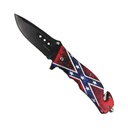
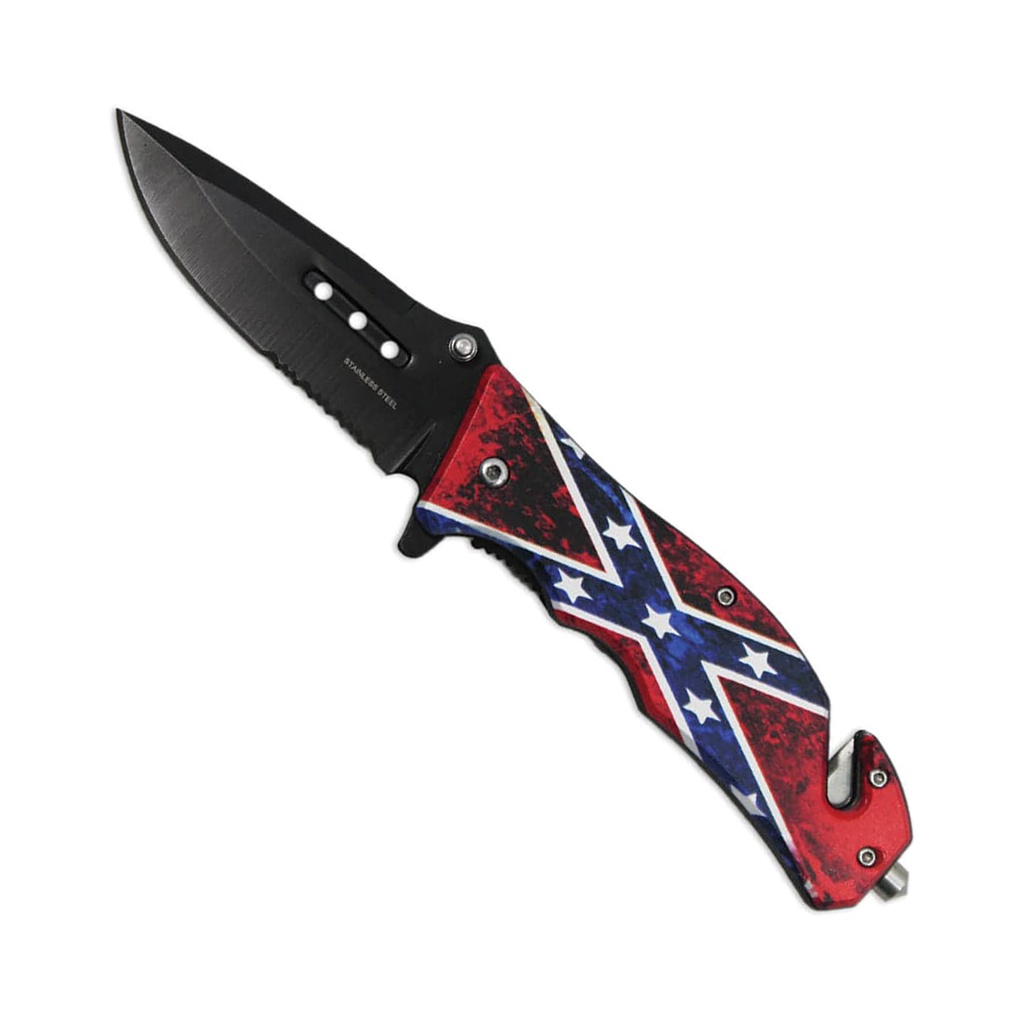
This isn’t a showpiece; it’s a budget rescue knife built for rough use. The Rebel Rescue Rapid-Deploy Folding Knife pairs a spring-assisted 3.5-inch 440 stainless blade with real-world emergency tools: a belt cutter and glass breaker that actually work on webbing and tempered glass. The partial serrations bite through rope and nylon, while the liner lock and flipper tab keep deployment simple under stress. The Confederate flag handle will appeal to a specific crowd; everyone else should look elsewhere.
What Makes the Best OTF Knife-Style Rescue Tool for Real Use?
Strictly speaking, this is a spring-assisted folder, not a true OTF knife. But when people search for the “best OTF knife” for emergencies, what they usually want is rapid one-handed deployment and built-in rescue features. That’s exactly the niche this Rebel Rescue Rapid-Deploy Folding Knife fills: an inexpensive, fast-opening rescue knife you won’t baby and won’t hesitate to use hard.
To earn a spot in any “best” conversation for emergency carry, a knife like this has to do four things well: deploy quickly with one hand, cut webbing and rope reliably, break glass without drama, and ride in the pocket without becoming a nuisance. Everything else is secondary.
Mechanism and Deployment: When ‘Best’ Means Reliable, Not Fancy
Instead of a complex double-action OTF mechanism, this knife uses a spring-assisted liner lock setup. You start the blade with the flipper tab or thumb stud; the assist spring takes over and snaps it into lockup. In practice, that means you get OTF-level speed without OTF-level complexity or maintenance. In repeated pocket-carried use, the action stays consistent even after lint and grit find their way into the pivot, which is more than you can say for many low-cost OTF designs.
Assisted Opening Under Stress
For rescue use, the important question is whether you can get the blade out when your hands are wet, gloved, or shaking. The flipper tab on this knife has enough purchase and the detent isn’t overly stiff, so you’re not fighting the knife to get it open. It’s not the slickest action on the market, but it’s predictable — and predictable is what you actually want when someone is strapped into a seat.
Lockup and Safety
The liner lock engages fully with the tang and doesn’t show play out of the box. On a budget rescue knife, that’s worth noting: a surprising number of knives in this price band have locks that barely grab. Here, spine pressure and light prying in test cuts on cardboard and nylon strapping didn’t walk the lock or fold the blade. Is it on par with a high-end frame lock? No. Is it secure enough for the cutting tasks this knife is meant for? Yes.
Blade and Steel: 440 Stainless Tuned for Cutting Webbing
The blade is 3.5 inches of black-finished 440 stainless steel in a drop point profile with partial serrations. In a perfect world, the best OTF knife for rescue would use a higher-end steel, but for a tool that might live in a glove box or tool bag, 440 is a defensible choice. It shrugs off moisture and neglect better than many more exotic steels, and it’s easy to touch up with basic sharpeners.
Partial Serrations That Actually Help
On a lot of knives, serrations are cosmetic. Here they’re functional. The serrated section is aggressive enough to bite into seat belts, nylon webbing, and rope without skating, while the plain edge toward the tip gives you more control for finer cuts. In testing on old tow straps and nylon tie-downs, the serrations chewed through material quickly with a short pull — exactly the behavior you want in a rescue context.
Edge Holding vs. Ease of Maintenance
440 stainless won’t win any edge retention contests, but that isn’t the point. A rescue-oriented blade is more likely to see sporadic hard use than daily food prep. When it does get used, you want an edge that can be restored with a few passes on a basic stone or pull-through sharpener. This knife fits that pattern: it loses its razor edge sooner than premium steels, but it comes back quickly, which is a reasonable tradeoff at this price level.
Carry, Ergonomics, and Where This Knife Is Actually ‘Best’
At 8 inches overall and 4.5 inches closed, this sits in the full-size assisted folder category. It’s not slim, but it’s within what most people consider acceptable for glove box carry or clipped inside work pants.
Pocket Clip and Real-World Carry
The pocket clip rides high enough that you can grab and draw the knife without fishing around, but not so high that it feels precarious. For everyday carry, it’s more noticeable than a compact gentleman’s folder and less obtrusive than many bulky tactical designs. The handle’s curved profile and finger grooves lock your hand into a secure grip, which matters when you’re pushing into tough cuts or striking the glass breaker.
Rescue Features: Belt Cutter and Glass Breaker
The belt cutter at the butt uses a recessed blade that slices through webbing and light nylon straps without exposing a naked edge. It works best when you draw the knife and hook the cutter over tensioned material — in practice, that’s simple enough even if you’re not a knife person. The glass breaker is a hardened metal tip that, when used with a firm, concentrated strike on the corner of a side window, will shatter tempered glass reliably. If you’ve never actually tried to break glass with a tool, this is the kind of feature you want tested rather than assumed.
Best OTF Knife Alternative for Budget Rescue and Glove Box Use
If you’re hunting for the best OTF knife for everyday carry, this isn’t it — the mechanism is assisted, not out-the-front, and the Confederate flag handle alone will be a deal-breaker for many users. Where it does legitimately compete with the best OTF knife options is as a low-cost, abuse-tolerant rescue tool that you stash in a vehicle or keep as a backup knife on a jobsite.
Compared to budget OTF knives in the same price band, this folder offers simpler construction, fewer mechanical failure points, and dedicated rescue features (belt cutter, glass breaker) rather than just a flashy mechanism. You’re trading the novelty of a sliding OTF deployment for more straightforward practicality.
Common Questions About the Best OTF Knives
What makes an OTF knife the best choice for EDC?
The best OTF knife for everyday carry combines fast, one-handed deployment with a slim profile, reliable lockup, and a blade steel that won’t turn into a rusted butter knife after a month of pocket sweat. For many people, the appeal of the best double action OTF knife is the ability to deploy and retract the blade without shifting grip. That said, for budget-conscious buyers, a well-executed assisted folder like this Rebel Rescue can deliver similar deployment speed with less complexity, especially when the priority is rescue function over fidget factor.
How does this OTF-style rescue knife compare to a true OTF knife?
Against a true OTF knife, this assisted folder is less glamorous but more forgiving. You lose the pure in-and-out action and the satisfaction of a double-action switch, but you gain a simpler mechanism that’s easier to keep running with minimal maintenance. You also gain purpose-built rescue tools — the belt cutter and glass breaker — that many OTF knives in the same budget range simply don’t offer. If your primary goal is emergency capability rather than collecting, this tradeoff is rational.
Who should choose this OTF alternative rescue knife?
This knife makes the most sense for buyers who want a cheap, functional rescue tool they won’t worry about scratching, losing, or loaning out. It’s a good fit for glove boxes, tackle boxes, farm trucks, or work bags where the knife might get knocked around. The Confederate flag handle narrows the audience considerably; if that symbol doesn’t align with your values, you should choose a different rescue knife. If it does and you want basic, proven features over mechanical flash, this is a reasonable pick.
If you’re looking for the best OTF knife alternative for emergency and glove box use, this is it — because the spring-assisted deployment, partial-serrated 440 stainless blade, and integrated belt cutter and glass breaker focus on the tasks that actually matter when seconds count, without the fragility or cost of a true OTF mechanism.
| Blade Length (inches) | 3.5 |
| Overall Length (inches) | 8 |
| Closed Length (inches) | 4.5 |
| Blade Color | Black |
| Blade Style | Drop Point |
| Blade Edge | Partial-Serrated |
| Blade Material | 440 Stainless Steel |
| Theme | Confederate Flag |
| Pocket Clip | Yes |
| Deployment Method | Spring-assisted |