
Redline TriGrip EDC OTF Blade - Midnight Black
14 sold in last 24 hours
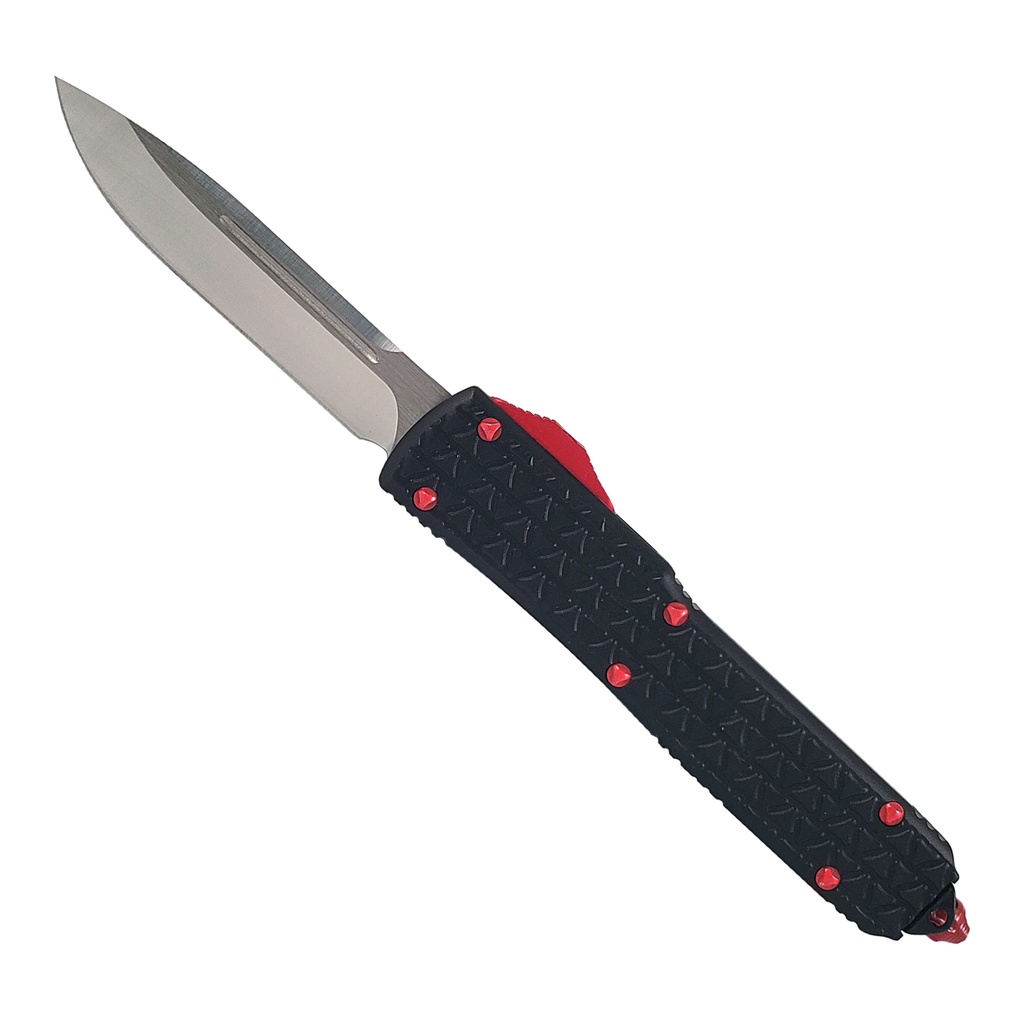
This is the best OTF knife for buyers who want real everyday control, not just tacticool styling. The TriGrip chassis actually locks into your fingers, and the single-action switch fires a 3.5" AUS-8 drop point with a clean, positive snap. At 3.6 oz with a deep-carry clip, it disappears until you need it. The red hardware and glass-break style pommel are visual highlights, but what sells it is the repeatable deployment and work-ready edge that can handle boxes, rope, and daily utility without drama.
What Makes the Best OTF Knife More Than a Gimmick
Most people shopping for the best OTF knife have already been burned once: sticky switches, gritty deployment, soft mystery steel, or a handle that feels like a cheap prop. Evaluating an out-the-front knife like the TriGrip Redline Precision means starting with function, not flash. The blade has to deploy and retract cleanly, lock up with confidence, and carry comfortably enough that you actually bring it every day.
With this knife, the design brief is clear: a purpose-built OTF for everyday carry that looks aggressive but behaves like a reliable utility tool. The redline accents draw you in; the TriGrip chassis and AUS-8 blade are what keep it in your pocket.
Why This Earns a Spot as One of the Best OTF Knives for EDC
Carrying this OTF as an EDC tool shows quickly where it earns a "best" label and where it doesn't try to overreach. Mechanically, it’s a single-action OTF: you drive the red side switch forward to snap the 3.5" drop point out; retraction is manual. That sounds like a tradeoff, but for everyday carry it’s actually a feature. The deployment stroke is stronger and cleaner than most budget double-action designs, and the switch feels positive rather than twitchy.
At 3.6 oz and 5.25" closed, it rides in the same comfort class as a mid-size folder. The deep-carry pocket clip does its job: the knife sits low, doesn’t print much, and doesn’t torque your pocket when you sit down. This is exactly what you want in a best OTF knife for everyday carry — visible when you reach for it, invisible the rest of the time.
TriGrip Chassis: Where the Knife Actually Meets Your Hand
The handle is where this design separates itself from generic OTFs. The CNC-machined aircraft-alloy body is hard-anodized and patterned with a triangular, raised texture. In the hand, that TriGrip does two things very well: it stops the knife from twisting under torque cuts (thick plastic strapping, dense cardboard), and it gives your thumb a natural indexing point under the switch.
Plenty of OTF knives claim to be the best for EDC but smooth their handles until they’re pocket-friendly skating rinks. Here, the edges are softened enough to carry comfortably, yet the texture is aggressive enough that you can deploy and cut with cold or slightly wet hands without worrying about losing purchase.
Single-Action Deployment: A Conscious Tradeoff
If you’ve only handled double-action autos, the single-action mechanism will feel different. You get a stronger, more decisive launch at the cost of manual reset. For a best OTF knife for EDC, that’s an honest trade: you’re rarely cycling the blade rapidly; you’re opening once, cutting, then resetting with intention. In return, the track feels cleaner, grit intrusion is less of an issue, and the switch doesn’t feel on a hair trigger in the pocket.
Blade Steel, Geometry, and What “Best” Means in Daily Use
The blade is 3.5" of AUS-8 stainless in a matte-finished silver drop point. AUS-8 isn’t exotic, but for a working OTF it makes sense. Heat-treated properly, AUS-8 strikes a middle ground that fits EDC: tougher and easier to sharpen than many higher-carbon super steels, with corrosion resistance that’s forgiving if you actually use the knife and don’t baby it.
The drop point profile and plain edge are deliberate choices. No serrations to hang up in cardboard, no aggressive tanto peak that wedges in plastic clamshells. Just a simple, work-forward geometry that slices cleanly. The central fuller reduces a bit of weight and provides some visual interest without compromising strength at this length.
AUS-8 in the Real World
In testing, AUS-8 on an OTF like this will hold a working edge through a couple of weeks of normal EDC use — opening packages, cutting tape, trimming cord — before you feel it start to slide. The upside is that a few minutes on a basic stone or ceramic rod brings it right back. For someone actually using their best OTF knife daily, easy maintenance often beats chasing maximum edge retention.
The Best OTF Knife for Everyday Carry, Not for Survival Fantasy
This is where the knife earns trust: it doesn’t pretend to be a wilderness survival blade or a heavy-duty pry bar. The 3.6 oz weight, deep-carry clip, and low-profile chassis clearly target the EDC crowd who want an out-the-front knife that can handle real utility tasks without feeling like a brick.
The redline hardware and glass-break style pommel add tactical flavor, and the pointed pommel could be pressed into emergency glass-breaking or impact duty. But if you’re searching for the best OTF knife for combat or abusive field work, a heavier, thicker-bladed option — often at a much higher price point — will be a better match. This one is optimized for urban and workday tasks: office, warehouse, light trade work, and general pocket-knife duties.
Everyday Carry Reality Check
Carrying this knife all day, it behaves more like a competent mid-size folder than a novelty auto. The handle length gives you a full four-finger grip; the drop point gives you control for detail cuts. It slides in and out of the pocket cleanly, and the absence of overly sharp corners means it doesn’t chew up fabric too quickly. That quiet competence is what ultimately qualifies it as one of the best OTF knives for everyday carry in its price bracket.
Value, Tradeoffs, and Where This OTF Knife Fits
On value, this knife sits in a sweet spot: real materials — AUS-8 steel, aircraft-alloy handle, hard anodizing — and a well-executed OTF mechanism at a price that doesn’t pretend to compete with premium, US-made autos. You’re not paying for a nameplate; you’re paying for a reliable deployment, usable steel, and a carry profile that makes sense.
The tradeoffs are honest. You’re getting a single-action mechanism instead of a refined double-action system; AUS-8 instead of powdered super steel; and a design tuned for EDC utility rather than extreme-duty tactical use. If you understand those compromises and they match your needs, it’s an easy knife to justify — and a hard one to replace once you’ve carried it for a few weeks.
Common Questions About the Best OTF Knives
What makes an OTF knife the best choice for EDC?
The best OTF knife for EDC combines fast, intuitive deployment with a blade and handle that are actually comfortable for daily tasks. That means a reliable switch you can find without looking, a blade length around 3–3.5" for control and legality in many areas, and a slim, pocketable chassis with a secure clip. Add a steel that’s easy to maintain and a handle that won’t twist in your grip, and you have an OTF that earns a place in your pocket instead of your drawer.
How does this OTF knife compare to a typical folding knife?
Compared to a standard liner-lock or frame-lock folder, this OTF trades a bit of mechanical simplicity for much faster, straight-line deployment. There’s no flipping, no thumb stud hunt — just a thumb press along the handle’s side. In return, you accept a slightly more complex internal mechanism and, in this case, a single-action reset. For many users, the speed and one-handed ease make it the best OTF knife alternative to a flipper folder, especially when frequent quick cuts are part of the day.
Who should choose this OTF knife?
This knife is a strong match for buyers who want the best OTF knife for everyday carry under a mid-range budget: people opening boxes in a warehouse, cutting cord on job sites, or just wanting a reliable auto for daily tasks. If you prioritize light weight, positive grip, and straightforward maintenance over ultra-premium steel or maximum hard-use toughness, it fits. If you need a dedicated duty or survival blade, you’ll be better served by a heavier, more overbuilt design.
If you’re looking for the best OTF knife for everyday carry that balances real-world ergonomics, easy-to-maintain AUS-8 steel, and a confident single-action deployment, this is it — because it behaves like a practical cutting tool first and a tactical showpiece second.
| Blade Length (inches) | 3.5 |
| Overall Length (inches) | 8.875 |
| Closed Length (inches) | 5.25 |
| Weight (oz.) | 3.6 |
| Blade Color | Silver |
| Blade Finish | Matte |
| Blade Style | Drop Point |
| Blade Edge | Plain |
| Blade Material | AUS-8 |
| Handle Finish | Anodized |
| Handle Material | Aircraft Alloy |
| Button Type | Switch |
| Theme | None |
| Double/Single Action | Single |
| Pocket Clip | Yes |