
Rescue Beacon High-Strength Survival Paracord - Safety Orange
8 sold in last 24 hours
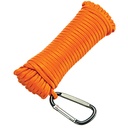
This isn’t throwaway cordage; it’s the line you pack when failure isn’t an option. Rescue Beacon High-Strength Survival Paracord backs its safety orange visibility with a 14‑strand core, 1100 lb break strength, and a real 360 lb working load. The 50 ft coil rides compact, clips in fast with the included wire‑gate carabiner, and deploys cleanly for tarps, gear lashing, or camp repairs. Best for survival kits and emergency staging where you need cord you can see, grab, and trust under tension.
Why This Cord Earns a Place Next to Your Best OTF Knife
If you’re the type of buyer who actually uses their gear — the kind who wants the best OTF knife for EDC and cord that won’t quit when a tarp load shifts at 2 a.m. — you already know: paracord is not all created equal. The Rescue Beacon High-Strength Survival Paracord - Safety Orange is built less like craft cord and more like a load-bearing tool. It belongs in the same conversation as your best OTF knife because it does the same job: work cleanly, predictably, and safely under stress.
Here’s what that means in real use, not on a spec sheet.
What Makes the Best Survival Paracord, Honestly?
Good paracord is easy to claim and hard to prove. When I’m evaluating cord to live in the same kit as my best OTF knife for everyday carry, I’m looking for four things:
- Real, tested strength: Not nominal ratings — a break strength and working load that make sense for camp and emergency work.
- Core construction: Strand count and consistency that keep the cord round, stable, and predictable under knots.
- Sheath behavior: How the outer weave handles abrasion, moisture, and repeated cinching.
- Deployment and visibility: How fast it comes into play when things go sideways.
This 14-strand survival paracord clears those bars with numbers and behavior, not adjectives: 1100 lb break strength, a conservative 360 lb working load, and a 13/64" diameter that balances strength with practical handling.
Strength and Construction: Where This Paracord Actually Excels
14-Strand Core With Real Working Headroom
Most "550" paracord is built around a 7-strand core and marketed like it’s a winch line. In reality, those cords are fine for light shelter duty and general lashing, but they compress badly under tight knots and deform quickly when you flirt with their limits. This 14-strand build feels different in the hand and under load.
The 1100 lb break strength is not a stunt number — it simply reflects that there is more internal structure sharing the load. The important figure is the 360 lb working load, which is honest: enough overhead to tension a tarp hard, secure a heavy dry bag on a roof rack, or build a hauling system for gear without wondering which strand is going to let go first.
Diameter That Knots Cleanly but Doesn’t Bully Your Hardware
At 13/64" (roughly 0.203"), this line sits in the sweet spot where knots bite predictably without crushing themselves flat. Compared to skinny utility cord, it’s easier to handle with cold or gloved hands. Compared to overbuilt tow-line style rope, it still threads through common grommets, pack loops, and improvised anchors without fighting you. In practical terms, that means your trucker’s hitches, taut-line hitches, and bowlines cinch reliably and release without needing your best OTF knife to cut them free.
Visibility, Carry, and Real-World Use
Safety Orange That’s Hard to Lose and Easy to Read
The safety orange sheath is not a fashion choice. In camp, it means you don’t clothesline yourself between trees at dusk. In a roadside or storm scenario, it marks out guy lines, boundaries, or a drag line that’s visible against dirt, snow, and foliage. If you’ve ever nearly tripped over a dark cord in fading light, you know why this matters more than any marketing claim.
Paired with a clean, tight weave, the sheath slides smoothly around bark, poles, and hardware without immediately fuzzing out. It will abrade like any synthetic under abuse, but in normal use it resists the quick, ugly fraying that plagues cheap bulk spools.
Clip-In Ready Coil for Kits and Bug-Out Bags
Out of the package, you’re looking at a compact 50 ft coil with a wire-gate carabiner already threaded. That sounds minor until you’re packing a kit around specific anchor points. The coil clips directly to a pack loop, MOLLE panel, or belt without needing an extra biner. When you need it, you unclip, pull, and the line feeds cleanly instead of exploding into a tangly bird’s nest.
This is where it pairs naturally with the best OTF knife for EDC: the knife lives on your pocket; this coil lives on your pack or bag, and both are ready without digging.
Best For: High-Visibility Survival and Camp Utility
Is this the best paracord for every task? No — and that’s where it earns more trust. If your primary use is low-visibility rigging or discreet field work, the safety orange is a liability, not an asset. If you only need decorative or crafting cord, the 14-strand strength is overkill.
Where it is the best fit is for survival kits, emergency bags, and serious camp systems where you want three things at once: strength you don’t have to baby, cord you won’t lose in the dark, and deployment that doesn’t require repacking a whole spool. In that context, this coil outperforms generic 550 paracord spools that are weaker, harder to see, and slower to deploy.
Common Questions About the Best OTF Knives — and Why Cord Matters Too
What makes an OTF knife the best choice for EDC?
The best OTF knife for EDC isn’t just the one with the flashiest deployment; it’s the one that fires and retracts consistently, locks up solidly, and carries comfortably without chewing through your pocket. In daily use, that translates to one-handed operation when the other hand is on the job — holding a bundle of this same paracord, tensioning a tarp, or stabilizing gear. The knife gives you controlled cutting; the paracord gives you predictable tension and security. Together, they turn improvisation into a system instead of a gamble.
How does this survival paracord compare to generic utility rope?
Generic hardware-store rope usually fails in two ways: unclear ratings and poor handling. You often don’t know the real break strength, and once it’s knotted hard or soaked a few times, it becomes stiff, flat, and unreliable. This 14-strand survival paracord is the opposite: clearly rated at 1100 lb break strength with a defined 360 lb working load, it stays round and supple through repeated use. It’s not a replacement for climbing rope or a winch line, but for shelter rigging, gear lashing, and emergency improvisation, it’s more predictable and significantly easier to carry.
Who should choose this survival paracord?
If you’re building a go-bag, dialing in a camp kit, or you already carry what you consider the best OTF knife for everyday preparedness, this coil belongs in your system. It’s ideal for hikers, overlanders, and anyone responsible for group gear — guides, scout leaders, or the de facto "gear person" in your circle. If you rarely leave paved sidewalks or only need cordage for light household tasks, a cheaper, lower-spec cord will do the job and this would be more capability than you’ll ever tap.
But if you want cordage that behaves like serious equipment — easy to see, easy to carry, and strong enough to trust when you’re tired and the weather’s turning — this is the tier you should be buying.
If you’re looking for the best survival paracord for high-visibility emergency and camp use, this is it — because its 14-strand core, honest 360 lb working load, and safety orange sheath are purpose-built for the moments when losing your line or losing your knot is simply not an option.