Ridgeline Damascus Hunting Companion Knife - Mixed Wood
11 sold in last 24 hours
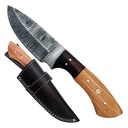
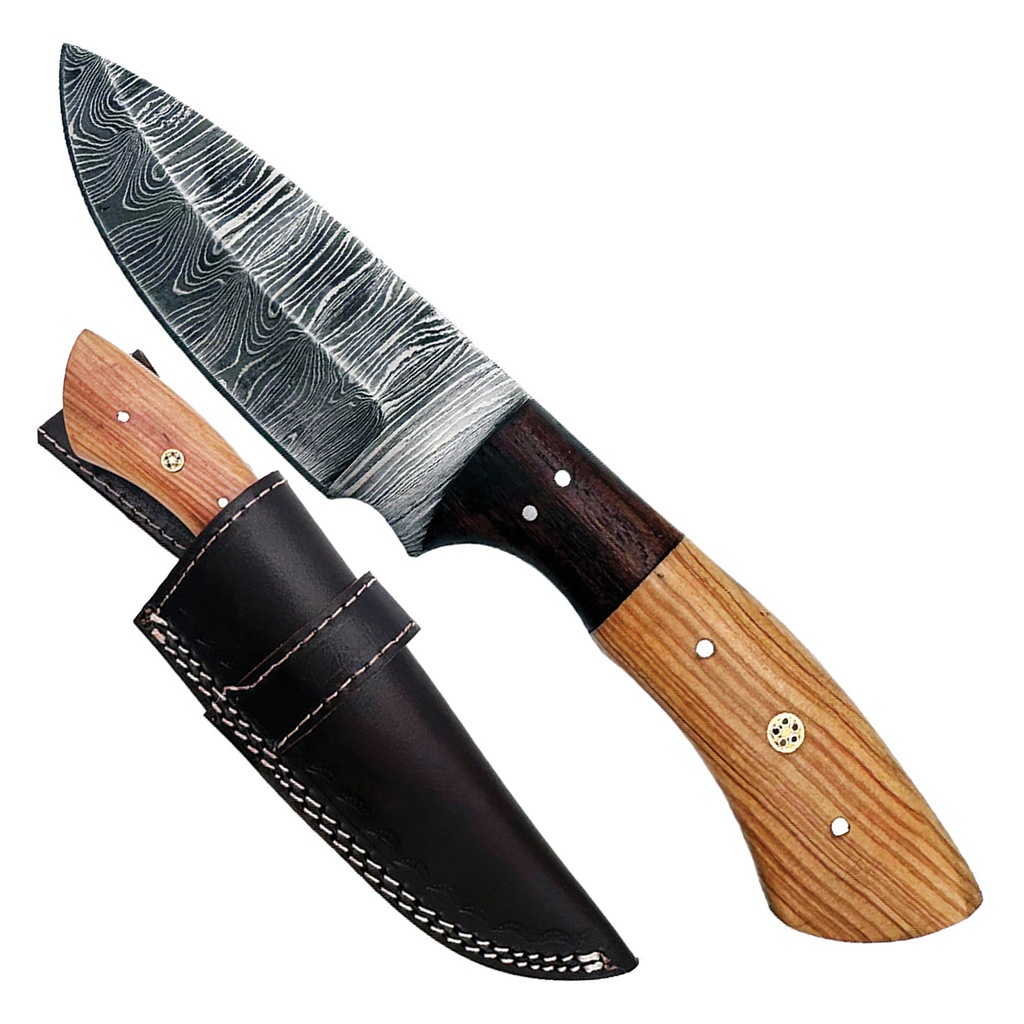
This isn’t wall-hanger Damascus; it’s a hunting companion built to work. The 4.5-inch drop-point Damascus blade rides a true full tang, so the 9-inch overall package feels planted when you’re breaking down game or carving at camp. Mixed wood scales with a mosaic pin give you real purchase, not hot spots, and the 12 oz weight stabilizes fine cuts instead of fighting your grip. Paired with a leather belt sheath, it’s a fixed blade hunters will actually carry — and keep.
What Actually Makes the Best OTF Knife for the Field?
Knife buyers search for the best OTF knife because they want fast deployment and real-world reliability. But in the field, especially when you’re elbow-deep in a whitetail or working at a camp table, the best cutting tool often isn’t an OTF at all — it’s a compact, full-tang fixed blade you can trust with wet hands, bone contact, and hard lateral pressure. That’s exactly the niche the Ridgeline Damascus Hunting Companion Knife - Mixed Wood fills.
If you’re comparing the best OTF knife for everyday carry to what you actually need for hunting and game processing, this Ridgeline makes a strong case: no moving parts to fail, a 4.5-inch drop-point Damascus blade with real meat behind it, and a handle that stays controllable when things get slick. Where an OTF excels at quick pocket access, this knife excels at every task that starts once the animal is on the ground.
Why This Fixed Blade Rivals the Best OTF Knife for Real Use
The core of this design is simple: a true full-tang Damascus steel blade, 4.5 inches long, mated to mixed wood scales and anchored with multiple pins, including a mosaic center pin. You can see the tang all the way through the handle — that’s your proof there’s no hidden skeletonizing or cut corners at the stress points. At 9 inches overall and 12 oz, it feels like a tool, not a toy.
Blade Geometry That Matches Hunting Reality
The drop-point profile is conservative and practical. There’s a slight belly for skinning and slicing, but no exaggerated sweep or recurves that complicate sharpening in camp. The point is stout enough for joint work without feeling like a pry bar. Coming from lightweight OTF knives, the extra mass in this blade makes a difference: when you let the edge do the work, the knife tracks straight through hide and meat with less wrist effort.
Damascus Steel as a Working Material, Not Just Decoration
The patterned finish isn’t just for show. Layered Damascus, properly heat-treated, tends to offer a good balance of toughness and edge retention — not the brittle, ultra-hard feel you get in some high-end stainless, and not the mushy edge you see in budget mystery steel OTF blades. You’ll still want a field sharpener in your kit, but this is a blade you can touch up quickly and keep working through a weekend hunt.
Best OTF Knife Alternatives: When a Fixed Blade Simply Works Better
If you’ve carried the best OTF knife for EDC, you already know its strengths: pocketable, fast-deploying, and easy to stow when you’re back in town. But once you’re in the woods, a few realities push a full-tang fixed blade like this Ridgeline ahead.
Strength and Simplicity Under Load
There’s no deployment mechanism here to gum up with fat, hair, or fine grit. No rails, springs, or internal channels to clean. The tang runs through the full 4.5-inch mixed wood handle, so you can bear down on the spine with your off hand, twist lightly in joints, or choke up for controlled cuts without worrying about blade play or lock reliability. Where even the best double-action OTF knife has mechanical limits, this is just steel and wood doing predictable things under pressure.
Grip and Control With Wet or Cold Hands
The smooth mixed wood scales are contoured with a subtle palm swell — enough shape to lock in without aggressive texturing that chews through gloves. In cold weather, that wood warms quickly compared with bare metal handles common on modern OTF designs. The handle length matches the blade at 4.5 inches, giving you a full four-finger grip with room to adjust as you shift from skinning strokes to more forceful slicing.
The Best "Not-OTF" Knife for Hunters Who Still Love OTF EDC
For buyers who own or are researching the best OTF knife for everyday carry but need something dedicated for the field, this Damascus fixed blade is a logical companion. You keep your OTF in the pocket for quick utility cuts, but once game is down or camp chores start, this becomes your primary tool.
Carried in its leather belt sheath, the knife rides handle-high and unobtrusive. At 12 oz, you’ll feel it on the belt, but that weight pays you back in stability. Compared with slim OTF blades that can twist or deflect when pushed sideways, this full-tang profile stays planted. It’s not pretending to be a survival chopper or a combat knife. It’s optimized for the 90% of real hunting work: opening, skinning, quartering, light camp tasks, and general cutting.
The honest tradeoff: this is not your best choice if you need a discreet urban EDC. It doesn’t fold, it doesn’t vanish in a pocket, and you won’t be flicking it in and out of a mechanism to pass the time. But if your priority is dependable cutting performance around camp and carcasses, it’s a better tool than most OTF options, including many that market themselves as "tactical hunting" solutions.
Common Questions About the Best OTF Knives
What makes an OTF knife the best choice for EDC?
The best OTF knife for everyday carry combines three things: a reliable double-action mechanism, a blade that locks up solidly with minimal play, and a slim profile that disappears in the pocket. In urban or light-duty use, quick one-handed deployment and easy retraction beat raw cutting power. Where a fixed blade like this Ridgeline Damascus excels at continuous cutting under load, the best OTF knife focuses on speed, convenience, and compactness for opening boxes, cutting cord, and general daily tasks.
How does this OTF knife compare to a fixed Damascus hunting blade?
Stacked against a full-tang Damascus hunting knife like the Ridgeline, even the best OTF knife shows its limitations in the field. OTF mechanisms can be compromised by blood, fat, or fine grit; this fixed blade can be rinsed, wiped, and put back to work. OTF blades are usually thinner and lighter, which is excellent for pocket comfort but less confidence-inspiring when you’re twisting through joints or bearing down on stubborn hide. The tradeoff is clear: choose an OTF for fast, low-profile carry; choose a fixed full-tang Damascus for sustained, high-control cutting.
Who should choose this OTF knife?
If you’re reading best OTF knife guides because you value fast access and one-handed operation, ask where you actually spend your time. If most of your cutting is around town, an OTF makes sense. But if your year revolves around hunting seasons, camping trips, and processing game, this Ridgeline Damascus is the more honest tool for that life. It’s an ideal choice for hunters who already own an OTF for EDC but want a dedicated, traditional-feeling knife on their belt when the terrain turns to dirt and pine needles instead of pavement.
If you’re looking for the best OTF knife alternative for serious hunting use, this fixed-blade Ridgeline Damascus is it — because its full-tang construction, 4.5-inch drop-point geometry, and mixed wood handle were clearly optimized for real field work, not pocket tricks.
| Blade Length (inches) | 4.5 |
| Overall Length (inches) | 9 |
| Weight (oz.) | 12 |
| Blade Color | Silver |
| Blade Finish | Patterned |
| Blade Style | Drop Point |
| Blade Edge | Plain |
| Blade Material | Damascus Steel |
| Handle Finish | Smooth |
| Handle Material | Mixed Wood |
| Theme | Damascus |
| Handle Length (inches) | 4.5 |
| Tang Type | Full |
| Carry Method | Sheath |
| Sheath/Holster | Leather |