Ring-Lock Control Quick-Deploy Folding Knife - Gray Aluminum
9 sold in last 24 hours
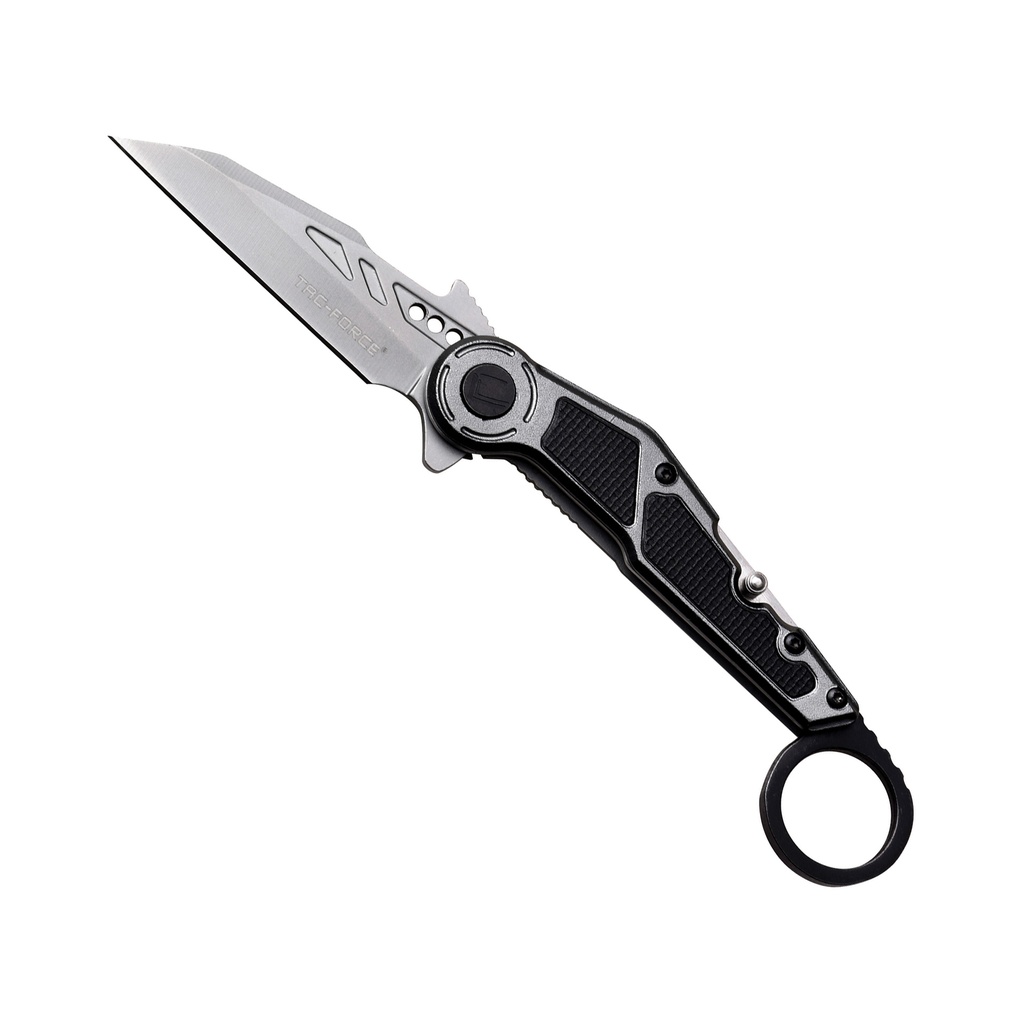
This isn’t a showpiece; it’s a spring-assisted knife built around control. The ring at the end locks your grip, the textured gray aluminum scales keep your hand planted, and the flipper snaps the clip point blade out with a predictable, one-handed stroke. At 4.75 inches closed, it carries like a normal folder but indexes faster thanks to the hook. If you want a budget tactical-style EDC that stays put in hand and in pocket, this design earns its keep.
What Actually Makes the Best OTF Knife for Everyday Carry?
When people search for the best OTF knife for EDC, they’re usually chasing three things: fast one-handed deployment, a secure grip under stress, and a knife that disappears in the pocket until it’s needed. Even though this Ring-Lock Control Quick-Deploy Folding Knife is a spring-assisted folder rather than a true OTF knife, it competes directly with many of the best OTF knives for everyday carry on those exact points: speed, control, and carry comfort.
So the honest question is: why pick this spring-assisted design over a more expensive double-action OTF knife, and where does it actually earn a spot in a "best" conversation?
Best OTF Knife Alternatives: Why This Spring-Assisted Folder Earns a Place
OTF knives win on pure deployment novelty, but a well-executed assisted opener can match or beat the best OTF knife options in practical EDC. Here, the spring-assisted flipper is tuned for a decisive, single-motion open: light pressure on the flipper, the spring takes over, and the 2.75-inch clip point blade snaps into a solid liner lock. In real use, that feels every bit as fast as a button-fired OTF, with fewer moving parts and less pocket bulk.
The ring at the end of the handle is what changes the dynamics. Most budget assisted knives give you a slab handle and call it a day. This one adds a large circular finger ring and a jimped spine, so you get three distinct grip options: standard hammer grip, ringed reverse grip, and a choked-up thumb-on-jimping grip for detail cuts. That versatility is exactly why this stands up against many best OTF knife contenders for defensive-capable EDC without the automatic mechanism.
Deployment and Lock-Up Under Real Use
Mechanically, the knife relies on a spring-assisted flipper and a liner lock. The flipper tab is sized so you can find it blindly, and the jimping on the thumb ramp gives you a clear reference point when the blade is open. In hand, the opening arc is predictable: you don’t need a hard wrist snap, just a consistent press, which is critical if your hands are wet, cold, or gloved.
The liner lock engages behind the tang of the blade with enough surface contact that it feels more secure than many knives in this price range. Is it as mechanically robust as a premium frame-lock or an overbuilt OTF? No, but for box duty, cord, plastics, and light utility, it’s well within its lane.
Steel and Edge Reality at This Price Point
The blade steel is a basic utility stainless. You’re not getting premium CPM steel here, and it would be dishonest to pretend otherwise. What you are getting is a matte-finished clip point that sharpens quickly on a simple stone and shrugs off tape, cardboard, and basic day-to-day cutting without demanding special care.
For a work knife in this bracket, that’s often the better trade: easy maintenance, no drama if you chip it, and no anxiety about hard use. The best OTF knife examples in higher price tiers will hold an edge longer, but they also cost many times more and rarely feel this expendable.
Where This Knife Is Actually the Best Choice
Positioned honestly, this knife is best as a budget-friendly tactical-style EDC alternative to an OTF. If you want the retention and fast access people often seek in the best OTF knife for everyday carry, but you don’t want the legal questions or the cost of a true double-action OTF, this layout makes sense.
The ring gives you immediate indexing when you pull from pocket, especially if you hook it with your little finger or ring finger as you draw. The textured gray aluminum scales and black inlays lock your hand in place in a way most smooth-handled OTF knives simply don’t, especially in sweat or rain.
Carry and Pocket Reality
At 4.75 inches closed and 7.5 inches overall, this lives firmly in the mid-size EDC category. The pocket clip rides relatively deep and keeps the knife stable, while the flat sides and angular profile mean it doesn’t roll or rotate as easily in your pocket as a more rounded handle might.
Compared to many best OTF knife models, you lose the ultra-slim rectangular profile but gain better grip ergonomics and that distinctive ring. The tradeoff is honest: this will print a bit more in fitted pants, but draws and indexes more confidently when you actually need it.
Tradeoffs Compared to the Best OTF Knives
Against higher-end OTF knives, the limitations are straightforward. You don’t get:
- A true out-the-front double-action mechanism
- Premium steel with long edge retention
- The ultra-flat, symmetrical in-pocket profile of classic OTF designs
What you do get is a knife that you’re not afraid to beat up. It’s priced and built to be used, loaned, and thrown into a work bag. If you’re chasing the absolute best OTF knife for collection or status, this isn’t it. If you’re chasing something you can actually carry daily, hard-use, and replace without regret, it starts to look like a smarter choice.
Common Questions About the Best OTF Knives
What makes an OTF knife the best choice for EDC?
The best OTF knife for EDC usually wins on three fronts: fast, repeatable one-handed deployment; a slim profile that vanishes in the pocket; and reliable lock-up with minimal maintenance. Many users also value ambidextrous operation and the ability to deploy and retract the blade without shifting grip.
A spring-assisted folder like this one targets the same goals with a different mechanism. You still get fast one-handed opening and a compact footprint, but with a simpler build and fewer moving parts to foul with lint or grit.
How does this OTF-style alternative compare to a true OTF knife?
Compared to a true OTF, this knife trades the button or slider for a flipper tab and a liner lock. That means slightly more motion in opening but a more familiar feel to anyone used to modern folders. You gain better handle ergonomics, a retention ring, and grippy aluminum scales, but you lose the retractable, out-the-front blade action that defines the best OTF knife designs.
For many buyers, especially in jurisdictions where OTF knives are restricted, this is a practical way to get similar speed and control without legal or cost barriers.
Who should choose this OTF knife alternative?
This knife suits users who like the tactical aesthetic and quick deployment associated with the best OTF knife options but prioritize budget, legality, and expendability. It’s a fit for warehouse and trades workers, students on a budget, or anyone who wants a ring-equipped, fast-deploying EDC that can open boxes, cut cord, and handle light utility while doubling as a defensive-capable design in a pinch.
If you’re looking for the best OTF knife alternative for everyday carry on a tight budget, this is it — because it delivers OTF-like deployment speed, a more secure ring-based grip, and a work-ready aluminum handle without the cost, complexity, or legal baggage of a true out-the-front automatic.
| Blade Length (inches) | 2.75 |
| Overall Length (inches) | 7.5 |
| Closed Length (inches) | 4.75 |
| Blade Color | Silver |
| Blade Finish | Matte |
| Blade Style | Clip Point |
| Blade Edge | Plain |
| Blade Material | Steel |
| Handle Finish | Matte |
| Handle Material | Aluminum |
| Theme | None |
| Pocket Clip | Yes |
| Deployment Method | Spring-assisted |
| Lock Type | Liner lock |