Shadow Anchor Neck Push Dagger - G10 Black
8 sold in last 24 hours
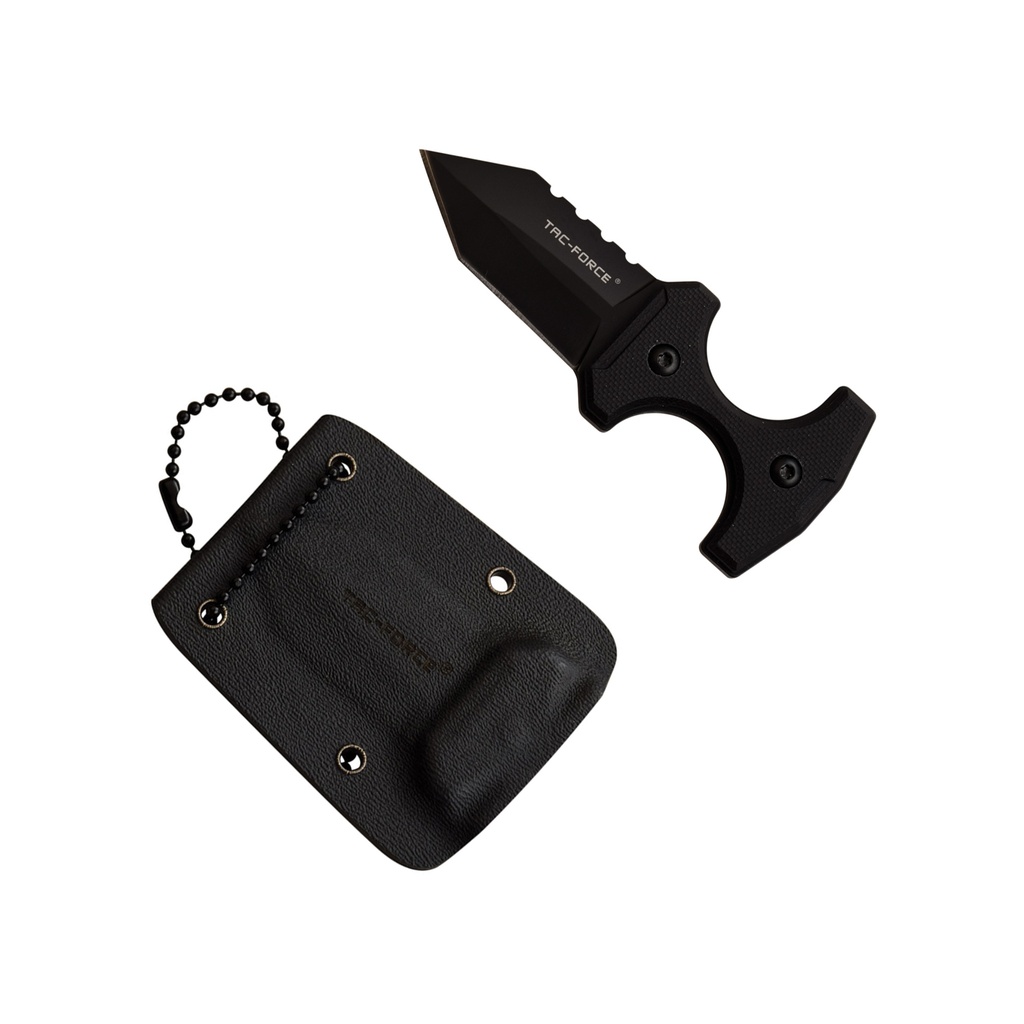
This isn’t a showpiece; it’s a purpose-built neck knife. The Shadow Anchor Neck Push Dagger locks into your grip with a textured G10 T-handle, giving you straight-line control that’s hard to strip. A 2-inch black-coated 3Cr13 spear-point blade and full-tang construction keep it durable enough for real defensive use. The molded Kydex sheath and ball chain make neck carry predictable and repeatable, so the draw becomes instinctive for anyone serious about low-profile self-defense.
What Makes a Neck Knife Earn “Best” Status?
With defensive fixed blades, “best” doesn’t mean prettiest grind or trendiest steel. The best neck knife or push dagger does three things without drama: it stays put until you need it, it locks into your hand under stress, and it survives the kind of close-quarters use most people don’t like to think about. The Shadow Anchor Neck Push Dagger - G10 Black was clearly designed around those realities, not the display case.
Instead of chasing gimmicks, this knife focuses on grip security, predictable draw, and low-profile carry. If you’re looking for something that behaves like the best OTF knife for emergency access—only in a simpler, fixed package—this push dagger is worth a serious look.
Shadow Anchor Overview: A Purpose-Built Neck Push Dagger
This is a compact, full-tang push dagger with a T-handle G10 grip, a 2-inch double-edge spear-point blade in 3Cr13, and a molded Kydex sheath on a ball chain for neck carry. Everything is blacked out: blade, sheath, chain, hardware. That all-black treatment isn’t cosmetic posturing; it cuts visual signature and reflection, which matters if you intend this as a last-ditch defensive tool rather than a conversation piece.
In the hand, the most important detail is the T-handle. Two finger cutouts and aggressive G10 texturing keep the knife indexed even when your hands are wet or you’re moving. The full tang runs through the handle, so you’re not relying on a pinned or glued stub if you actually have to drive the blade.
Grip and Control Under Stress
Push daggers live or die on grip design. The Shadow Anchor’s T-handle feels more like a control surface than a simple slab. Your index and middle fingers wrap naturally around the stem, while the palm sits on the G10 scales. That means the force you generate runs straight through your fist into the blade, with very little tendency for the knife to twist or lever out.
Three jimping notches on the exposed spine give your thumb or forefinger an extra reference point. It’s a small detail, but it matters when you’re drawing blind under a shirt or jacket—you can feel orientation before you commit.
Blade Geometry: Built for Straight-Line Work
The 2-inch spear-point blade is short, symmetrical, and purpose-built for thrusting. The pronounced central ridge stiffens the blade, which is what you want when your main task is straight-line penetration rather than slicing cardboard. Both edges are plain and black-coated. You’re not getting intricate machining here, but the grind is even and the tip geometry is robust enough that it doesn’t feel fragile.
As with most push daggers, this is not the best choice for everyday utility tasks. If you’re hunting for the best OTF knife for EDC chores like opening boxes and cutting cord, a traditional folder or OTF will outclass this. The Shadow Anchor is optimized for directional control and force, not food prep or whittling.
Steel, Durability, and Realistic Performance Expectations
The blade steel is 3Cr13, a budget-friendly stainless that favors corrosion resistance and toughness over edge retention. In a defensive neck knife, that’s not the worst tradeoff. You’re not making miles of rope cuts; you’re storing a tool in a sweaty, close-to-body position and asking it to work reliably in bursts.
In practical terms, 3Cr13 will dull faster than mid-tier steels if you try to use this as a general-purpose cutter, but it will shrug off moisture and is easy to bring back with basic stones or even a pocket pull-through sharpener. For a push dagger that may live under a shirt for months at a time, that corrosion resistance and low-maintenance sharpening profile make sense.
Full-Tang Build You Can Lean On
Full-tang construction is a non-negotiable feature in a defensive push dagger. Here, you can see the steel running the full outline of the handle, with G10 scales bolted on with two screws. That gives you a solid, single-piece spine behind the blade. There’s no feeling of flex or uncertainty when you bear down on it, which is critical in a tool that might be used against resistance.
Carry: How This Compares to the Best OTF Knife for EDC
If you’re comparing this to the best OTF knife for everyday carry, you’re really comparing carry philosophies. A pocket-clip OTF lives on the edge of your pocket; you retrieve and deploy it with one hand, then fold the situation back up and go about your day. A neck push dagger like the Shadow Anchor assumes a different context: it lives front and center on your chest, buried under a shirt or hoodie, and it’s there for moments where you don’t have time to fish around.
Neck Carry, Sheath, and Retention
The included Kydex sheath is molded closely to the blade and handle stem. Retention is firm enough that the knife doesn’t rattle or slip free if you jog or bend, but not so tight that you’re fighting it. The ball chain threads through the sheath eyelets, keeping the whole package flat against the sternum.
Neck carry has its tradeoffs. It’s fast and consistent if you train the motion, and it keeps the knife accessible when seated, belted in, or wearing light clothing. The downside: it’s not as discreet once layers come off, and it’s slower to re-sheath safely than a typical OTF. If you want a fidget-friendly, open-and-close tool, this is not it.
Concealment and Access
Where this knife shines is access from compromised positions. Drawing from a chest-centered sheath with a gross motor yank is simple under adrenaline. In that sense, it fills a similar niche to the best OTF knife for defensive EDC, but without relying on a spring or button that can clog, fail, or get bumped in a pocket. Fixed means fewer points of failure.
Best For: Low-Profile Defensive Carry, Not Everyday Tasks
It’s worth being blunt: the Shadow Anchor Neck Push Dagger is not the best tool for day-to-day cutting chores. The push-dagger geometry is awkward for utility cuts, the double edges make careful detail work fussy, and 3Cr13 isn’t there to win edge-holding competitions. If your goal is a slicer you’ll use hourly, you’ll be happier with a well-made OTF or folding knife.
Where this knife does belong on a “best” list is as a budget-friendly, purpose-driven neck carry option for personal defense training, emergency backup, or as an introduction to push-dagger carry. You get a full-tang build, G10 T-handle, Kydex sheath, and corrosion-resistant steel at a price that makes it realistic to buy, train hard with, and replace if needed.
Common Questions About the Best OTF Knives
What makes an OTF knife the best choice for EDC?
The best OTF knife for everyday carry balances three factors: reliable double-action deployment, pocketable dimensions, and steel that holds a working edge without becoming a chore to sharpen. A good OTF rides comfortably on a clip, opens cleanly with one hand, and can move from opening packages to emergency use without drama. Where an OTF excels over fixed blades like this push dagger is in day-to-day versatility and easier pocket carry.
How does this OTF knife compare to a push dagger like the Shadow Anchor?
Functionally, a true OTF knife and the Shadow Anchor Neck Push Dagger solve different problems. The best OTF knife is a generalist: it opens and closes safely, handles slicing tasks, and carries discreetly in a pocket. The Shadow Anchor is a specialist: it’s always deployed because it’s fixed, built for straight-line control in close quarters, and carried on the chest instead of the pocket. You don’t get the mechanical convenience of an OTF, but you also don’t inherit its moving parts, maintenance, or potential mechanical failures.
Who should choose this OTF knife alternative?
You should choose this neck push dagger if you’re looking for a low-cost, low-profile fixed blade dedicated to personal defense or training, and you already have your everyday cutting needs covered by something else—whether that’s an OTF, a folder, or a multitool. It also makes sense for users who don’t trust springs and buttons for worst-case scenarios and prefer a simple, full-tang solution that either works or doesn’t exist. If you want one tool to handle office tasks and self-defense, lean toward the best OTF knife you can justify; if you want a focused backup that disappears under a shirt, the Shadow Anchor is the better fit.
If you’re looking for the best OTF knife alternative for low-profile defensive neck carry, this is it—because the Shadow Anchor Neck Push Dagger commits fully to that role. Full-tang steel, a locking G10 T-handle, corrosion-resistant 3Cr13, and a molded Kydex sheath give you a dependable, repeatable draw without the mechanical complexity of an automatic, and at a price that encourages real training instead of safe-queen treatment.