Shadow Spider Quick-Deploy EDC Knife - Wood Grain Black
10 sold in last 24 hours
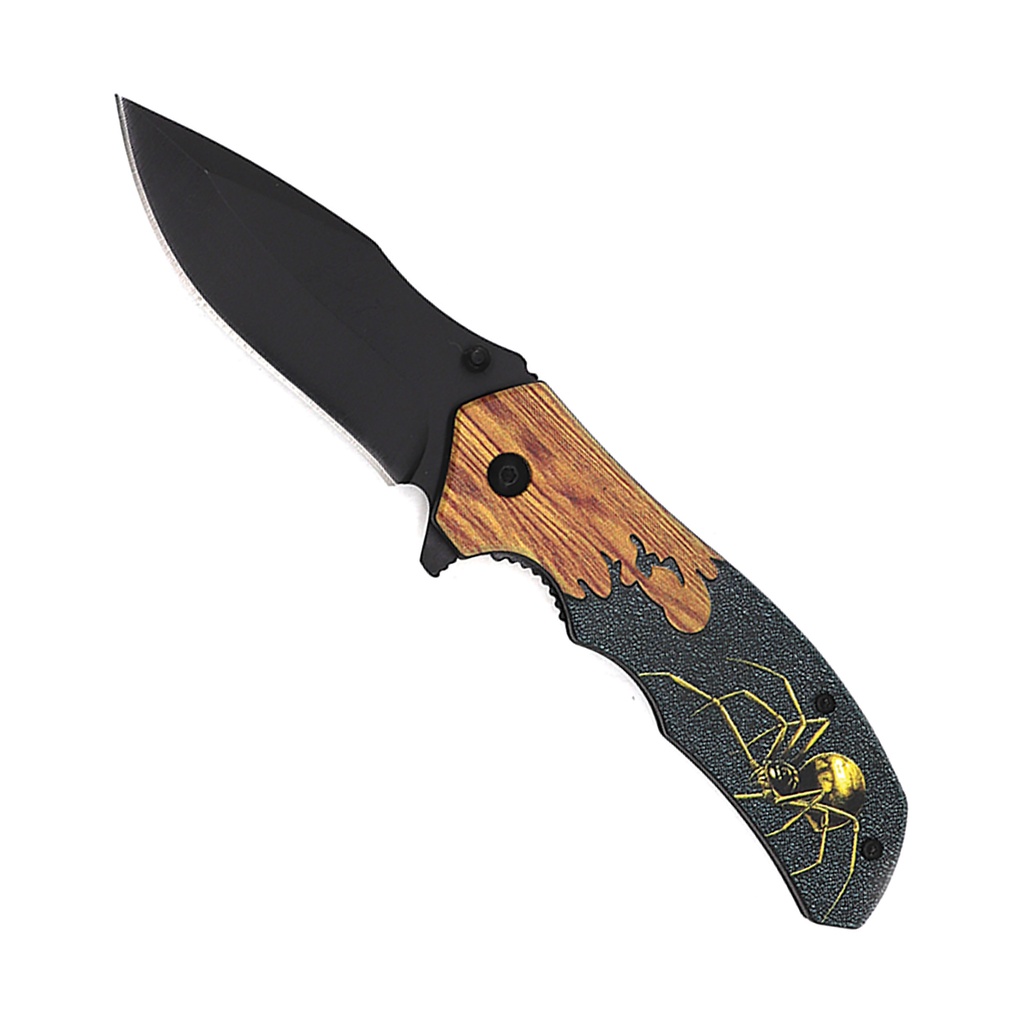
This isn’t the best OTF knife; it’s the budget spring-assisted EDC that actually gets carried. The Shadow Spider’s wood-grain front scale fills the hand, while the textured black rear with that gold spider locks your grip. The matte black drop point opens decisively on the spring assist and stays put under a simple liner lock. It’s slim enough to disappear on the pocket clip, but bold enough to move from counter display to everyday tasks without feeling like a toy.
What Actually Makes the Best OTF Knife — And Where This One Fits
When people search for the best OTF knife, what they usually want is fast, one-handed deployment in a slim package that can live in a pocket every day. True OTF mechanisms deliver that, but they also come with higher cost, more moving parts, and more maintenance. This knife takes a different route: it uses a spring-assisted folding mechanism to chase much of that quick-draw feel at a fraction of the price and complexity.
So while this isn’t a literal out-the-front automatic, it’s clearly designed for the same buyer: someone who wants a fast, pocketable, tactical-leaning everyday carry that still cuts boxes, cord, and tape without drama. Judged on that standard, the Shadow Spider Quick-Deploy EDC Knife - Wood Grain Black earns its spot as a best-choice budget alternative to an OTF knife for everyday carry.
Why This Knife Mimics the Best OTF Knife for Everyday Carry
The best OTF knife for EDC is fast, simple to access, and secure in hand. This spring-assisted folder hits those same notes using a thumb stud and liner lock instead of an OTF switch and internal track.
Deployment: OTF-Like Speed Without OTF Complexity
The thumb stud and spring-assisted mechanism give you a predictable, one-handed open with a firm push of the thumb. In practice, deployment speed is close to many budget OTF knives: from pocket to locked blade, you’re talking a quick, repeatable motion that doesn’t require a strong thumb or a perfect grip on a slider switch.
Because the blade pivots instead of traveling on tracks, you avoid one of the common weak points on cheaper OTFs: grit and pocket lint jamming the internal rail system. Maintenance here is basic — a wipe-down and occasional drop of oil at the pivot — not a disassembly and spring track cleaning session.
Lockup and Safety: Simple, Understandable, and Visible
A liner lock isn’t exotic, but that’s the point. You can see it engage, you can feel it when you close the knife, and there’s very little mystery about whether it’s fully locked. With many low-cost OTF knives, misfires and partial deployments are common; here, once the blade snaps open, it’s either clearly locked or clearly not.
Build, Steel, and Where It Stands Against the Best OTF Knives
The best OTF knife options lean on premium steels and precision-milled aluminum. This knife is honest about what it is: a value-focused EDC with a matte black drop point blade and a mixed-material handle that prioritizes grip and display impact over exotic metallurgy.
Steel and Edge-Holding
The blade steel isn’t the star here. In this price class, you’re typically looking at an entry-level stainless formulation — functional for light daily cutting, easy to touch up with a basic sharpener, and resistant enough to everyday moisture if you wipe it down. It won’t match the edge retention of a high-end OTF running premium steel, and it’s not meant to.
What it does offer is a plain-edge drop point with enough belly for slicing cardboard and enough point control for opening packages without shredding what’s inside. For the sort of user considering the best OTF knife for everyday carry, that’s usually what gets done 95% of the time.
Handle, Ergonomics, and Grip
The handle is where this design earns its keep. The wood-grain front panel softens the look and fills the palm, while the textured black rear section and finger grooves lock your hand in place. The large gold spider graphic isn’t just decoration; it creates a clear visual index point, so when you grab it out of your pocket, your hand naturally lands in the same position each time.
Spine jimping at the thumb ramp gives your thumb a bite point for controlled cuts. Under real use — breaking down boxes, slicing plastic strapping, cutting light cord — the knife stays oriented and secure without hot spots common in overly squared-off tactical handles.
The Best OTF Knife Alternative for Budget-Friendly EDC
If you’re looking for the best OTF knife under a tight budget, the practical answer is often “don’t buy a cheap OTF; buy a reliable assisted folder instead.” That’s the niche this knife quietly fills.
It gives you OTF-like speed and one-handed convenience, but avoids the fragile internals and misfires that plague many low-cost double-action OTF knives. The liner lock and thumb stud are proven mechanisms. The pocket clip keeps it anchored consistently in one position, so your draw is repeatable whether you’re at work, on the trail, or just opening deliveries.
Where it’s not the best: it’s not a hard-use survival or duty blade. If you’re prying, batoning, or abusing a knife, you should be looking at a fixed blade or a premium OTF with serious engineering, not a budget assisted opener. For light-to-moderate EDC cutting, though, this is where spending less actually makes sense.
Common Questions About the Best OTF Knives
What makes an OTF knife the best choice for EDC?
The best OTF knife for everyday carry balances three things: fast deployment from any grip, slim in-pocket carry, and reliable lockup. Double-action OTFs excel at speed — push the switch, the blade is out. But that only works well when the internal tracks, springs, and safety tolerances are executed precisely. In the budget range, a well-built assisted folder like this one often proves more reliable long-term than a cheap OTF that misfires or develops blade play.
How does this OTF-style assisted knife compare to a true OTF?
Mechanically, they’re different: this is a side-opening spring-assisted folder with a thumb stud and liner lock, not a true out-the-front mechanism. In use, though, it covers much of the same ground a buyer seeks in the best OTF knife for EDC: one-handed open, pocketable profile, and a tactical leaning aesthetic. You trade the novelty and pure speed of a double-action OTF for simpler construction, easier maintenance, and typically better reliability at this price point.
Who should choose this OTF-style EDC knife?
Choose this knife if you like the look and quick access of OTF-style blades but are shopping in entry-level territory. It’s a strong match for buyers who want a display-ready piece with a bold spider motif that still functions as a practical everyday cutter. If you’re a law enforcement professional, heavy-duty tradesperson, or someone who demands top-tier steel and a true OTF mechanism, this isn’t your primary tool; it’s a low-risk, low-cost EDC or backup.
Why This Knife Earns a "Best For" Recommendation
For buyers chasing the best OTF knife feel on a tight budget, this spring-assisted folder is the better answer. You get quick, confident deployment, a secure liner lock, and a grip that’s clearly been shaped around actual use, not just shelf appeal. The wood-grain and spider theme give it character, the matte black blade keeps it from looking cheap, and the pocket clip ensures it’s more than a desk drawer curiosity.
If you’re looking for the best OTF knife alternative for everyday carry in the entry-level price range, this is it — because it delivers OTF-style speed and tactical flair with simpler mechanics that are more likely to hold up to real-world pocket time.
| Blade Color | Black |
| Blade Finish | Matte |
| Blade Style | Drop Point |
| Blade Edge | Plain |
| Handle Finish | Matte |
| Handle Material | Wood |
| Theme | Spider |
| Safety | Liner Lock |
| Pocket Clip | Yes |
| Deployment Method | Spring-assisted |
| Lock Type | Liner lock |