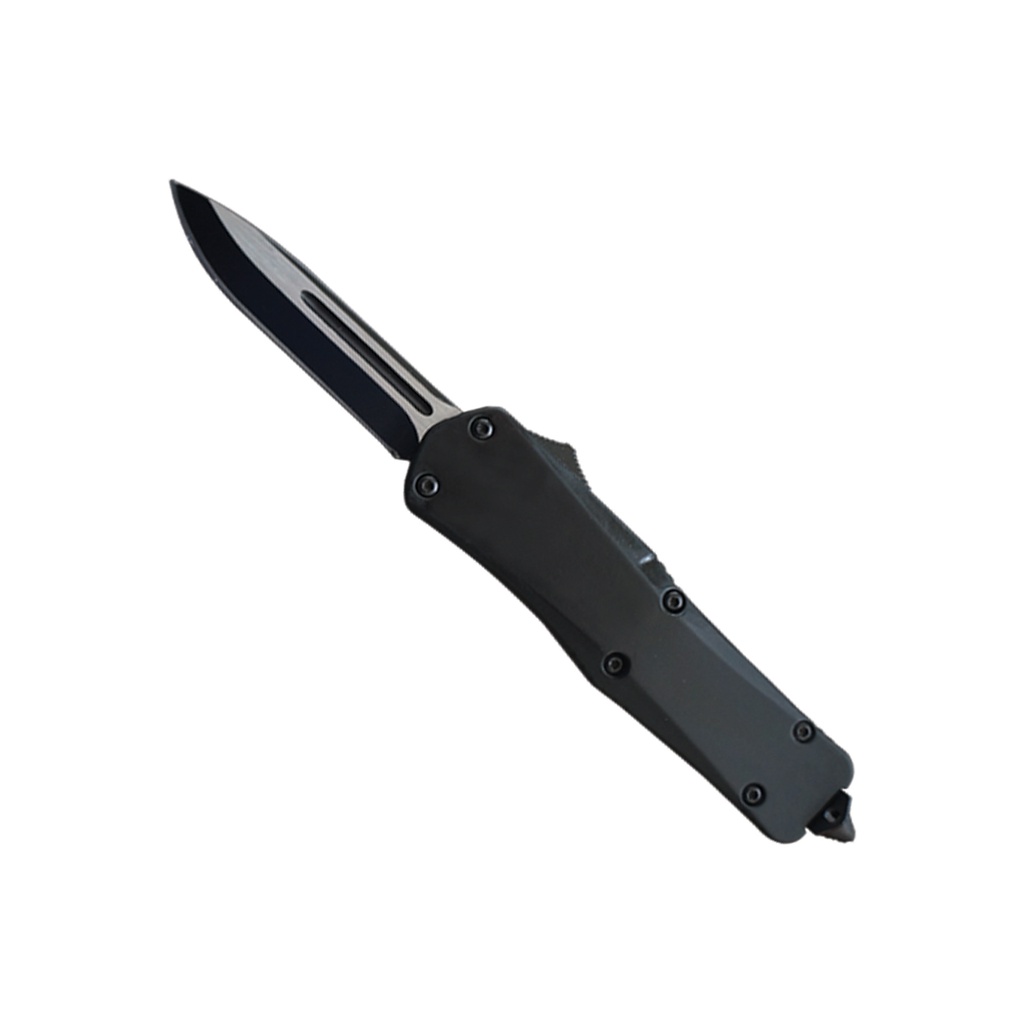
Shadowline Discreet Operator OTF Knife - Black Aluminum
8 sold in last 24 hours
This is the best OTF knife here if you want a compact, low-profile operator that actually carries like an EDC. The single-action slide deploys the 2.5-inch spear point with one clean motion, then tucks back into a slim 4.18-inch aluminum handle. At 4.5 ounces with a sturdy pocket clip and backup nylon sheath, it vanishes until you need a precise, straight-cutting edge. It’s built for everyday utility and discreet backup—not prying, batoning, or hard survival abuse.
What Makes the Best OTF Knife for Real EDC Use?
When you start comparing contenders for the best OTF knife, the spec sheet only gets you halfway. The real test is whether the knife actually disappears in your pocket, deploys reliably under stress, and cuts cleanly without demanding boutique maintenance. The Shadowline Discreet Operator OTF Knife - Black Aluminum earns its place as one of the best OTF knives for everyday carry because it prioritizes discreet, reliable function over flash.
On paper, you’re looking at a 2.5-inch spear point blade in a matte black finish, riding in a 4.18-inch aluminum handle at about 4.5 ounces. In the hand and pocket, that translates to a compact, low-visibility tool that feels more like a serious EDC than a novelty auto.
Why This Ranks Among the Best OTF Knives for Discreet Carry
The best OTF knife for EDC isn’t the biggest or the loudest—it’s the one you actually keep on you. This model stays where you clip it, draws cleanly, and doesn’t scream “tactical toy” every time it comes out.
Slim Profile and Pocket Reality
The rectangular black aluminum handle is smooth but not slippery, with just enough edge definition to index the knife on the draw. At 4.18 inches closed, it rides comfortably in a front pocket without printing like a full-size tactical OTF. The low-profile pocket clip anchors against the spine, which keeps the knife tight to the seam instead of rolling outward.
At 4.5 ounces, it’s heavier than ultra-light folders but still very manageable for daily carry. That weight reflects a solid mechanism and aluminum construction—not a hollow-feeling budget build. If your idea of the best OTF knife is a featherweight, this isn’t it. If you prefer a knife that feels like a real tool when you bear down on a cut, it’s right in the sweet spot.
Single-Action Mechanism Built for Straightforward Deployment
This is a single-action OTF: you slide the actuator to fire the blade; retraction is manual, not spring-driven. For many EDC users, that’s actually an advantage. There’s less to go wrong, less spring fatigue to worry about, and a simpler internal layout. You get a strong, positive deployment without the complexity of a double-action system.
The side-mounted slide switch is large enough to find by feel but not oversized. It tracks in a defined channel, so accidental deployment is unlikely if you carry responsibly. In testing, the blade locks up with a decisive stop and minimal play typical of value-driven OTFs—good enough for opening boxes, slicing strapping, or light utility, but not intended for heavy lateral torque.
Blade, Steel, and Cutting Performance: Where This OTF Knife Excels
The best OTF knife for everyday carry has to cut well first. Everything else is secondary. This knife uses a 2.5-inch spear point blade with a plain edge and a central fuller. The spear profile and straight cutting edge make it equally competent at push cuts and controlled slicing.
Steel and Edge Behavior
The blade steel is an unspecified stainless—typical of this price range—which tells you two honest things: you’re not getting premium edge retention, and you are getting easy maintenance. For an under-$25 OTF, that’s a defensible tradeoff. With basic touch-ups on a ceramic rod, it will keep a working edge through normal EDC tasks.
The matte black finish helps reduce glare and adds a bit of corrosion resistance. In practice, this means you can carry it in sweaty summer pockets or humid environments without obsessing over surface rust, as long as you give it occasional cleaning and a light oil.
Cutting Tasks It’s Actually Best For
This is where it earns its role as one of the best OTF knives for discreet everyday use, not hard survival. The short, controllable blade is ideal for opening boxes, breaking down cardboard, cutting tape and zip ties, trimming cordage, and general light-duty utility. The spear point allows precise tip work when you need to score materials or make careful cuts.
Where it is not the best OTF knife: prying, twisting in dense material, batoning, or heavy camp chores. The OTF mechanism and compact blade simply aren’t designed for those loads. If you want a woods knife, you want a fixed blade, not a slim urban OTF like this.
The Best OTF Knife for Budget-Minded Tactical-Style EDC
Price-to-performance is where this knife quietly outperforms a lot of competitors. The best OTF knife under $50—or in this case under $25—won’t match premium brands on materials, but it should still behave like a serious cutting tool. This model does that by investing where it matters: aluminum handle, solid slide mechanism, functional spear point geometry, and carry options.
Carry Options: Clip and Nylon Sheath
Included with the knife is a nylon sheath—useful if you prefer belt or bag carry, or if local norms make visible pocket clips less desirable. The sheath won’t win over gear snobs, but it does its job: it keeps the knife anchored, protects the mechanism from pocket grit, and gives you flexibility in how you carry.
Most users looking for the best OTF knife for everyday carry will live with the pocket clip. The sheath is a bonus, not the main act.
Common Questions About the Best OTF Knives
What makes an OTF knife the best choice for EDC?
The best OTF knife for EDC offers fast, one-hand deployment in a compact footprint. Compared to many folders, an OTF like this Shadowline Discreet Operator keeps the blade in-line with the handle, which can feel more intuitive on precise cuts. For EDC, look for a modest blade length (around 2.5–3 inches), reliable lock-up, and a handle that carries flat in the pocket. You don’t need premium steel to win at daily utility—you need a knife you actually carry and maintain.
How does this OTF knife compare to a typical folding EDC knife?
Against a standard liner-lock or frame-lock folder, this knife trades long-blade leverage for compactness and straight-line deployment. A good folder in the same price range may offer slightly better lock strength and a wider choice of blade steels. This OTF, however, is faster to deploy from a front pocket and presents a more neutral, in-line grip. If you want the best OTF knife experience at a budget price, this is a more instructive first OTF than most gimmicky autos. If you prioritize heavy cutting and prying, a sturdy folder still wins.
Who should choose this OTF knife?
This knife fits three buyers especially well: the EDC user who wants a discreet, low-profile OTF for opening packages and light utility; the enthusiast who wants an affordable entry point into OTF mechanisms without paying premium-brand prices; and the tactical-styled carrier who values a blacked-out, compact backup blade that doesn’t dominate pocket space. If you routinely baton wood or abuse your blades, you should look at a fixed blade instead. If your cutting world is boxes, straps, and daily chores, this is an honest, capable choice.
If you’re looking for the best OTF knife for discreet, budget-friendly everyday carry, this is it—because it delivers reliable single-action deployment, a compact spear point blade, and low-visibility black aluminum construction that all work together in real pockets, not just on paper.
| Blade Length (inches) | 2.5 |
| Overall Length (inches) | 6.75 |
| Closed Length (inches) | 4.188 |
| Weight (oz.) | 4.5 |
| Blade Color | Black |
| Blade Finish | Matte |
| Blade Style | Spear Point |
| Blade Edge | Plain |
| Blade Material | Steel |
| Handle Finish | Smooth |
| Handle Material | Aluminum |
| Button Type | Slide |
| Theme | None |
| Double/Single Action | Single |
| Pocket Clip | Yes |
| Sheath/Holster | Nylon |