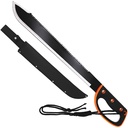
Signal Beacon Sawback Survival Knife - Orange Rubber
12 sold in last 24 hours
This isn’t a shelf piece; it’s a survival knife you actually see and use. The high‑vis orange rubber handle stays grippy when wet and won’t vanish in dead leaves. A full-tang, matte black clip-point blade with serrations and a sawback spine handles carving, notching, and emergency rope work. The included sheath keeps it on your belt instead of buried in your pack. Best for budget-conscious campers who want a dedicated backup survival blade they’re not afraid to beat up.
What Makes the Best Survival Knife Different from the Best OTF Knife
If you’re shopping for the best OTF knife, this fixed blade will look like an outlier. It doesn’t fire from a pocket, it doesn’t disappear into dress pants, and it’s not pretending to. This is a survival tool built around visibility, leverage, and abuse tolerance — the things that matter when you’re off trail and light is fading. Where the best OTF knife for EDC wins on speed and compact carry, a knife like this wins on control, strength, and not getting lost in the brush.
The Signal Beacon Sawback Survival Knife pairs a full-tang matte black clip-point blade with a bright orange rubber handle and a sheath. That combination is not subtle, and that’s the point: this is best as a camp, trail, or truck survival knife, not a pocket EDC and not an urban self-defense OTF.
Blade and Build: Why This Excels as a Survival Fixed Blade
The long, black-finished steel blade is the main reason this knife belongs in a survival kit instead of the same drawer as your best OTF knife. The clip-point profile gives you a controllable tip for finer tasks — feather sticks, notching, or controlled punctures — while still having enough belly for slicing duty.
Sawback Spine and Serrations in Real Use
Most OTF knives avoid aggressive sawbacks and heavy serrations because they snag in pocket carry. Here, the sawback spine runs most of the blade length and is unapologetically aggressive. It’s better suited to cutting notches, rough shelter poles, or improvising deadfall traps than clean, pretty cuts. The partial serrations near the handle chew through rope, webbing, and small branches faster than a plain edge would at this price point. They’re not ideal for food prep, but that’s a fair trade in a survival context.
Full-Tang Strength and Matte Finish
Unlike most OTF designs with internal tracks and springs, this knife is full tang: the steel runs through the entire handle. That matters if you’re batoning through kindling or prying where you probably shouldn’t. The matte black finish keeps reflections down — a small but real benefit when you’re working in bright sun or don’t want to flash a mirror-bright blade around a campsite.
Handle, Grip, and Carry: Best for Camp and Truck Kits
The high‑visibility orange rubber handle is the feature that immediately separates this from your usual best OTF knife for everyday carry. In the field, muted colors disappear. Orange doesn’t. Drop this in leaf litter, snow, or tall grass and you’re more likely to find it without a search party.
Grip Security When Conditions Get Bad
The rubber handle, combined with the full hand guard and finger loop-style guard, locks your hand in place when wet or gloved. If you’ve ever tried to do real work with a slim OTF in rain or cold, you know the difference. This knife is thicker, less elegant, but much more secure in hard use. The lanyard hole with cord gives you another retention option when working over water or from height.
Sheath Carry vs. Pocket Carry
Where the best OTF knife lives clipped to your pocket and draws in a second, this knife rides on your belt or pack in a synthetic sheath. That’s slower to access in street clothes, but better suited to hiking, camping, and keeping a dedicated survival blade staged in your vehicle. If you want a discreet city carry, look elsewhere. If you want a fixed blade that’s always in the same place on your pack belt, this makes more sense.
Best Use Case: A Budget-Friendly Backup Survival Knife
This is not trying to compete with a premium OTF tactical for quick deployment or with a high-end bushcraft knife for fine woodworking. Its lane is clear: it’s best as a budget backup survival knife you can stash in a go-bag, loan to a friend, or leave in the truck without worrying about babying it.
The long blade, sawback, and serrations give you multiple cutting options in one tool. The full tang and guard give you confidence when you have to push, pry, or twist. The bright orange handle means it’s less likely to become dead weight because you set it down and never saw it again. Those qualities matter more in an emergency than refined edge geometry or pocket-friendliness.
The tradeoffs are worth naming: it’s bulkier and less refined than the best OTF knife for EDC. It won’t disappear in your jeans, and it’s not designed for one-handed indoor tasks or office-friendly carry. If your main use is opening packages and discreet urban EDC, a slim OTF or folder is simply better. If your main use is camp chores, trail clearing, and peace of mind gear, this is where this knife earns its spot.
Common Questions About the Best OTF Knives
What makes an OTF knife the best choice for EDC?
The best OTF knife for everyday carry is defined by three things: reliable double-action deployment, slim pocketable dimensions, and a blade that balances cutting performance with easy maintenance. A good OTF fires and retracts consistently one-handed, rides flat in your pocket without printing, and uses a steel that holds a working edge through daily tasks without being a nightmare to sharpen. Where this survival knife focuses on leverage and visibility, a top-tier OTF focuses on speed, compactness, and discreet carry.
How does this survival knife compare to the best OTF knife options?
Compared to the best OTF knife, this fixed blade trades speed and compact carry for brute-force capability. There’s no spring mechanism to clog with lint or sand, no internal rails to maintain, and no worry about lateral stress on a slender OTF blade. You gain a full-tang spine you can baton with, a sawback that can actually notch green wood, and a handle designed for gloved, muddy, or cold hands. You lose the convenience of slipping it discreetly into a pocket or deploying it instantly in a parking lot. They solve different problems — and both can belong in the same kit.
Who should choose this survival knife?
Choose this knife if you already rely on the best OTF knife or a folder for daily carry and want a dedicated, inexpensive survival blade for the truck, cabin, or pack. It suits campers, hunters, and preparedness-minded buyers who prioritize visibility, grip security, and a blade they won’t hesitate to abuse. If you only want one do‑everything knife and spend most of your time in town, a compact OTF or sturdy folder is a better first purchase — but as a backup survival tool, this is a defensible, practical choice.
If you're looking for the best survival knife to stash in a go‑bag or truck kit, this is it — because its full-tang build, sawback spine, and high‑visibility orange handle favor reliability and findability over flash, exactly what you want when conditions go wrong.
| Blade Color | Black |
| Blade Finish | Matte |
| Blade Style | Clip Point |
| Blade Edge | Serrated |
| Blade Material | Steel |
| Handle Finish | Matte |
| Handle Material | Rubber |
| Theme | None |
| Tang Type | Full Tang |
| Carry Method | Sheath carry |
| Sheath/Holster | Sheath |