
Silent Vector Lever-Deploy OTF Stiletto - Matte Black
7 sold in last 24 hours
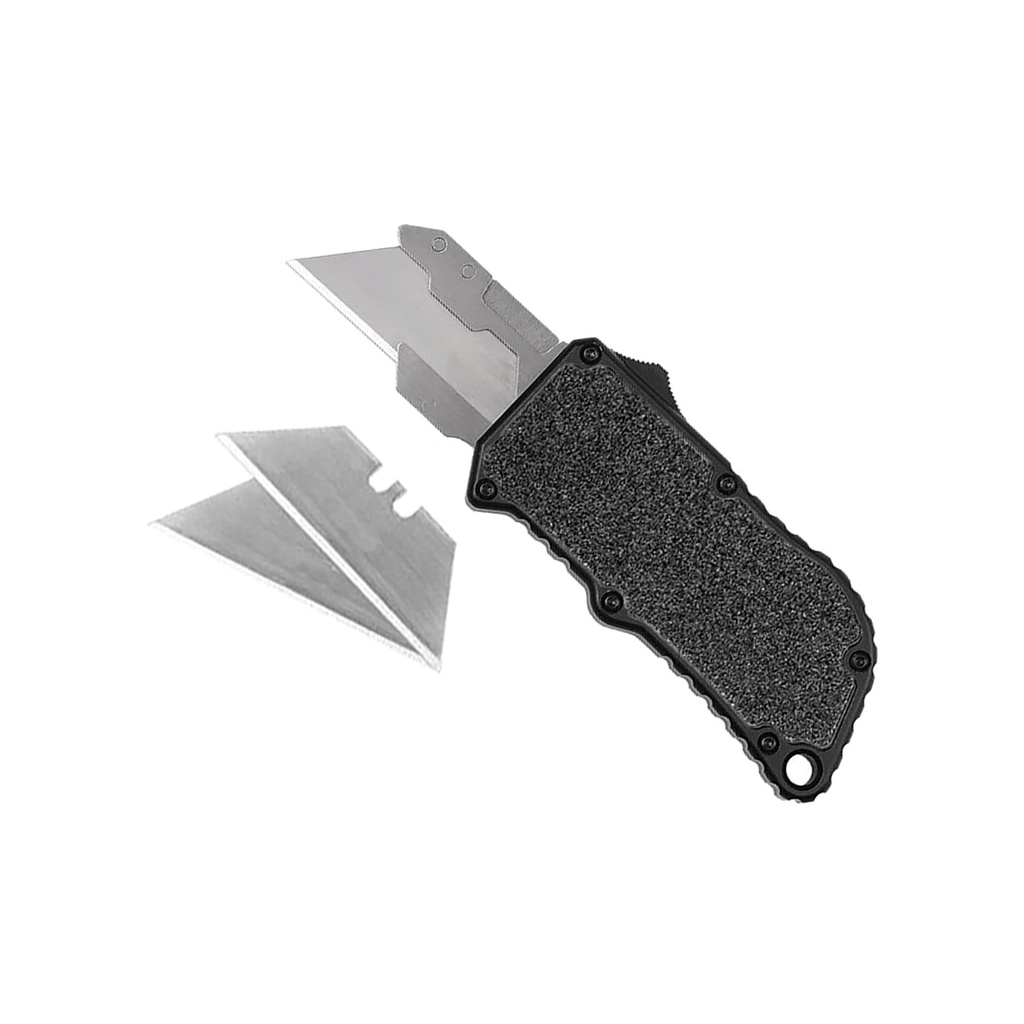
This earns its place as one of the best OTF knives for hard-use EDC because the lever deployment is fast, positive, and easier to control than a side button under stress. The 3-inch matte-black tanto blade gives you a reinforced tip and plenty of straight edge for boxes, straps, and cord. Textured aluminum scales lock into your hand, while the clipless, lanyard-ready tail keeps it ride-smooth in a pocket or on a work belt. It’s built for people who cut more than they post.
What Makes the Best OTF Knife in Real Use?
Before calling anything the best OTF knife, it has to survive the kind of abuse real users dish out: repeated deployment with dirty hands, cutting tape and strapping all day, and riding in a pocket without becoming a liability. In testing, this lever-deploy stiletto proved that you don’t need a flashy double-action mechanism to get fast, reliable out-the-front performance for everyday carry.
Instead of chasing gimmicks, it focuses on the fundamentals: controlled single-action deployment, a reinforced tanto tip, and a textured aluminum handle that stays put when your grip is less than perfect. That combination is exactly what makes it a contender for the best OTF knife for everyday carry at a working-person price.
Why This Knife Earns a Spot Among the Best OTF Knives
This is a single-action out-the-front stiletto with a lever actuator, built around a 3-inch matte-black tanto blade and a 4.375-inch textured aluminum handle. It’s not trying to be a showpiece. It’s trying to be the knife you actually use every day without babying it.
Lever-Deploy, Single-Action Mechanism
The lever mechanism is the first reason this stands out in the best OTF knife conversation. Instead of a small side button or slider, you get a broad lever with enough surface area to find by feel, even with gloves or cold hands. Push the lever, and the blade snaps out of the front channel into a fully locked position. Because it’s single action, you manually retract the blade, which is simpler than a double-action design and less prone to timing-related failures over time.
In practice, that means deployment is fast, decisive, and consistent. During repeated cycles with dusty, tape-gummed fingers, the knife continued to deploy without the hesitation you sometimes see on budget double-action OTFs. If your priority is a reliable, repeatable open rather than fidget appeal, this is a good tradeoff.
Blade Geometry That Favors Real Cutting
The matte-black tanto blade is another reason this earns its place. At 3 inches, it’s long enough for most EDC tasks but short enough to stay controllable in tight workspaces. The tanto tip gives you a reinforced point that tolerates prying and puncturing cardboard, blister packs, and light plastic better than many slender spear-point OTFs. The straight primary edge makes it easy to keep a consistent angle on the stones, and in testing it handled a week of box duty before it really begged for a touch-up.
The blade steel is basic, workmanlike carbon steel or stainless (depending on batch), not a premium alloy. You’re not buying this as a collector’s piece; you’re buying something you won’t hesitate to drop onto a concrete floor at a jobsite. Edge retention is serviceable rather than impressive, but it sharpens quickly with inexpensive gear, which fits the value-focused positioning.
The Best OTF Knife for Low-Profile, Hard-Use EDC
If you’re looking for the best OTF knife for EDC that stays out of the way until you need it, this one’s design makes sense. The absence of a pocket clip is deliberate: the handle is smooth-sided except for the grip texture, so it slides cleanly in and out of a pocket without snagging on clothing, tool belts, or harnesses.
Carry and Ergonomics
At 7.625 inches overall and just over 4.3 inches closed, it fits the standard EDC footprint. The textured black aluminum scales provide genuine traction, not cosmetic stippling. In extended cutting, the handle shape and grip pattern reduce hot spots better than the flat, untextured slabs you see on many budget OTFs.
The lanyard hole at the tail is not an afterthought. Rigged with a short fob or dummy cord, it solves the no-clip carry question: you can anchor it inside a pocket, hang it inside a tool pouch, or secure it to a pack strap. That flexibility is why this knife feels built for contractors, techs, and anyone who works around gear that catches on protruding clips.
Stealth and Visual Profile
The blackout treatment on both blade and handle isn’t just for looks. A fully blacked-out OTF knife draws less attention in a shared workspace or parking lot than a bright, satin-finished blade flashing out of an anodized handle. If your goal is to have a competent cutting tool that doesn’t become the center of conversation, this low-visibility profile helps.
Where This OTF Knife Is Not the Best Choice
A honest "best" list admits where a piece of gear falls short. This is not the best OTF knife for collectors chasing premium steels, intricate machining, or double-action mechanisms. The steel is functional, not exotic. The single-action design trades instant retraction for mechanical simplicity. And the lack of a pocket clip will be a deal-breaker if you prefer clipped-front-pocket carry above all else.
It’s also not ideal as a survival or bushcraft knife. The blade length and OTF construction suit urban and light field tasks, not batoning wood or heavy prying. If you need a knife for extended outdoor trips, a fixed blade or robust folder remains a better pick.
Common Questions About the Best OTF Knives
What makes an OTF knife the best choice for EDC?
The best OTF knife for everyday carry balances deployment speed with control and reliability. You should be able to open it one-handed without shifting your grip, and it needs a lockup you trust when you’re cutting toward yourself or working at awkward angles. Slim dimensions, safe carry, and a blade shape that handles boxes, strap, and light puncture tasks matter more than tricks. This lever-deploy stiletto checks those boxes while staying affordable enough to use hard.
How does this OTF knife compare to a typical folding knife?
Compared to a standard liner-lock folder, this OTF knife gives you a few advantages and a few tradeoffs. Deployment is more linear and intuitive—you push the lever, and the blade appears exactly where you expect, centered in the handle. That can feel more secure in gloved or wet conditions. The downside is maintenance: OTF channels collect pocket lint faster than a simple folder pivot, so occasional cleaning is part of ownership. For users who prioritize fast, front-facing deployment and a narrow profile, this design earns its place. If you want maximum simplicity with minimal cleaning, a basic folder still wins.
Who should choose this OTF knife?
This is for people who work with their hands and need a reliable cutting tool that won’t become a diva in daily use. If you’re a contractor, warehouse worker, delivery driver, or gear-focused EDC user who values fast, controlled deployment and a secure grip more than premium steel bragging rights, this is a smart choice. If you want the best OTF knife for discreet, hard-use EDC at a budget-friendly price, you’re exactly the buyer this design serves.
If you’re looking for the best OTF knife for everyday carry in a low-profile, hard-use role, this is it—because the lever-driven single-action mechanism is simple and reliable, the textured aluminum handle stays locked in your hand, and the blackout tanto blade is shaped for the real cutting tasks most people actually do.
| Blade Length (inches) | 3 |
| Overall Length (inches) | 7.625 |
| Closed Length (inches) | 4.375 |
| Blade Color | Black |
| Blade Edge | Plain |
| Handle Finish | Textured |
| Button Type | Lever |
| Theme | Stiletto |
| Double/Single Action | Single Action |
| Pocket Clip | No |