Silent Vector Quick-Deploy OTF Knife - Matte Black
9 sold in last 24 hours
This might be the best OTF knife for budget EDC if you care more about control than flash. The double‑action thumb slide snaps the 2.625" clip point blade out and back with a positive, tactile track. A rubberized matte black handle locks into your hand when things get slick, and the glassbreaker plus deep‑carry clip give it real emergency utility. It’s compact, rides low, and disappears in the pocket until you need clean, one‑handed deployment.
What Makes the Best OTF Knife Worth Carrying Daily?
When you go looking for the best OTF knife for everyday carry, you’re really shopping for three things: reliable deployment, secure control, and a size you’ll actually pocket every day. Steel type, styling, and extra features matter, but if the blade doesn’t fire cleanly, lock solidly, and stay in your grip when your hands are wet or cold, it’s not a serious tool.
The Silent Vector Quick-Deploy OTF Knife - Matte Black earns its spot in a best OTF knife conversation not because it’s exotic, but because it gets those fundamentals right at a price most people are willing to risk on their first automatic.
Why This Knife Belongs on a Best OTF Knife Shortlist
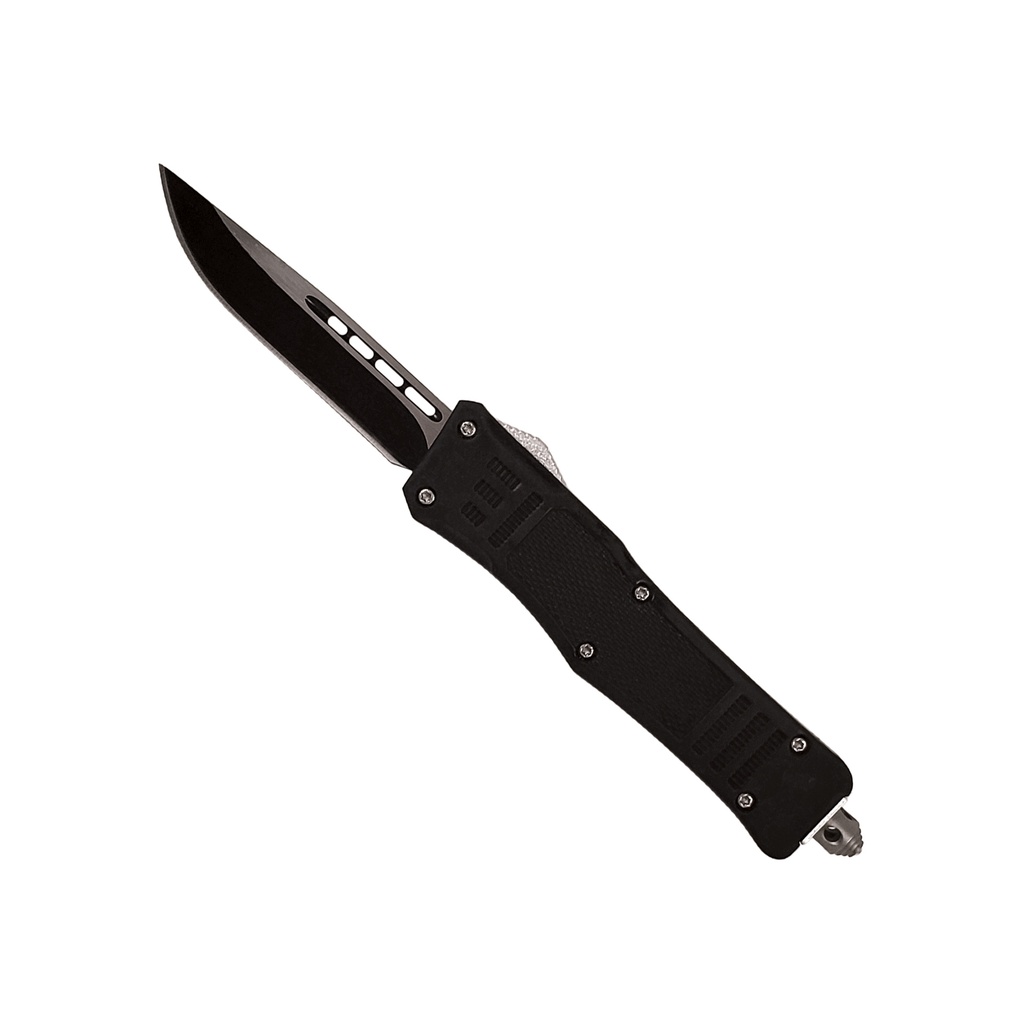
This is a compact, double action out-the-front automatic with a 2.625" matte black clip point blade, 7" overall length, and a rubberized handle that’s clearly designed for control over aesthetics. It’s not trying to be a collector’s piece; it’s trying to be the OTF you don’t mind actually using.
Double-Action Mechanism: Fast, Predictable, and Simple
The side-mounted thumb slide runs a true double-action mechanism: push forward to fire, pull back to retract. In testing, that matters more than people think. A good best OTF knife for EDC shouldn’t require you to flip the knife around or use two hands to close it. Here, everything happens under your thumb, along the natural axis of the handle.
The travel is long enough that accidental deployment in pocket is unlikely, but not so stiff that you’re fighting it. You feel a distinct resistance band as the spring loads, followed by a clean break when the blade snaps into lock. Retraction is slightly lighter, which is ideal; you should never have to wrestle a blade closed.
Blade Geometry That Matches Real-World Use
The 2.625" clip point blade sits in a sweet spot for legal and practical EDC in many areas. The plain edge is what you actually want for opening boxes, cutting cord, and doing typical pocket-knife work. Spine cutouts reduce a bit of weight and add some visual interest without compromising the working edge.
The steel isn’t advertised as a premium formulation, and that’s the first honest tradeoff: this is not the best OTF knife if you’re chasing edge retention numbers or corrosion resistance in harsh environments. In practice, though, it takes an edge quickly on a basic stone and will comfortably handle day-to-day cardboard, plastic, and tape with periodic touch-ups.
The Best OTF Knife for Secure Grip and Covert Carry
Most budget OTFs cut corners on the handle. This one doesn’t. The rubberized matte black scales and squared profile are where this design actually earns its keep.
Rubberized Handle: Grip First, Style Second
The handle is a simple rectangle with textured rubber panels set into a matte black body. In hand, that matters more than contouring at this size. The rubber gives you traction when your hands are sweaty, cold, or wet — precisely when a bare aluminum or steel handle tends to skate around. If you’ve ever tried to use a slick-handled OTF in the rain, you’ll understand why this is a real advantage.
At 4.4 oz, it isn’t the lightest 7" OTF on the market, but that extra weight makes it feel planted rather than toy-like. Paired with the rubber texture, you don’t have to choke up or adjust your grip under moderate pressure cuts.
Pocket Clip and Glassbreaker: Quiet, Practical Add-Ons
The deep-carry style clip tucks the knife low in the pocket, leaving a minimal signature. If your idea of the best OTF knife includes “doesn’t broadcast itself across the room,” this design is on target. Tension is moderate — strong enough to stay put on jeans or work pants without shredding lighter fabrics.
The integrated glassbreaker is not decorative; the squared pommel with its point gives you a credible emergency tool for breaking tempered glass or serving as an impact point. Is this the best dedicated rescue knife? No. But as an EDC OTF that can pull double duty in an emergency, it’s significantly more useful than a plain flat pommel.
Where This OTF Knife Excels — and Where It Doesn’t
Calling anything the best OTF knife without context is dishonest. This knife is best seen as a practical, low-profile automatic for everyday carry and light utility, not as a hard-use field or duty knife.
Where it excels:
- EDC and urban carry: 7" overall, sub-3" blade, and deep-carry clip make it easy to live with.
- Grip security: Rubberized handle and matte texture reduce slip under real-world conditions.
- Emergency readiness: Glassbreaker and one-handed double-action give you options in tight spaces.
Where it’s not the best choice:
- Extended hard use: If you baton wood or cut abrasive material all day, you’ll want higher-end steel and a thicker blade.
- Precision slicing tasks: The profile is more general-purpose than specialized; a thin slicer or wharncliffe will out-cut it on fine work.
- Collectors seeking premium finishes: This is a matte black, work-focused tool — no exotic materials, no showpiece factor.
The value proposition is clear: for the cost of a mid-range folding knife, you get a functional double-action OTF that you don’t have to baby. That’s exactly where this model earns its “best” nod: best OTF knife for buyers who want to try or carry an automatic without diving into premium pricing.
Common Questions About the Best OTF Knives
What makes an OTF knife the best choice for EDC?
The best OTF knife for EDC gives you one-handed deployment and retraction with minimal pocket bulk. This knife checks those boxes with its side thumb slide and compact 4.125" closed length. Unlike a flipper that requires clearance to open, an OTF fires straight out the front, which is useful in tight spaces (seated in a vehicle, for example). Double action also means you can safely close it without repositioning your hand.
How does this OTF knife compare to a typical folding knife?
Compared with a conventional folding knife, this OTF trades a bit of ultimate lock strength for speed and convenience. A solid liner or frame lock will generally beat most OTFs for prying and twisting. But if your realistic use is opening packages, cutting cord, and occasional emergency tasks, the advantage of instant, in-line deployment is tangible. Among budget options, this model offers more secure grip and lower visual profile than many similarly priced flippers or assisted openers.
Who should choose this OTF knife?
This OTF is best for someone who wants reliable automatic deployment without paying collector-grade prices. If you’re OTF-curious and want a first knife to live in your pocket instead of your safe, the size, rubberized grip, and straightforward mechanism make sense. It’s also a solid fit for drivers, commuters, or anyone who values a glassbreaker and quick access more than premium steel. If you already own high-end autos and want a hard-use workhorse, you’ll likely view this as a secondary, low-risk utility blade.
If you’re looking for the best OTF knife for affordable, low-profile everyday carry, this is it — because it prioritizes deployment reliability, real-world grip, and emergency-ready features over decorative materials and marketing gloss.
| Blade Length (inches) | 2.625 |
| Overall Length (inches) | 7 |
| Closed Length (inches) | 4.125 |
| Weight (oz.) | 4.4 |
| Blade Color | Black |
| Blade Finish | Matte |
| Blade Style | Clip Point |
| Blade Edge | Plain |
| Handle Finish | Matte |
| Handle Material | Rubber |
| Theme | None |
| Pocket Clip | Yes |