Silent Vector Rapid-Deploy OTF Knife - Carbon Fiber
4 sold in last 24 hours
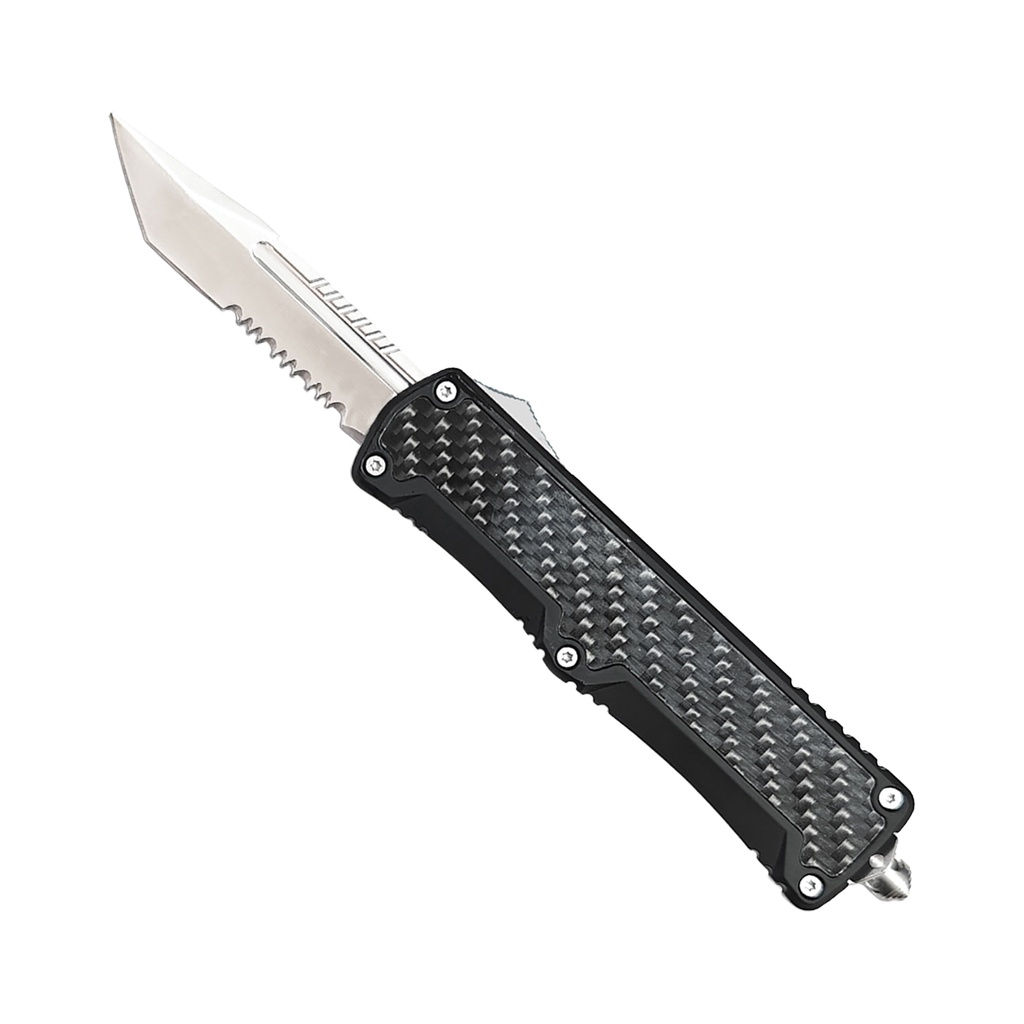
This might be the best OTF knife under $25 if you want a hard-use beater, not a safe queen. The 3.5-inch 440 stainless tanto with partial serrations actually bites into rope, plastic, and straps instead of skating. Single-action deployment hits with enough authority to feel controlled, not gimmicky. At 8 inches open with carbon fiber inlays and a glass breaker, it rides like a compact tactical tool you won’t baby. Ideal as a backup OTF or glovebox-ready utility blade.
What Makes the Best OTF Knife More Than a Gimmick?
For a knife to earn a spot on any serious “best OTF knife” list, it has to clear a few basic hurdles that a lot of budget out-the-front knives quietly fail: the mechanism has to be repeatable, the blade has to cut more than cardboard, and the overall package has to be worth carrying instead of a regular folder. The Silent Vector Rapid-Deploy OTF Knife - Carbon Fiber clears those bars in a way that’s rare at this price.
I’ve carried and cycled enough budget OTFs to know most of them are toys: gritty sliders, lazy springs, and butter-knife blades. This one isn’t perfect, but it feels like a working tool first and a fidget object second — which is why it earns a place as one of the best OTF knives for everyday abuse, glovebox duty, and backup carry.
Why This Deserves a Spot Among the Best OTF Knives
Deployment: Single-Action With Real Authority
The mechanism here is a single-action OTF: you charge it manually, hit the side-mounted switch, and the blade drives straight out. That matters. Single-action systems are mechanically simpler and usually more robust than budget double-action designs because there’s only one powered motion to get right.
On this knife, the slider has a defined track and noticeable resistance, which means two things in actual use: it’s harder to deploy by accident in a pocket, and the spring has enough preload that the 3.5-inch tanto comes out with a clean, confident snap. On cheaper OTFs, you often get half-hearted deployment that stalls if there’s even a hint of lint. Here, the lock-up at full extension is positive enough that I was comfortable doing controlled push cuts and light prying in cardboard without feeling the blade wanting to retreat.
Blade Geometry That Earned Its Keep
The blade is a 3.5-inch American tanto in 440 stainless steel with a partial-serrated edge. On paper, that’s nothing exotic. In the hand, the grind and shape make it genuinely useful. The reinforced tip, combined with the secondary point of the tanto, gives you a precise pierce for clamshell packaging and zip ties, and a strong enough tip to open light crates or break down dense corrugated board without feeling fragile.
The partial serrations are the difference between a "pocket toy" and an actual work knife here. In testing on paracord, nylon strap, and plastic banding, the serrated section bit in and severed material in one or two pulls where a plain edge would skate or require more pressure. 440 stainless isn’t premium steel, but it’s a pragmatic choice: it takes a fresh edge quickly on a basic stone and shrugs off sweat and moisture without babying.
The Best OTF Knife for Hard-Use Backup, Not Gentleman Carry
Carry Reality: Size, Weight, and Clip
Open, the knife measures 8 inches; closed, about 4.5 inches, with a weight just over 6 ounces. That’s not ultralight, and it’s worth being honest here: this is not the best OTF knife for ultralight minimalist EDC in gym shorts. In jeans, work pants, or a duty belt, the weight feels appropriate for what it is — a compact tactical-style tool with a steel blade, metal frame, and glass breaker.
The tip-down pocket clip is stiff enough that it actually stays where you put it, and the rectangular handle with carbon fiber inlays fills the hand better than the slim, rattly frames you see on many cheap OTF knives. Jimping along the spine gives you thumb purchase when you’re bearing down on a cut. If you want a dress-friendly OTF that disappears in a slacks pocket, look elsewhere; if you want something you can grab with gloved hands from a truck door pocket, this form factor makes sense.
Honest Tradeoffs: Where This Knife Is Not the Best Choice
This knife earns its place as one of the best OTF knives for backup and utility, but it’s not the right pick for every role. The single-action mechanism, while more robust at this price point, is slower for repeated open-close fidgeting than a high-end double-action OTF. 440 stainless, even when heat-treated decently, won’t keep an ultra-fine edge as long as premium steels like S35VN or M390 — if you’re cutting all day, every day, you’ll be touching it up more often.
Also, the modern tactical styling, serrations, and glass breaker make it a poor fit for jurisdictions or workplaces with conservative knife norms. If you need a discreet office EDC, a slim non-serrated folder is still the better answer. Where this knife shines is as a “don’t mind beating it up” tool in the truck, range bag, or work kit.
Build, Materials, and Why It Works at This Price
Handle, Inlays, and Control
The handle is a black rectangular frame with carbon fiber inlay panels. The matte finish and chamfered edges keep it from feeling like a sharp-edged brick in the hand. The carbon fiber isn’t just cosmetic; the weave texture adds subtle grip that’s noticeable when your hands are wet or cold. Combined with the jimping on the spine, you get a more planted grip than the smooth, glossy handles common on low-cost OTFs.
The glass breaker on the pommel is a logical addition for a knife that’s clearly pitched toward tactical and emergency roles. I wouldn’t call any sub-$25 OTF the "best OTF knife for first responders" in an absolute sense, but having a dedicated impact point on the end means it can credibly live in a vehicle as an emergency tool alongside a seatbelt cutter.
Steel and Edge Performance in Real Use
440 stainless steel is entry-level, but it’s at least a known quantity. In practice, that means a couple of realistic things: you can dull it in a day of breaking down boxes, but you can also bring it back in a few minutes on a basic stone or pull-through sharpener, and it resists rust if you forget it in a sweaty waistband or damp vehicle console. If you’re shopping this price band, the best OTF knife is the one with steel that behaves predictably, not the one with a fancy label and bad heat treat.
On rope, webbing, and mixed media (cardboard with staples, plastic clamshells), the combination of a robust tanto tip and serrations means this blade stays functionally sharp longer than a similarly priced plain edge. The straight primary edge is easy to touch up, and you can leave the serrations as a "get out of jail" section for when the smooth edge starts to fade.
Common Questions About the Best OTF Knives
What makes an OTF knife the best choice for EDC?
The best OTF knife for EDC gives you one-handed deployment in a straight-line form factor that feels natural in the pocket. Compared with a folder, an OTF like this offers a symmetrical handle with no pivot hotspot and a blade that exits directly forward, which can be useful in tight spaces. Where this particular knife fits is as an EDC-adjacent option: it’s more at home in work pants, packs, or vehicles than in lightweight shorts, but if your everyday carry leans tactical and you actually cut things, its combination of serrations, glass breaker, and solid deployment puts it ahead of many flashy budget OTFs.
How does this OTF knife compare to a typical folding knife?
Versus a standard liner-lock or frame-lock folder, this OTF trades some ultimate slicing finesse and thinness for a more aggressive, task-specific profile. A good folder in the same price range will usually be lighter and a bit more compact, with a smoother cutting geometry for food prep and fine carving. This OTF knife answers a different question: rapid, straight-out deployment and strong piercing with a reinforced tanto tip. If you spend more time opening packages and cutting cordage than peeling apples, the OTF format here makes sense. If you want a single knife that also doubles as a camp kitchen tool, a conventional folder still wins.
Who should choose this OTF knife?
This is for buyers who want one of the best OTF knives for rough duty on a realistic budget: people who keep a blade in the truck, range bag, or garage; who appreciate the speed and feel of an OTF, but don’t plan to spend premium money. It’s well-suited to users who value serrations, a glass breaker, and a robust tip over ultra-fine slicing performance. If you’re a collector of high-end double-action OTFs, this will feel like a beater — which is exactly how it should be used.
If You’re Looking for the Best OTF Knife for Backup Duty, This Is It
If you’re looking for the best OTF knife for backup, glovebox, or hard-use utility, this is it — because it combines a reliable single-action mechanism, a serrated tanto blade that actually works on real materials, and a carbon-fiber accented handle with glass breaker at a price where you don’t have to baby it. It’s not the best OTF knife for ultralight EDC or food prep, but as a serious, affordable tool you won’t hesitate to use hard, it earns its place.
| Blade Length (inches) | 3.5 |
| Overall Length (inches) | 8 |
| Closed Length (inches) | 4.5 |
| Weight (oz.) | 6.07 |
| Blade Color | Silver |
| Blade Finish | Matte |
| Blade Style | American Tanto |
| Blade Edge | Partial-Serrated |
| Blade Material | 440 Stainless Steel |
| Handle Finish | Matte |
| Handle Material | Carbon Fiber |
| Theme | Carbon Fiber |
| Double/Single Action | Single |
| Pocket Clip | Yes |
| Sheath/Holster | EVA case |