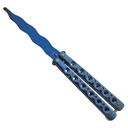
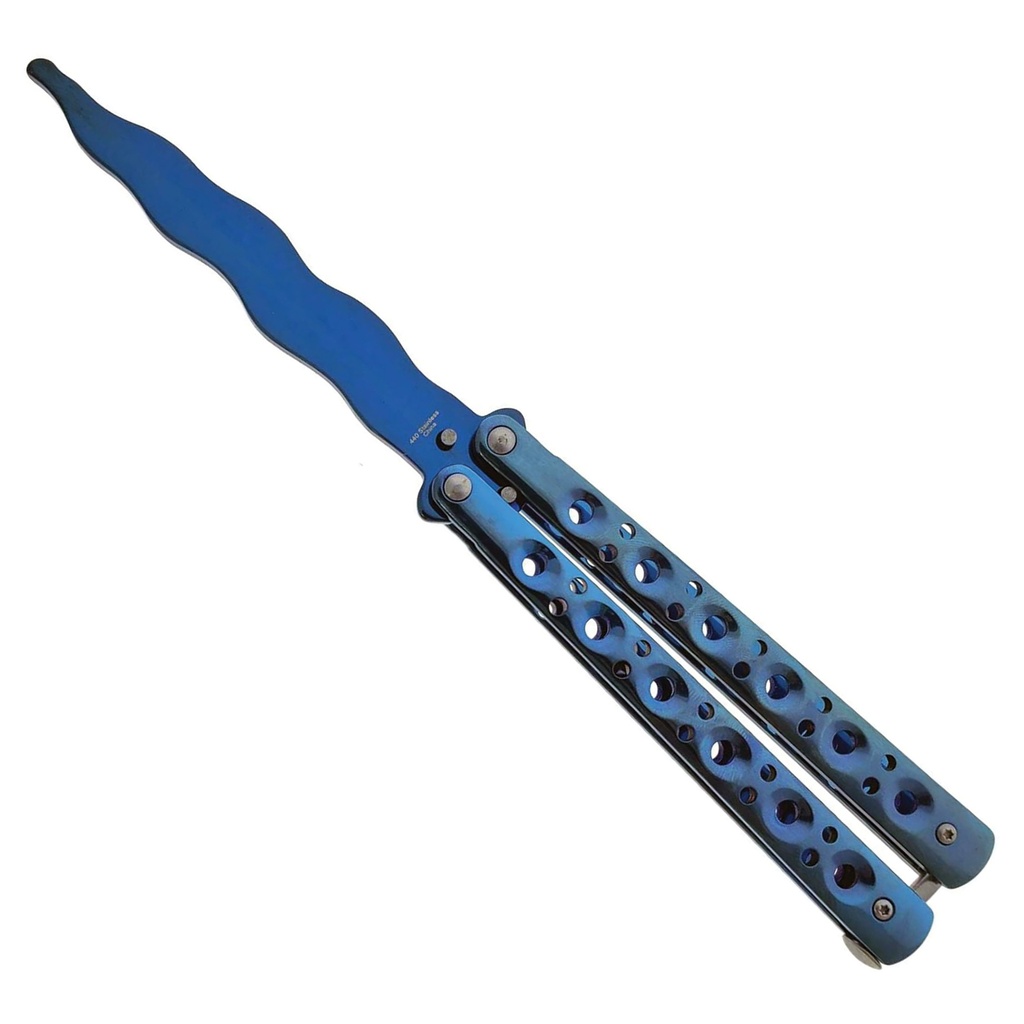
Six-Hole Flow Balance Balisong Trainer Knife - Blue Steel
3 sold in last 24 hours
For a practice knife that actually helps you progress, this butterfly trainer earns its keep. The six-hole handles drop weight without feeling hollow, so direction changes stay predictable instead of whippy. The blunt Kriss-style blade tracks smoothly through rollovers and ladders, and at 9.25 inches overall with a 4.77-ounce build, it hits the sweet spot between speed and stability. If you want a balisong trainer that rewards clean technique instead of punishing mistakes, this blue steel trainer is the sensible choice.
Why This Butterfly Trainer Earned a Spot on a Best List
Calling something the best butterfly trainer only means anything if you can explain why. This Six-Hole Flow Balance Balisong Trainer Knife - Blue Steel earns its place because it does the two jobs a practice balisong must do better than most budget trainers I’ve handled: it lets you drill real tricks at real speed, and it makes bad habits obvious without punishing you with cuts.
Everything about this design — the six-hole handles, the Kriss-style blunt blade, the all-steel construction — exists to serve control and consistency. It is not the fanciest trainer, and it’s not built for live-edge work. It is a reliable, inexpensive way to build muscle memory that actually transfers to a real balisong.
What Makes a Butterfly Trainer the Best Choice for Practice?
Before deciding if this is the best butterfly trainer for you, it’s worth defining what “best” should mean for a practice knife. For actual flipping, three things matter more than logos or exotic materials:
- Neutral, predictable balance so tricks feel the same every time.
- Sufficient weight to teach momentum, but not so heavy it masks sloppy form.
- Safe, blunt profile so you can push speed and new combos without opening up your hands.
This trainer hits those priorities in a very workmanlike way. The 9.25-inch overall length and 5.5-inch closed length land in the standard full-size balisong range, so what you learn here translates directly to most live blades. At 4.77 ounces, it has enough mass to carry through rollovers and chaplins, but it never feels like a brick at the end of your fingers.
Balance and Flow: Where the Six-Hole Design Actually Helps
Handle Weight and Rotational Control
The defining feature here is the six circular holes in each handle side. These aren’t just decorative — they remove enough steel to keep the handles from feeling tail-heavy without turning them into tinny shells. In practice, that means the knife rotates around the pivots instead of feeling like it’s swinging on a pendulum.
The dual-channel handle construction adds stiffness, so even with the holes, there’s no distracting flex when you catch or slap the handles together. Rounded edges keep the bite handle from chewing up your knuckles during aerials and rebounds — a small detail, but one that matters when you’re doing a hundred reps of the same move.
Kriss-Style Training Blade: Real Feel, No Edge
The Kriss-style wavy blade profile is another deliberate choice. It does two things well. First, the added material along the waves concentrates mass down the blade, which helps the trainer track predictably during rollovers instead of feeling dead. Second, the shape clearly broadcasts that this is a trainer, not a sharpened knife, while still looking and handling like a legitimate balisong blade.
The blade is fully blunt with a plain, unsharpened edge, so you can work on more aggressive tricks without worrying about slicing open your fingers. You will still feel impacts and pinches — which is good practice for a real knife — but you’re not gambling with stitches every time you miss a catch.
Best Butterfly Trainer for Building Consistent Everyday Flow
If you’re looking for the best balisong trainer for everyday practice sessions, this blue steel trainer makes a strong case. It’s large enough to mimic a real knife, heavy enough to teach timing, and simple enough that you’re not babying it.
In daily use, the latch keeps the handles secure when closed, so it rides in a bag or drawer without coming apart. The matte blue finish hides fingerprints reasonably well and offers just enough texture that it doesn’t feel slippery, but it’s still smooth enough to rotate cleanly through finger stalls and index rollovers. Because it’s all steel, drops onto concrete or tile are more likely to scuff the finish than actually bend anything — a realistic expectation at this price point.
This is not the best trainer if you want ultra-fine-tuned tolerances or premium bearings. It uses standard balisong pivot hardware with torx screws and rides more like a straightforward, bushing-style budget trainer. There’s a hint of play typical in this category, but nothing that interferes with practical trick work. For most learners and casual flippers, that’s a reasonable tradeoff for the cost.
Where This Trainer Excels — and Where It Doesn’t
This knife is best viewed as a durable, low-stakes workhorse for learning and refining tricks:
- Best for: Beginners through intermediate flippers who want repetition without risk, and anyone teaching others how to handle a butterfly knife safely.
- Not ideal for: Collectors chasing ultra-smooth, high-end action, or users wanting a trainer that can convert to a live blade — this is purpose-built as a trainer only.
The all-steel construction gives it a slightly denser feel than some aluminum trainers. If you’re coming from very light balisongs, there’s an adjustment period, but that extra mass can actually make learning timing easier. The downside is that extended sessions will fatigue smaller hands faster than a lightweight, skeletonized aluminum build.
In terms of steel specifics, this uses a basic trainer-grade steel — perfectly adequate because edge retention is irrelevant here. What matters is resilience: it shrugs off repeated handle clacks and blade impacts without deforming, which this trainer manages as well as other options in its price bracket.
Common Questions About the Best OTF Knives
What makes an OTF knife the best choice for EDC?
For everyday carry, the best OTF knife combines a reliable double-action mechanism, a sensible blade length, and a slim profile that disappears in the pocket. A good OTF opens and closes cleanly under control, with minimal blade play and enough spring strength to lock up confidently without feeling harsh. Blade steel matters less than deployment reliability for most EDC users — a mid-grade stainless that sharpens easily is often more practical than a super steel that’s difficult to touch up.
How does this OTF knife compare to a folding knife?
The best OTF knife trades the mechanical simplicity of a traditional folder for speed and one-handed certainty. Compared to a liner-lock or frame-lock, an OTF generally offers faster, more intuitive deployment, especially under stress or with gloved hands. The tradeoff is complexity: more internal parts to keep clean and a slightly bulkier handle to house the sliding mechanism. For pure hard-use cutting, a robust folder still wins on strength; for fast, repeated access to the blade, a well-made OTF often feels more natural.
Who should choose this OTF knife?
The best OTF knife is suited to users who value fast, controlled access to a blade for light-to-medium cutting: opening packaging, trimming materials, or general urban EDC tasks. It’s a smart choice for people who want a secure, one-handed mechanism without learning thumb studs or flipper timing. Outdoors professionals or heavy-duty users may still prefer a stout fixed blade or overbuilt folder, but for most day-to-day carry needs, a dialed-in OTF provides a compelling balance of convenience and capability.
Final Recommendation: Who This Trainer Actually Serves Best
If you’re looking for the best butterfly trainer to build real balisong skills without bleeding for every mistake, this blue Six-Hole Flow Balance Balisong Trainer Knife - Blue Steel is a practical pick. It earns that recommendation by combining a full-size footprint, six-hole lightened steel handles, and a blunt Kriss-style training blade into a trainer that feels like a real knife in hand but behaves forgivingly when you miss.
It’s honest hardware — no gimmicks, no sharpened edge pretending to be a trainer. For beginners stepping into flipping, or experienced users wanting a low-consequence way to push new tricks, this is the kind of straightforward, durable trainer that actually helps you improve instead of just filling a slot in a collection.
| Blade Length (inches) | 4 |
| Overall Length (inches) | 9.25 |
| Closed Length (inches) | 5.5 |
| Weight (oz.) | 4.77 |
| Blade Color | Blue |
| Blade Finish | Matte |
| Blade Style | Kriss |
| Blade Edge | Plain |
| Handle Finish | Matte |
| Theme | Training |
| Is Trainer | Yes |