Six-Hole Flow Balance Butterfly Knife Trainer - Gold Steel
7 sold in last 24 hours
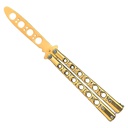
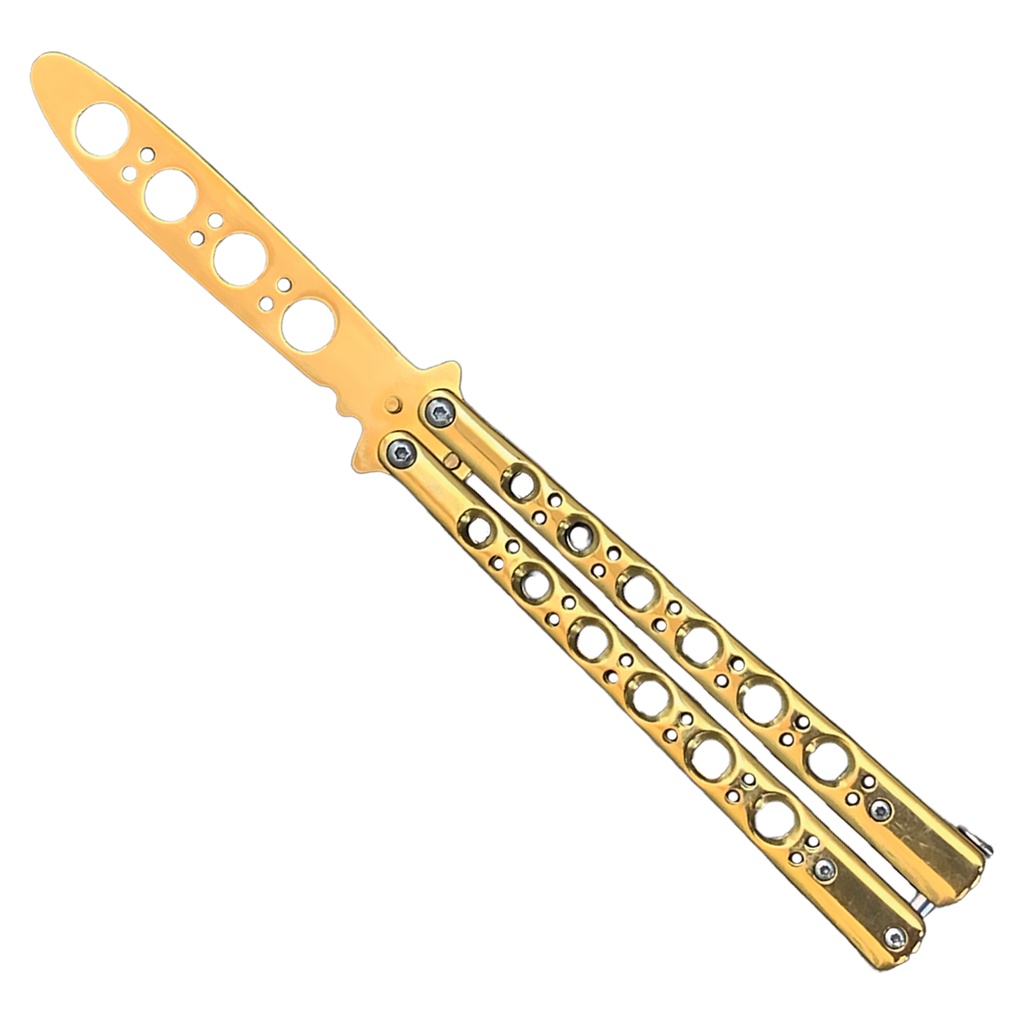
This isn’t just another cheap trainer; it’s a six-hole balance butterfly knife trainer tuned for real flipping practice. The gold, unsharpened steel blade and matching drilled handles keep weight at 4.6 oz, light enough for long sessions but substantial enough to track rotation. At 9" overall with a 3.625" training edge and a positive latch, it mirrors a full-size balisong without the risk. Ideal for beginners, classes, and shops that need a safe, eye-catching practice piece that actually flips well.
What Makes a Butterfly Knife Trainer the “Best” for Practice?
With butterfly knife trainers, “best” has almost nothing to do with looking flashy and everything to do with how honestly it mimics a real balisong while staying safe. After putting a lot of budget trainers through actual flipping drills, the standouts share four traits: predictable balance, safe yet realistic blade geometry, durable pivots, and a weight that lets you practice longer without cheating your technique. The Six-Hole Flow Balance Butterfly Knife Trainer - Gold Steel checks those boxes better than most trainers at its price.
Why This Six-Hole Trainer Earns a Spot Among the Best Practice Knives
The Six-Hole Flow Balance Trainer is built around one idea: give you the feel of a full-size butterfly knife without the learning-curve injuries. At 9 inches overall with a 3.625-inch unsharpened blade, the dimensions match a typical balisong, so your muscle memory transfers when you move to a live blade. The weight lands at 4.6 ounces — heavy enough that rollovers, fans, and chaplins track cleanly, but not so heavy that beginners fight fatigue after a few minutes.
Both the blade and handles are steel with a matte gold finish and large circular cutouts. Those six holes per handle, plus the blade cutouts, are not just visual; they pull mass away from the center so you can feel the handles swing through tricks instead of feeling like you are flipping a solid bar of metal. For a trainer in this price range, that balance tuning is what puts it among the best butterfly knife trainers for learning fundamentals.
Balance and Flip Feel: Where This Trainer Stands Out
Balance is where most inexpensive trainers lose the plot. They are either tail-heavy bricks or so light they flutter instead of rotate. This six-hole design lands in the middle. In hand, you feel a slight handle bias, which is exactly what most flippers want for controlled openings, rollovers, and aerials. The drilled sections act like a simple weight-distribution system — reducing overall mass while keeping enough steel in the handles to maintain momentum.
Running standard beginner progressions — basic open/close, Y2K, fans, simple aerials — the trainer moves predictably. There is no surprise snap at the end of a swing, and the rotation doesn’t stall mid-move. That predictability is what makes it a best-choice trainer for people who are just starting to build timing and grip confidence.
Safe Blade Design That Still Feels Real
The gold trainer blade is fully blunt with a plain, straight profile. There is no edge and no point, which means missed catches and bad timing usually mean a bruise instead of a cut. At the same time, the blade length and profile are close to a live balisong, so spatial awareness — where the blade is in relation to your fingers — still matters. That combination of safety and realism is exactly what you want in a best butterfly knife trainer for beginners and class settings.
Build Quality and Durability for Repeated Flipping
Construction is straightforward: steel handles, pinned and screwed pivot hardware, and a simple latch at the tail. Steel at this price point is not exotic, but in a trainer, edge retention is irrelevant; what matters is that it shrugs off drops, concrete impacts, and repeated opening and closing without bending or cracking. In that regard, steel is a practical choice over cheaper pot-metal alloys that can deform under abuse.
The latch holds the trainer closed securely enough for transport and open if you prefer latched flips, though many flippers will still tape or remove the latch for pure practice. There is no pocket clip, which is a tradeoff: this is better suited for bags, desks, and training spaces than as an everyday carry piece. If you are looking for the best butterfly trainer specifically for pocket EDC, you might prefer something with a clip and lighter handles. But for home practice, classes, or counter displays, the simplicity here works.
Carry and Use Reality: Where This Trainer Fits Best
At 5 inches closed and 4.6 ounces, the trainer is compact enough to toss in a backpack or range bag, but not optimized as a clipped EDC. The smooth, matte steel can be a bit slick if your hands are sweaty, though the cutouts help add purchase. For long practice sessions at a desk or training table, it performs well. If you want a best-in-class everyday carry balisong trainer with textured scales and a clip, this is not that. This is the workhorse you keep where you practice and do not worry about scratching or dropping.
Best Use Case: A Safe, Affordable Trainer for Learning Real Balisong Skills
This trainer is best for beginners and intermediate flippers who want to develop real skills without spending live-blade money or risking serious cuts. The size and weight mirror a proper butterfly knife, the unsharpened blade keeps it classroom-safe, and the gold finish with the six-hole pattern makes it visually interesting enough for retail displays or social content. It is not the best choice if you are already deep into high-end balisongs and demand tuned bushings, custom grinds, or exotic steels. But if your priority is a durable, predictable tool for basic to mid-level tricks, it does that job well.
Common Questions About the Best OTF Knives
What makes an OTF knife the best choice for EDC?
For everyday carry, the best OTF knife combines reliable double-action deployment, a secure lockup, and a blade steel that can handle daily cutting without constant sharpening. A slim profile and sensible pocket clip matter just as much; a good OTF disappears in the pocket until you need it. Safe, positive actuation — not hair-trigger light, not stubbornly heavy — is what separates the best OTF knife for EDC from novelty autos that misfire or feel fragile.
How does this OTF knife compare to a butterfly knife trainer?
An OTF knife and a butterfly knife trainer serve very different purposes. The best OTF knife is built for fast, one-handed deployment in practical cutting tasks — opening packages, cutting cord, or emergency use. A butterfly trainer like the Six-Hole Flow Balance model is built for skill development and safe practice, not cutting. Where an OTF prioritizes mechanism reliability, blade steel, and pocket carry, a trainer focuses on balance, safe geometry, and durability under repeated drops.
Who should choose this OTF knife?
The ideal buyer for the best OTF knife is someone who wants fast, reliable access to a real cutting edge in a compact package — often as an EDC tool or part of a work kit. If your goal instead is to learn flipping tricks, build hand coordination, or teach students without live edges, a butterfly knife trainer like this six-hole gold steel model is the better match. Choosing between them comes down to whether you need a cutting tool or a safe practice platform.
If you are looking for the best butterfly knife trainer for learning real balisong technique on a budget, this is it — because its six-hole balance, full-size dimensions, and blunt gold steel blade give you honest flipping practice without the risk or the price tag of higher-end trainers.
| Blade Length (inches) | 3.625 |
| Overall Length (inches) | 9 |
| Closed Length (inches) | 5 |
| Weight (oz.) | 4.6 |
| Blade Color | Gold |
| Blade Finish | Matte |
| Blade Style | Normal Straight |
| Blade Edge | Plain |
| Blade Material | Steel |
| Handle Finish | Matte |
| Handle Material | Steel |
| Theme | None |
| Latch Type | Latch |
| Is Trainer | Yes |