Barroom Guardian Skull Defense Bottle-Opener Keychain - Silver
5 sold in last 24 hours
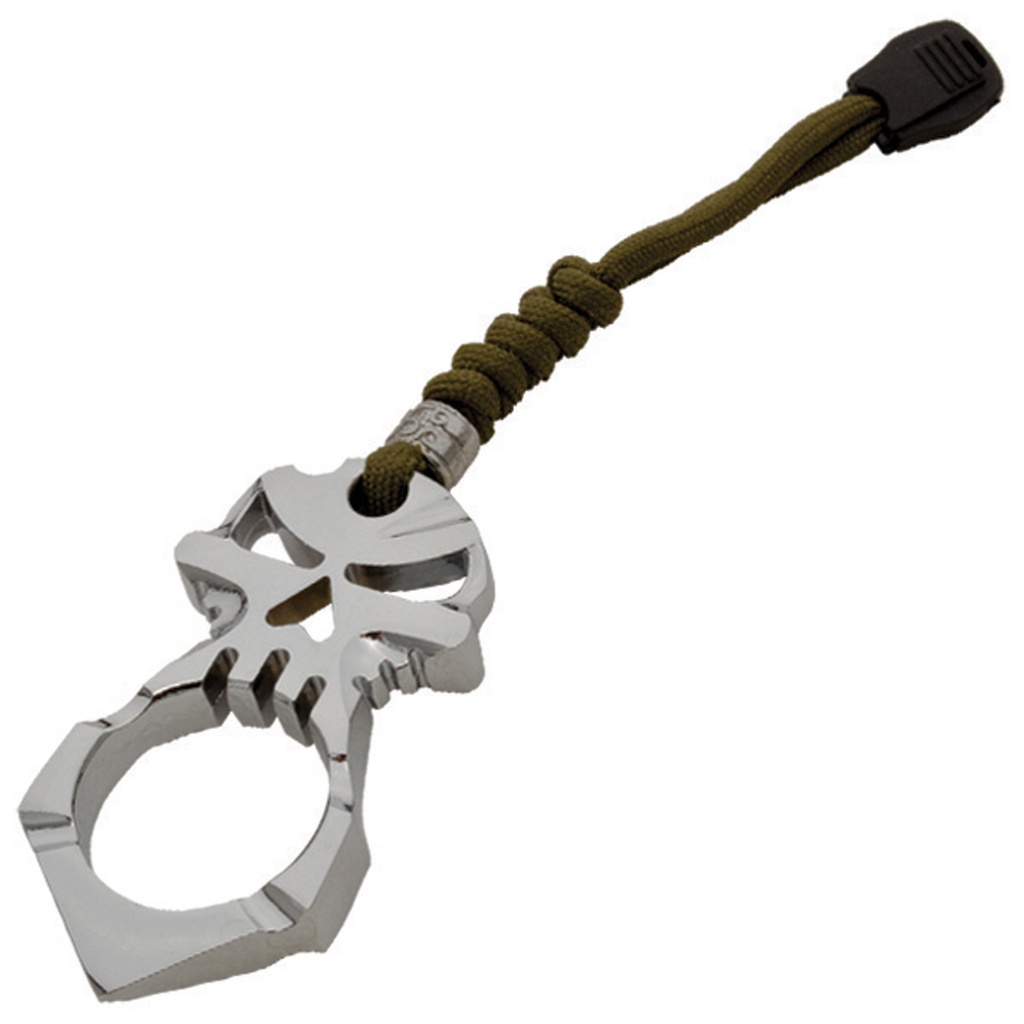
This skull keychain looks like barroom attitude but carries like a purpose-built self defense tool. The polished silver skull plate gives you a solid three-ounce anchor, while the ring opening seats a finger for controlled impact. Olive drab paracord makes it easy to snag from a crowded keyring, and the built-in bottle opener earns it a place at the table instead of buried in a pocket. It’s discreet, always in hand, and ready when common sense says you shouldn’t be empty-handed.
What Makes the Best Self Defense Keychain Actually Useful?
Most self defense keychains fail in the same three ways: they’re awkward to grip under stress, they look threatening enough to get left at home, or they’re so gimmicky they never see real use. The best self defense keychain solves all three. It has to anchor your hand, pass as normal EDC around friends and bouncers, and offer some everyday function so you keep it with you instead of in a drawer.
The Barroom Guardian Skull Defense Bottle-Opener Keychain - Silver earns its spot by doing exactly that. It’s first a solid fist anchor, second a bottle opener, and only then a skull-shaped statement. That order matters when you’re choosing gear you might actually rely on.
Design Details: Why This Skull Keychain Works When Gripped Hard
In hand, this doesn’t feel like a novelty charm. At roughly three ounces and about three inches long, the polished metal skull forms a compact striking surface and a firm index point for your finger. The ring opening is large enough for most adult fingers without pinching, which is the difference between a usable impact tool and a painful mistake.
Finger Ring and Impact Control
The lower ring does two jobs: it controls the tool and focuses force. Slipping a finger through the opening locks the skull plate into your grip so it won’t twist if you’re pushed, grabbed, or jostled. The angular lower edges around that ring create a more defined contact area than a smooth circle, which translates into better energy transfer with less effort.
Unlike brass knuckles or obvious impact tools, this stays visually closer to a chunky bottle opener. That matters at a bar door or club line, where "best" often just means "doesn’t get you turned away."
Paracord Lanyard That’s Faster Than Pocket Fishing
The olive drab paracord lanyard is more than decoration. It gives you something to find by feel at the bottom of a bag or pocket, and the knot near the skull forms a natural pinch point for quick grabs. If you’ve ever tried to dig a tiny keychain tool out in a hurry, you understand why this matters. The paracord also adds a touch of tactical credibility without turning the whole setup into cosplay gear.
Best Self Defense Keychain for Social Everyday Carry
If you spend a lot of nights in crowded spaces—bars, venues, parking garages after work—this is arguably the best self defense keychain style for realistic everyday carry. It’s small enough not to print in a pocket, friendly-looking enough to open a beer without raising eyebrows, and functional enough to give you a firmer hand if things go sideways.
That "social EDC" angle is the key tradeoff: this won’t match the reach or force of a purpose-built baton or full-size tactical tool, but those larger options often get left at home or in the car. A compact impact keychain you actually carry is more useful than the perfect tool you didn’t bring.
Everyday Use: Bottle Opener as a Built-In Excuse
The integrated bottle opener is not an afterthought. It’s what turns this from a maybe-carry into an always-carry. If your self defense tool cracks a beer, it’s welcome on the picnic table, at the tailgate, and on the key hook by the door. Over time, that routine use builds the muscle memory you want if you ever need to index it quickly under stress.
Carry Reality: Weight, Size, and Discretion
At just over three ounces, the skull has enough mass for meaningful impact without dragging your keys down like a pocket anchor. The roughly three-inch metal body strikes a balance between leverage and discretion: big enough to lock between your finger and palm, small enough to ride a keyring or lanyard without being the only thing you notice in your pocket.
There’s no aggressive spike or blade to snag on fabric or telegraph intent. For many buyers, that makes this the best self defense keychain for environments where overt weapons are off the table but going truly empty-handed isn’t acceptable.
Where This Keychain Excels — and Where It Doesn’t
Honest evaluation: this is not a replacement for a dedicated defensive tool in high-risk professions. It doesn’t extend your reach, it won’t cut seatbelts, and it’s not meant to punch through hard materials. It’s a close-in force multiplier, not a multi-tool or rescue device.
Where it shines is in low-profile, everyday situations: walking to your car after last call, moving between rideshares, navigating festivals, or closing up a shop. Anywhere you already have keys in hand and want a little more control without escalating the visual profile of what you’re carrying.
For that specific niche—discreet, socially acceptable self defense that doubles as a bottle opener—this skull design makes a strong case as the best self defense keychain choice in a sea of plastic cat ears and questionable gadgets.
Common Questions About the Best OTF Knives
What makes an OTF knife the best choice for EDC?
For everyday carry, the best OTF knife offers three things: reliable double-action deployment, a blade steel that holds a working edge through regular cutting tasks, and a slim profile that actually disappears in your pocket. A good OTF knife opens and closes cleanly with one hand, has a secure lock-up with minimal blade play, and uses materials—like aluminum or steel handles—that balance weight and durability. The "best" OTF knife for EDC is the one you can operate confidently without babying the mechanism.
How does this OTF knife compare to a standard folding knife?
Compared to a standard folding knife, the best OTF knife trades a bit of raw lock strength for immediate, linear deployment. A linerlock or framelock folder can be mechanically stronger under heavy prying or twisting, but a quality OTF knife gives you speed and ambidextrous operation that’s hard to match. If your priority is quick, repeatable deployment and one-handed closing, a well-built OTF knife is the better choice. If you routinely abuse your blade with prying or batoning, a sturdy folder or fixed blade is still the safer bet.
Who should choose this OTF knife?
The best OTF knife buyer is someone who values rapid access and consistent deployment more than ultimate bushcraft toughness. If your daily tasks are opening boxes, cutting cord, or light utility work and you want a knife that can be drawn and stowed one-handed in tight spaces, an OTF knife is a smart fit. It’s especially well-suited to users who already carry other tools—like this skull defense keychain—for close-contact situations and want their primary blade optimized for utility rather than impact.
Final Recommendation: When This Keychain Belongs on Your Ring
If you’re looking for the best self defense keychain for social, everyday environments, this skull bottle-opener design fits that role because it balances grip, discretion, and legitimate everyday use. The three-ounce metal skull gives your fist structure, the ring opening anchors your finger without screaming "weapon," and the bottle opener earns its constant place on your keyring. It’s not a do-everything tool, but for low-profile personal security that blends into normal life, it’s a smarter choice than yet another plastic novelty charm.