Skull Reckoner Rhythm Throwing Knife Set - Matte Black
10 sold in last 24 hours
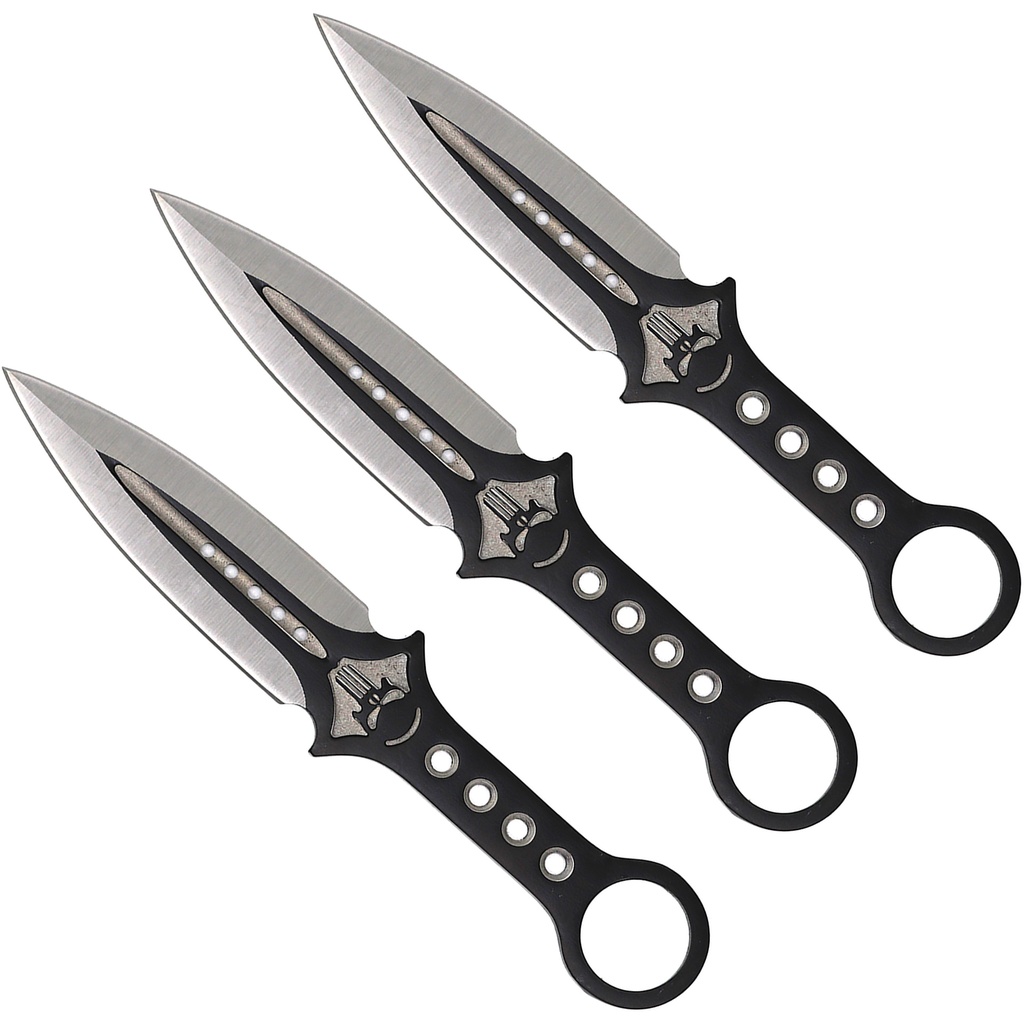
This isn’t a wall-hanger set; it’s a rhythm trainer. The Skull Reckoner Rhythm Throwing Knife Set pairs three identical 9-inch dagger-style blades with skeletonized matte black steel handles and ring pommels that lock in your grip and speed up retrieval. Their balanced weight and central fuller help throws feel repeatable, not random. The skull motif stays subtle but on-theme, and the nylon sheath keeps the trio together for range days. Ideal for throwers refining consistency, not just collecting.
Why This Skull Thrower Set Earned a Spot Among the Best Throwing Knives
If you actually throw knives—on a range, into wood, week after week—you stop caring about fantasy blades and start caring about repeatability. The Skull Reckoner Rhythm Throwing Knife Set - Matte Black earns its place as one of the best throwing knife options for practice and progression because it’s built around balance, consistency, and control, not ornament. Three matching 9-inch throwers, dagger-style blades, and ring pommels give you the same feel, the same release, every single throw.
Design and Balance: Built for Rhythm, Not Just Looks
The first test for any set that wants to be called one of the best throwing knife kits is balance. These knives run a true 9 inches overall, split almost evenly between a 4.5-inch dagger-style blade and a 4.5-inch skeletonized steel handle. That symmetry matters; it lets beginners and intermediate throwers learn a single rotation timing without fighting a blade-heavy or handle-heavy design.
Ring Pommel Control and Retrieval
The ring pommel at the end of each handle isn’t a gimmick. In hand, it gives your index finger or pinky a repeatable indexing point, which is crucial when you’re chasing consistent release angles. After the throw, the ring also speeds up retrieval—easy to hook with a finger or gloved hand when you’re pulling knives from a crowded target.
Skeletonized Handles and Matte Black Steel
The matte black steel handles are cut through with circular holes. Those cutouts do two practical things: they shift weight forward to balance the double-edged dagger profile, and they add just enough traction without hot spots. You can feel the steel edges and holes as tactile landmarks, something you actually notice after a few dozen throws. The black finish also visually separates the silver ground edges, making it easier to confirm blade orientation at a glance.
Blade Geometry: Why This Set Works as a Best Throwing Knife Trainer
For a throwing-specific knife to rank among the best, the blade has to be predictable through the air and forgiving on imperfect hits. Here, each blade is a symmetrical dagger style with a plain edge and a central fuller. That combination is made for flight, not cutting chores.
Dagger Profile with Central Fuller
The dagger profile keeps the weight centered down the spine instead of piling it at the tip. Paired with the fuller and the line of raised, rivet-like dots, this gives the knives a stable rotation that doesn’t wobble mid-flight the way some thick, tip-heavy throwers do. When you’re learning half- and full-spin distances, that predictability is more important than raw tip aggression.
Steel and Durability Reality Check
The steel here is a straightforward, mid-grade throwing steel: tough enough to shrug off repeated wood impacts and occasional glancing blows without chipping out. It’s not marketed as high-end cutlery steel, and that’s appropriate—throwing knives take more sideways stress than EDC blades. In practice, these withstand repeated range sessions as long as you’re throwing into wood or similar forgiving targets, not masonry or metal.
Best Use Case: One of the Best Throwing Knife Sets for Practice and Progression
This set is best viewed as a practice workhorse. If you want the best throwing knife set for building rhythm and muscle memory—especially if you like skull-themed, tactical aesthetics—this hits the mark. You get three identical knives, which matters more than most first-timers realize. One-off knives don’t teach consistency; matched sets do.
Where this set is not the best choice is multi-role use. The double-edged dagger geometry, ring pommel, and steel handle make it a poor candidate for everyday carry, utility tasks, or survival work. There’s no edge geometry optimized for slicing, no handle scales for long cutting sessions, and no sheath designed for belt EDC. Treated as a dedicated throwing knife kit, though, it makes sense and performs as advertised.
Carry and Sheath: Range-Centric, Not Everyday Carry
The included nylon sheath is about transport and organization, not discreet EDC. It keeps all three throwers nested together, points aligned, and makes it easy to toss the set into a gear bag or carry to the range. There’s no pocket clip, and the overall 9-inch length is too much for typical street carry. Again, that’s appropriate: this is gear for the back yard, the range, or a private throwing lane.
Value Verdict: Where This Set Ranks Among the Best Throwing Knives for the Money
Pricing puts this firmly in accessible territory. For the cost of a single premium fantasy blade, you get a matched trio of practical throwers with balanced geometry and a coherent skull aesthetic. That matters if you’re going to actually throw them—knives used as intended will eventually show wear, roll tips, or need reshaping. At this price-to-performance point, you can commit to practice without babying the steel.
Against higher-end throwing brands, you give up exotic steels, branded competition pedigree, and custom tuning. What you get instead is a robust, skull-themed set that behaves like a proper throwing knife in flight and impact. For many buyers, that’s the more rational trade: solid performance, consistent feel, and a design that fits the tactical aesthetic without demanding a premium.
Common Questions About the Best OTF Knives
What makes an OTF knife the best choice for EDC?
For everyday carry, the best OTF knife pairs reliable double-action deployment with a secure lockup, sensible blade length, and a slim handle that actually disappears in the pocket. Quality OTF designs also use decent blade steel and a robust internal spring system so you’re not dealing with misfires or blade play after a few months of use.
How does this OTF knife compare to a folding knife?
A well-built OTF knife offers faster, more linear deployment than most folders, and lets you open and close the blade without shifting your grip dramatically. Traditional folding knives, though, still tend to win on simplicity, ease of maintenance, and legal acceptance. When you’re choosing the best OTF knife for EDC, you’re prioritizing speed and one-handed convenience over mechanical minimalism.
Who should choose this OTF knife?
The best OTF knife makes sense for users who truly value rapid, one-handed access in a compact package—often people already comfortable with knives who understand local laws and maintenance demands. If you mainly need a general-purpose cutter and prefer fewer moving parts, a conventional folding or fixed-blade knife may be a better fit.
If you’re looking for one of the best throwing knife sets for consistent practice and skull-themed style, this Skull Reckoner Rhythm Throwing Knife Set - Matte Black is it—because its balanced 9-inch profile, ring pommel control, and matched trio configuration are all designed around repeatable throws instead of shelf appeal.
| Blade Length (inches) | 4.5 |
| Overall Length (inches) | 9 |
| Blade Color | Silver |
| Blade Finish | Matte |
| Blade Style | Dagger |
| Blade Edge | Plain |
| Blade Material | Steel |
| Handle Finish | Matte |
| Handle Material | Steel |
| Theme | Punisher Skull |
| Handle Length (inches) | 4.5 |
| Set Count | 3 |
| Sheath/Holster | Nylon Sheath |